
Back to Blogs
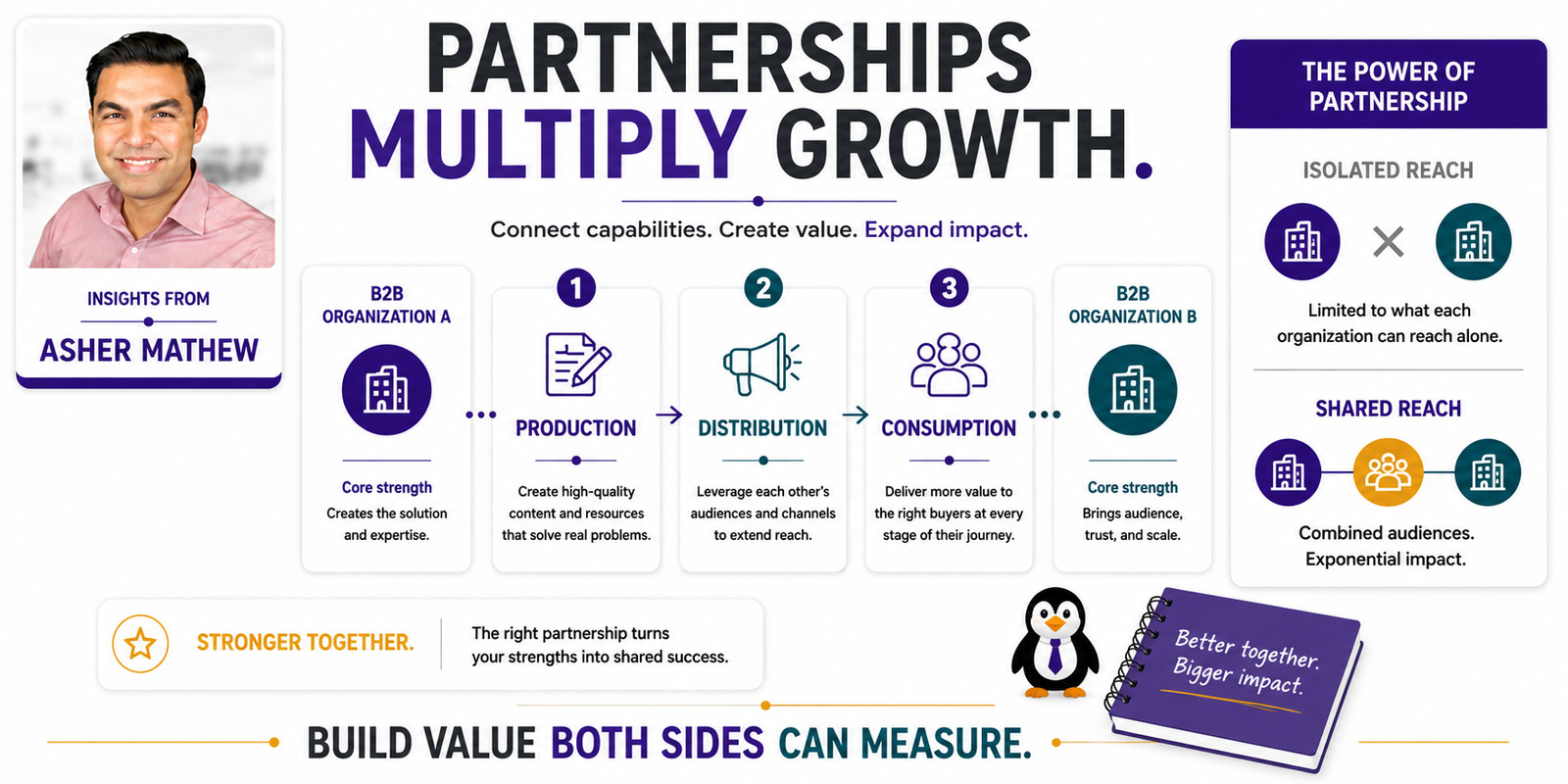
Partnerships can extend reach, strengthen credibility, improve customer value, and create new revenue paths when both parties contribute something meaningful. Asher Mathew explains why CMOs need explicit goals, ownership, repeatable processes, partner health measures, and disciplined planning. Successful partnerships are operating programs, not hopeful introductions followed by a webinar and a shared contact list afterward.
Partnerships become especially attractive when marketing budgets tighten. Another organization may offer an established audience, complementary expertise, product capabilities, distribution, or credibility that would be expensive to build alone.
Those advantages do not make partnerships free. Every collaboration creates planning, coordination, production, approval, and measurement work. When that labor is ignored, an apparently efficient partnership can consume more capacity than it creates.
Asher Mathew, co-founder and CEO of Partnership Leaders, joined CMO Huddles to explain how companies can make partnerships more rigorous and repeatable.
His framework treats partnerships as a business discipline spanning production, distribution, and consumption. CMOs can use it to decide which relationships deserve investment and which ones are likely to remain vague promises.
A credible partnership starts with a goal both organizations have a reason to pursue. Brand recognition, customer advocacy, product adoption, market education, pipeline, retention, or expansion can each support collaboration, but the desired outcome needs to be explicit.
Partnership Leaders’ relationship with HubSpot began with alignment around advocacy and community-led growth. Partnership Leaders could contribute access and credibility within a professional community. HubSpot could contribute brand strength, reach, and resources.
The relationship produced reports, event participation, partner strategy work, and further credibility for both parties. The activity worked because it supported an established corporate priority rather than beginning with a disconnected co-marketing idea.
A CMO evaluating a prospective partner should ask:
If those answers remain abstract, the partnership is not ready for execution.
Asher organizes partnership activity into production, distribution, and consumption.
Production partnerships help companies create something together. Technology integrations are a common example, but the category can also include joint research, solutions, or intellectual property.
Distribution partnerships help an organization reach the market. Channels, resellers, co-selling, co-marketing, and audience exchange fit here.
Consumption partnerships help customers use or receive value from the solution. Services firms, agencies, implementation partners, and alliances often operate at this layer.
The categories can overlap. A technology partner may integrate products, co-market the result, and provide implementation support.
The framework helps CMOs move beyond the generic label of partnership. Different models require different capabilities, economics, resources, and measures.
Potential partners may appear obvious inside the company while offering little relevance to customers. Asher recommends asking customers directly.
One useful question is where customers go to stay informed about the category. Their answers can reveal trusted publications, communities, analysts, events, experts, and platforms.
Another asks which company could make the organization’s story more useful or compelling. That may uncover adjacent technologies, service providers, or data sources customers already combine with the product.
“One of the quickest ways” to identify co-marketing partners, Asher said, is to ask customers. Their responses ground the strategy in actual behavior instead of executive enthusiasm.
Customer input is a starting point rather than automatic approval. The CMO still needs to examine brand fit, audience overlap, reputation, strategic alignment, and execution capacity.
Partnerships create work before they produce value. Teams must align objectives, define audiences, create assets, coordinate calendars, secure approvals, resolve data questions, and distribute the result.
Asher describes this overhead as a planning tax. It becomes especially burdensome when partnership responsibilities are added to marketers whose primary jobs do not include building external programs.
A content marketer may wait for messaging. A digital marketer may wait for assets. Both organizations may treat the partnership as extra work, producing an unremarkable webinar or download neither side wants to repeat.
A partnership plan should therefore identify:
This planning does not eliminate friction. It makes the cost visible before both teams commit.
Modern partnership management is multidisciplinary. The owner needs enough knowledge of marketing, sales, customer experience, product, operations, and commercial agreements to coordinate the program.
Asher recommends starting with co-marketing when a company is moving from zero to one in partnerships. Co-marketing can help both organizations test message alignment, audience relevance, working relationships, and mutual commitment before attempting a more complex motion.
The early program should remain small enough to execute well. A focused research project, customer event, content series, or targeted campaign can produce clearer learning than a broad alliance announcement.
The goal is not one attractive activity. It is evidence that the two organizations can create a repeatable go-to-market motion.
Partnerships between organizations of different sizes can work when each possesses something the other values.
A larger company may offer market reach, brand recognition, distribution, or technology. A smaller company may contribute expertise, community trust, speed, access to a specific audience, or a capability the larger organization lacks.
The smaller partner should not assume that enthusiasm compensates for an unclear contribution. The larger partner should not treat exposure as sufficient value while transferring most of the work.
A two-page partnership brief can clarify the exchange:
Reviewing the brief until both sides can explain the arrangement in the same way reduces ambiguity later.
Partnership performance needs business measures appropriate to the model. These may include sourced or influenced pipeline, joint customers, adoption, retention, integrations, partner-sourced opportunities, event engagement, referrals, content use, or audience growth.
CMOs should also measure relationship health. A partner may deliver short-term results while becoming increasingly difficult to engage. Warning signs include missed meetings, slow responses, incomplete commitments, leadership turnover, or recurring disagreement about value.
A partner health review can assess:
The purpose is to identify relationships that deserve deeper investment and those that need repair or closure.
One successful webinar does not establish a partnership engine. Repeatability requires a clear audience, reliable process, measurable value, and enough commitment to run the motion again.
Asher’s advice is to “drive rigor from the start.” That means refusing to let vague promises substitute for owners, timelines, and outcomes.
After an initial program, the teams should review what happened:
Scaling should follow evidence. A partnership portfolio filled with inactive logos creates less value than a smaller group of relationships with clear operating momentum.
Both parties pursue a shared business goal and contribute complementary value. The relationship has accountable owners, sufficient resources, clear measures, and a plausible path to repetition.
Ask customers which companies, experts, communities, tools, and services influence their decisions or complete their experience. Then evaluate strategic, audience, and brand fit.
It is the coordination work required to define goals, produce materials, secure approvals, manage data, distribute programs, and measure results. Ignoring it often leads to under-resourced execution.
Use measures aligned with the model, such as sourced pipeline, influenced revenue, referrals, adoption, retention, audience growth, or joint customers. Track relationship health alongside business results.
Listen to the full conversation with Asher Mathew.
CMO Huddles connects B2B marketing leaders with peers and experts who can help them stretch resources without lowering standards. Apply to join the community.