
Back to Blogs
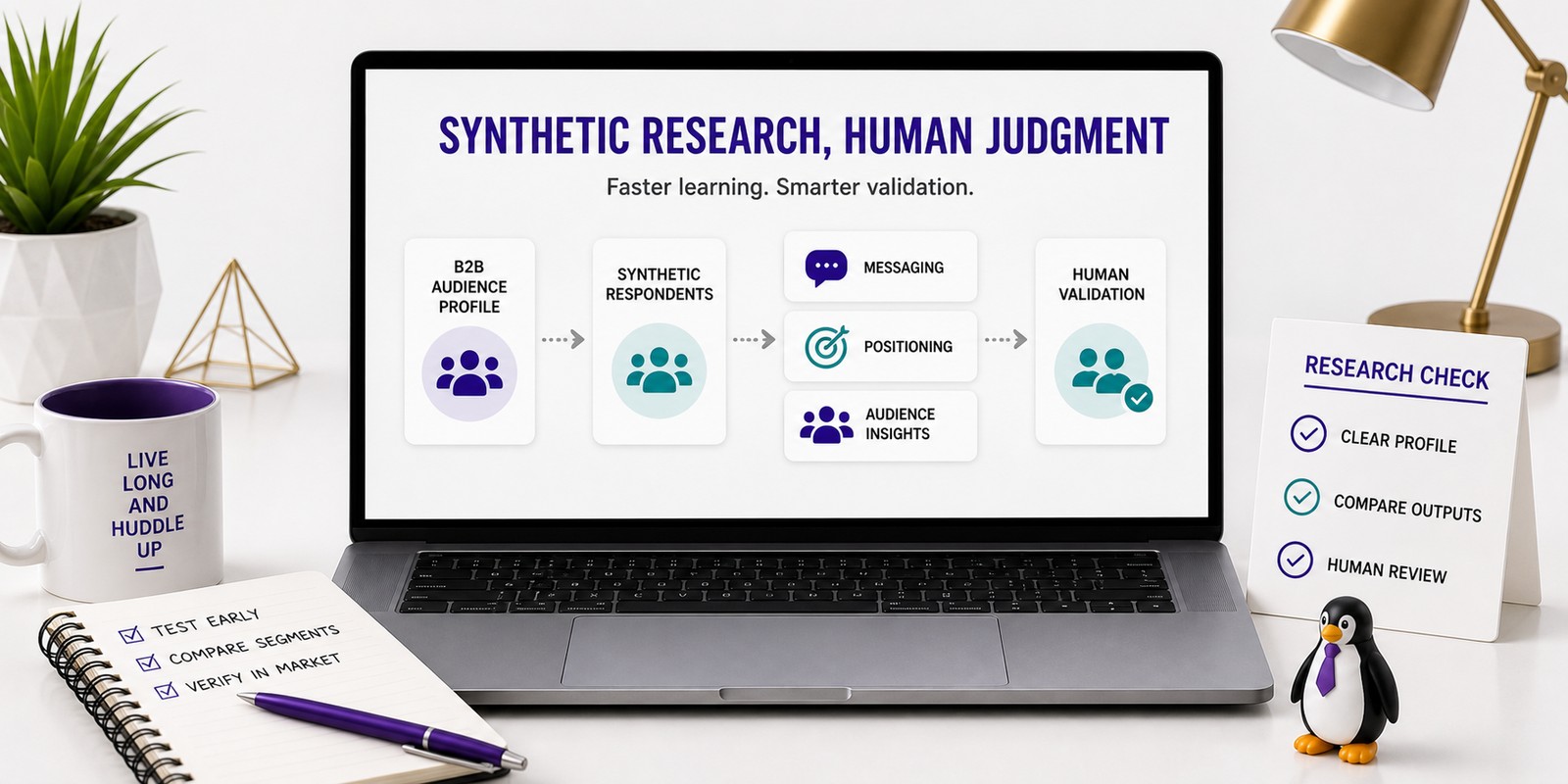
Synthetic research gives B2B marketers a faster, more iterative way to test messaging, explore audience needs, and interrogate findings. Evidenza co-founder Jon Lombardo explains how digital twins can complement human research while reducing survey remorse and fatigue. The opportunity is substantial, but confidence depends on calibration, comparison, thoughtful questions, and human validation for consequential decisions.
Traditional B2B research can be slow, expensive, and difficult to repeat.
Recruiting specialized respondents takes time. Buying committees contain several roles. Surveys have to remain short enough to complete. If the team discovers a poorly worded question after fielding the study, correcting it may require another round of recruitment and expense.
Synthetic research changes those constraints by using AI-generated respondents designed to reflect a defined audience.
In a CMO Huddles Bonus Huddle, Jon Lombardo of Evidenza explained how these digital twins can support messaging, positioning, segmentation, and customer research.
“You are defining your customer set for us, then we build their digital twin.”
Synthetic research does not involve asking a general-purpose chatbot what buyers think.
The process begins by defining the audience. That may include:
Those specifications inform digital respondents that can answer structured and open-ended questions.
The quality of the outcome still depends on the definition, model, calibration, and research design. A poorly framed audience can produce misleading confidence just as a poorly recruited human sample can.
Jon highlighted two familiar limitations of traditional surveys.
Survey remorse occurs when the team sees the results and realizes an important question was missing or confusing. Rerunning the study may be expensive.
Survey fatigue affects respondents. Long studies can reduce attention and answer quality, so researchers limit the number and complexity of questions.
Synthetic respondents do not become tired. Questions can be revised, rerun, or expanded without recruiting the same audience again.
That enables a more iterative research process. Initial findings can lead to follow-up questions, deeper segmentation, or alternative hypotheses while the work is still underway.
Faster research creates value when it increases the number and quality of learning cycles.
Synthetic studies can help explore questions such as:
The ability to interrogate an ambiguous word can be particularly useful in B2B. Internal teams may use terms such as “integration,” “intelligence,” or “transformation” without understanding how buyers interpret them.
Synthetic research creates room to ask what those terms mean in context.
Jon described comparing synthetic results with completed human surveys to understand which model settings most closely reproduce the established findings.
That comparison can include different models, respondent definitions, and levels of response variability.
The purpose is not to assume synthetic results are automatically correct. It is to evaluate how well they correlate with relevant evidence and refine the approach.
Jon reported seeing strong correlations between synthetic and human studies in Evidenza’s work. Those figures belong to the company’s research and still need to be interpreted within the design of each project.
Confidence grows through comparison, not novelty.
Synthetic research does not make human research unnecessary.
Human validation remains valuable when:
Synthetic research can narrow hypotheses, improve the questionnaire, or identify promising directions before the team invests in human interviews or surveys.
It can also extend completed human work by exploring follow-up questions that were not included originally.
AI-generated respondents can surface patterns and alternatives. They cannot accept accountability for the business decision.
Marketing leaders still interpret findings alongside customer conversations, behavioral data, sales insight, and organizational context.
That boundary is especially important because polished synthetic answers can appear more certain than the evidence warrants.
The most useful role is research acceleration: More questions, faster iteration, and broader exploration, combined with clear validation where the stakes require it.
Synthetic research uses AI-generated respondents modeled on a defined audience to answer research questions, test ideas, and explore potential buyer perspectives.
It can complement or reduce some traditional research, but human interviews remain valuable for emotional nuance, specialized audiences, direct testimony, and consequential decisions.
Common applications include messaging, positioning, segmentation, category entry points, buying-committee perspectives, and the language buyers use to describe a problem.
Results depend on audience definition, available training data, model behavior, research design, and calibration. Synthetic findings can also underrepresent emerging experiences or specialized populations.
Listen to the full conversation with Jon Lombardo about synthetic research.
CMO Huddles helps B2B marketing leaders win by bringing together peers, fresh perspectives, and opportunities to build stronger personal brands. Want to join the huddle? Learn more about CMO Huddles and apply to join the community.