
Back to Blogs
Drew Neisser is the founder of CMO Huddles and a globally recognized authority on B2B marketing. He’s an AdAge columnist, LinkedIn TopVoice, leading CMO coach, podcast host & friend of penguins everywhere.
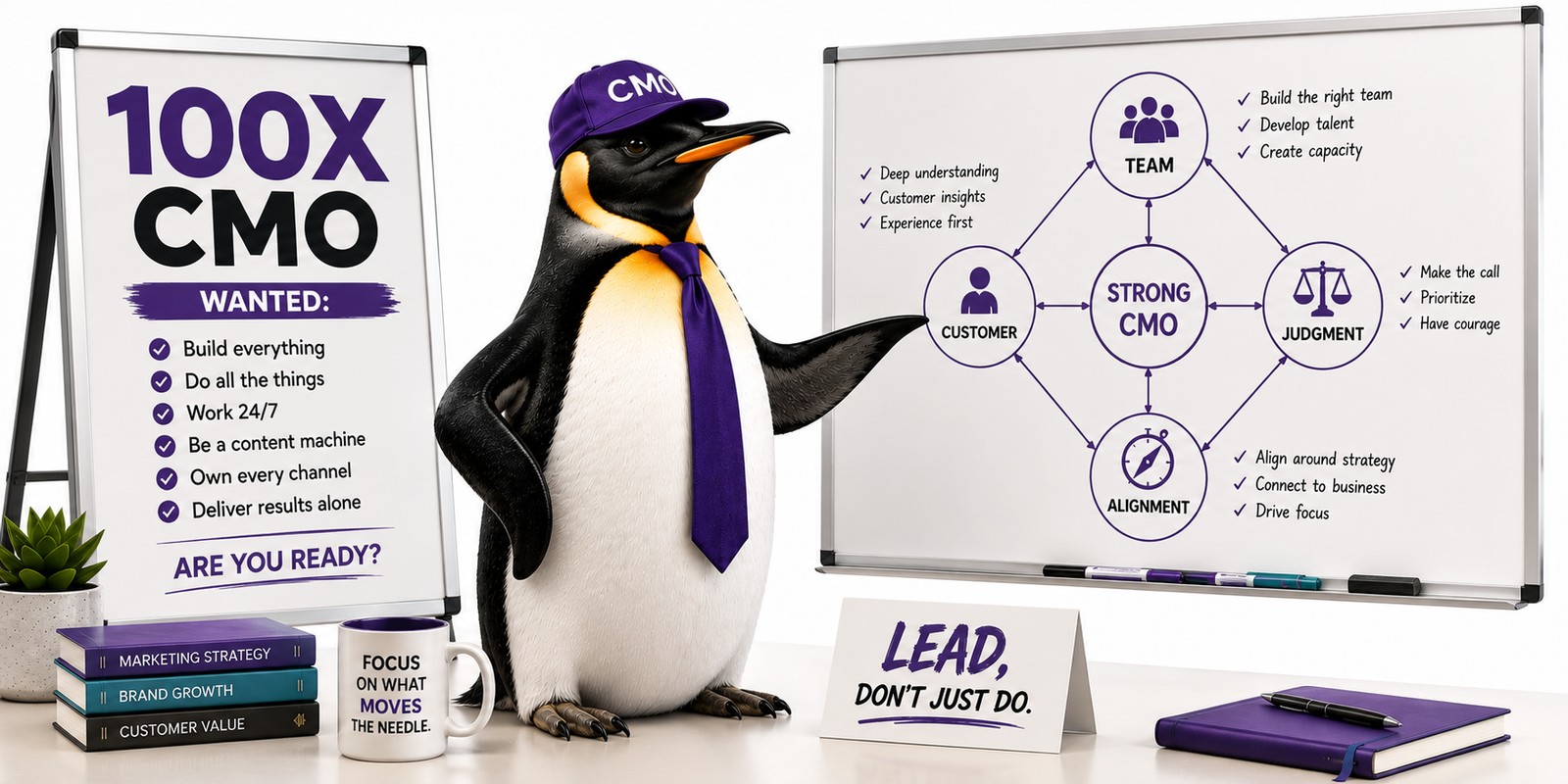
ClickUp’s 100x CMO stunt makes a sharp publicity point and a weak leadership model. Marketing leadership is not one person supervising AI output. It depends on teams, customer understanding, cross-functional influence, judgment, and restraint. AI can expand a CMO’s impact, but producing more marketing is only a fraction of leading the organization toward sustainable growth.
“I’m looking for a 100x CMO,” stated Zeb Evans, CEO of ClickUp, in a LinkedIn ad this week.
Shameless stunt? Or just brazen ignorance of the role?
Zeb is offering $1 million for one person to own ClickUp’s entire brand marketing function. This person will not manage a team of 50, sit in meetings all day, or write briefs for other people to execute.
Instead, the chosen one will build systems that produce world-class marketing at scale, then review everything with enough taste to separate the great from the garbage.
A CMO is not a content machine with better taste.
The ad has reportedly attracted roughly 100 applicants. That might sound impressive, but it is remarkably low for a million-dollar CMO role in this market.
Perhaps a lot of smart marketers are staying away.
Whatever its merits as a job, Zeb has managed to get an entire community of senior marketers debating ClickUp, AI, organizational design, and the future of the CMO role.
Margaret Molloy, a three-time global CMO, offered a concise verdict:
“Super PR stunt, especially if a goal is to build awareness among the CMO community. As for the job, well that’s a whole other thing.”
The fundamental problem is that Zeb reduces the role of the CMO to doing marketing rather than leading marketing. His job description treats marketing as a production function when its greatest value comes from shaping strategy, aligning the organization, and mobilizing people around growth.
That work cannot be reduced to one person directing an army of agents.
Thomas Barta, co-author of The 12 Powers of a Marketing Leader and CEO of the Marketing Leadership Institute, studied the traits that contribute most to a marketing leader’s business impact.
His highest-ranked power is Get the Mix Right.
As Thomas puts it:
“Your team needs the right mix of skills, styles and personalities and to align closely around a common goal.”
Good luck doing that with a team of bots.
The best marketing teams are not simply collections of hands waiting to execute a leader’s taste. They include strategists, writers, designers, operators, analysts, and emerging leaders who challenge assumptions and improve the thinking behind the work.
Anurag Singhal challenged Zeb’s distinction between taste and execution:
“The hands were never just hands. The writer who pushes back or the junior teammate who asks the awkward question isn’t just executing taste. They’re helping form it.”
One person’s taste should not become the only taste with authority.
Eric Eden took the math in a different direction:
“Five great marketers orchestrating a team of agents for epic results.”
That sounds far closer to the AI-empowered marketing organization we should be building.
Thomas’ second power is Fall in Love with Your World.
Great CMOs develop deep expertise in their customers, products, category, competitors, and industry, then use that knowledge to inspire others.
This understanding does not come from sitting behind a screen supervising automated workflows. It comes from listening to customers, spending time with sales, learning from customer success, challenging product teams, and developing a feel for what is changing in the market.
You can query the market. You still have to know the market.
AI can summarize customer interviews, identify patterns, and analyze enormous volumes of market data. It cannot replace the judgment that comes from repeated human contact or the trust required to convince an organization to act on what the CMO has learned.
Dr. Kartik Nagendraa calls this the Agentic Marketing Trap:
“AI doesn’t just multiply your output. It multiplies everyone else’s.”
As AI makes it cheaper to produce campaigns, emails, content, and personalization, every company will create more marketing.
The winning CMO may not be the leader who produces the most. It may be the leader who exercises the greatest restraint, deciding what not to automate, what not to say, and where human judgment can create disproportionate trust.
The customer does not need 100 times more marketing.
Thomas’ third power is Walk the Halls.
“You won’t change the world by sitting at your desk. Marketers have to go out and engage people to make things happen.”
Marketing works best when product, sales, customer success, finance, and leadership are aligned around a shared ambition. Creating that alignment requires conversations, persuasion, compromise, trust, and, yes, meetings.
Dariusz Paczuski described the CMO as the owner of an interconnected growth system spanning strategy, people, alignment, routines, and culture:
“CMO work and growth is human sport.”
Agents can accelerate portions of that system. They cannot assume responsibility for all of it.
Anyone who has served as a CMO knows that some of the most important work happens outside the formal marketing function. It happens while resolving tension between sales and product, defending long-term brand investment, helping the CEO clarify the company story, or persuading peers to put the customer ahead of internal convenience.
No agent can walk those halls for you.
The ClickUp ad may be absurd, but it did not emerge from nowhere. Many CEOs are frustrated by growing marketing teams, rising budgets, impressive dashboards, and disappointing business results.
Pranav Piyush noted that companies often increase paid media spending, add headcount, and report healthy-looking marketing metrics, only to discover 18 months later that the investment did not produce enough incremental revenue.
That is a legitimate problem.
Zeb has diagnosed the frustration, not the solution.
CMOs should be held accountable for outcomes. They should also be expected to eliminate waste, redesign inefficient workflows, automate low-value work, and make their teams dramatically more productive.
But replacing a leadership function with a one-person production system is not transformation. It is an overcorrection.
6x CMO Grant Johnson was equally direct:
“Great PR, absurd idea. Compensation should be tied to outcomes, not trying to prove that you can AI everything.”
He also raised the obvious question. Where are the want ads for the one-person finance function, sales organization, product team, or executive suite?
Apparently, only marketing can be reduced to a prompt.
None of this is an argument against AI-empowered marketing.
AI can help smaller teams create more, learn faster, personalize at scale, reduce repetitive work, and spend more time on the activities that require strategic judgment.
The future marketing organization will probably be leaner. It will almost certainly be more automated.
But efficiency is not leadership.
The strongest CMOs will use agents to extend their teams, not erase them. They will redesign the work before redesigning the organization and deploy automation in service of a clear strategy rather than treating automation as the strategy.
A one-person marketing factory might produce a lot of marketing.
A great CMO gets the whole company moving.
That is the difference between doing marketing and leading it. It is also the difference between a clever job ad and a credible vision for the future of the marketing organization.
Zeb’s 100x CMO post succeeded brilliantly as publicity.
As a definition of marketing leadership, it is roughly 1/100th of the job.
To hear more about what actually makes marketing leaders effective, watch the replay of my Expert Huddle with Thomas Barta on The 12 Powers of a Marketing Leader.
CMO Huddles helps B2B marketing leaders win by bringing together peers, fresh perspectives, and opportunities to build stronger personal brands. Want to join the huddle? Learn more about CMO Huddles and apply to join the community.