
Back to Blogs
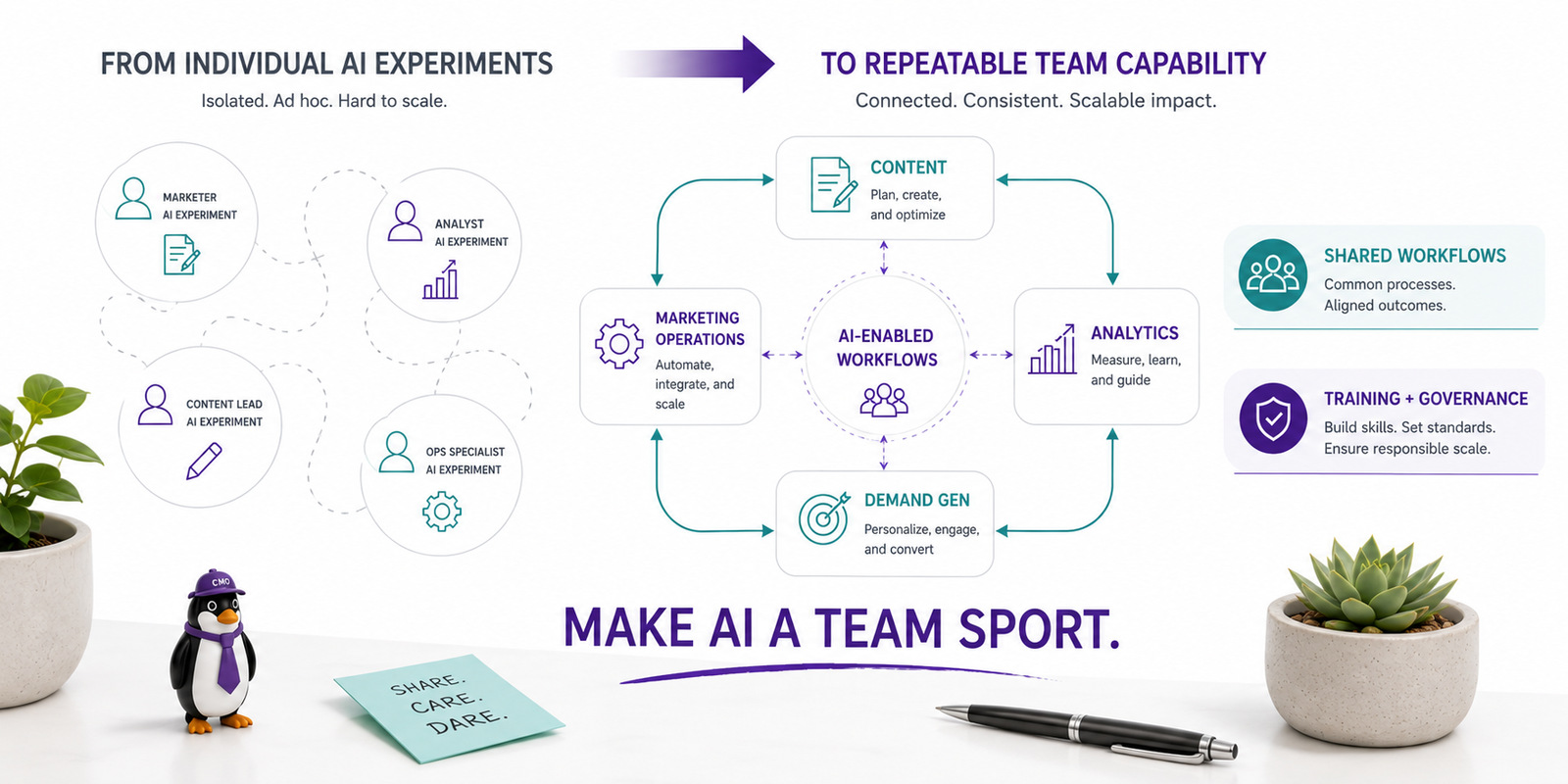
Teamwide AI adoption develops when the CMO becomes an active architect rather than a distant sponsor. François Dufour explains how repeated building time, structured context, shared workflows, internal champions, and outcome-based measurement turn experimentation into organizational leverage. These practices help marketing teams apply AI consistently while keeping business priorities, reliable information, and human judgment central.
A marketing leader can approve AI tools, encourage experimentation, and still remain disconnected from how the work is changing. Teamwide adoption becomes more credible when the CMO has enough direct experience to understand what AI can do, where it fails, and how it affects workflows.
In a Renegade Marketers Unite conversation about the AI-augmented CMO, François Dufour, who now works in product marketing at Anthropic, examined how AI changes marketing leadership and operations.
“You can’t delegate entirely to your team because you need to be acting as the top architect, just like you’re the one deciding what context, what direction to give your team. It’s the same thing with AI.”
The CMO does not need to build every workflow. Someone still needs to understand the strategic architecture: What information AI can access, where it connects with existing systems, what the team is trying to accomplish, and what may be missing.
Direct involvement helps leaders recognize technical or organizational barriers before they become reasons for stalled adoption. The CMO gains enough fluency to evaluate possibilities, ask better questions, and understand what the team needs.
AI learning competes with every other priority on a marketing team. Without protected time, experimentation can remain something employees intend to do when their existing work slows down.
Teams can become “too busy to learn the things that will make [them] less busy.” Recurring sprints, demonstrations during all-hands meetings, and protected building sessions can make experimentation part of the operating rhythm.
A hackathon may create initial momentum, but follow-through determines whether that momentum becomes capability. Continued building time allows teams to refine promising projects, resolve obstacles, and apply what they learned.
These sessions do not require everyone to construct the same workflow. Blocking the time together gives employees permission to focus without competing meetings and messages consuming their attention.
“These agent systems are becoming so good that what we need to spend more time on is giving them access to well-structured context.”
That context can include brand guidelines, persona research, product messaging, approved claims, operating processes, customer knowledge, strategic priorities, and examples of strong work.
AI does not independently know what the organization considers accurate, useful, or on-brand. Structured context gives the system a more reliable foundation while reducing the information employees need to reconstruct manually for every request.
This extends beyond prompt writing. Teams need systems for maintaining institutional knowledge and making appropriate portions available to AI workflows.
For CMOs, this is another reason architecture matters. Brand, customer, product, and strategic context already sit near the center of marketing leadership. AI adds the need to organize that information so people and machines can use it consistently.
An individual employee can create an impressive agent without creating a repeatable capability for the organization. The next question is whether the workflow matters to other people, how difficult it is to maintain, and which systems or integrations it requires.
Personal workflows and organization-wide systems create different ownership requirements. “You need to find who are my system thinkers,” François said.
Those people can collect requirements, understand how work moves across the organization, and connect individual AI capabilities into a broader process. They may sit in product marketing, corporate marketing, go-to-market, marketing operations, or another function.
More systematic workflows may also require someone who understands both the marketing problem and the technical environment. That person does not necessarily need to be an engineer, but they need enough systems awareness to recognize dependencies, integrations, governance requirements, and maintenance needs.
When leaders identify capable builders, François recommends giving them additional time, resources, and opportunities to collaborate. That support can help isolated experimentation become team capability.
A one-time training session can introduce concepts and tools. It rarely creates durable behavior on its own.
Teams need repeated opportunities to use AI in the context of their actual work. A product marketer may need to organize positioning research. A demand team may want to analyze campaign performance. A communications leader may want to compare narratives across a large body of source material.
Training becomes more useful when it connects with those real workflows. Employees can build, test, review, and improve something they expect to use again.
Leaders also gain visibility into where adoption is slowing. The problem may be a skills gap, unclear governance, weak source material, missing integrations, or uncertainty about which work deserves attention.
Usage metrics can help during early adoption because they show whether employees are experimenting. They become less useful when the organization treats activity as proof of impact.
François acknowledged that token-based leaderboards can “drive the wrong behavior.” A more useful next step is to document what was built, whether it saves time or creates strategic value, and how the workflow could help other people.
That creates a different form of accountability. Instead of rewarding someone simply for using AI frequently, the organization can examine what changed because of the work.
Strong demonstrations also make progress visible. An employee can show the original workflow, the AI-supported version, the context required, the limitations discovered, and the resulting benefit.
The number of things a marketing team could build with AI is effectively unlimited. Prioritization becomes more important as the range of possibilities grows.
Hackathons and building sessions work better when teams begin with meaningful customer or business problems. An experiment might shorten a critical workflow, create a customer experience that was previously impractical, improve strategic analysis, or give the team a capability it could not reasonably develop before.
Efficiency can be valuable, but output volume alone is a limited definition of progress. A faster process matters more when it frees capacity for higher-value work or improves the quality of a decision.
François’s framework gives the CMO a clear role in creating those conditions. The leader participates enough to understand what is possible, protects time for teams to learn, organizes the context AI needs, identifies people who think in systems, and makes useful work visible across the organization.
Teamwide adoption develops through an operating rhythm rather than a single rollout. Teams build, compare, document, and refine. Useful workflows spread. Unsuccessful experiments still reveal missing context, technical constraints, or flawed assumptions.
Over time, the organization develops more than a collection of tools. It gains a stronger understanding of where AI can improve the work, which information the systems need, and how people can retain judgment and accountability.
The AI-augmented CMO helps connect those pieces. Architecture gives experimentation direction, while repeated building turns individual learning into shared capability.
It is a marketing leader who understands AI directly enough to shape the context, priorities, workflows, learning, and accountability required for teamwide adoption.
AI does not independently know a company’s brand standards, customer insights, product messaging, processes, strategic priorities, or institutional knowledge.
Teams need repeated opportunities to build on real workflows, compare approaches, solve obstacles, and apply what they learn.
Early usage can indicate participation. Over time, measurement can focus on useful workflows, time saved, strategic value, customer outcomes, and newly available capabilities.
Listen to the full conversation with François Dufour.
CMO Huddles helps B2B marketing leaders win by bringing together peers, fresh perspectives, and opportunities to build stronger personal brands. Want to join the huddle? Learn more about CMO Huddles and join CMO Huddles Starter.