
Back to Blogs
Drew Neisser is the founder of CMO Huddles and a globally recognized authority on B2B marketing. He’s an AdAge columnist, LinkedIn TopVoice, leading CMO coach, podcast host & friend of penguins everywhere.
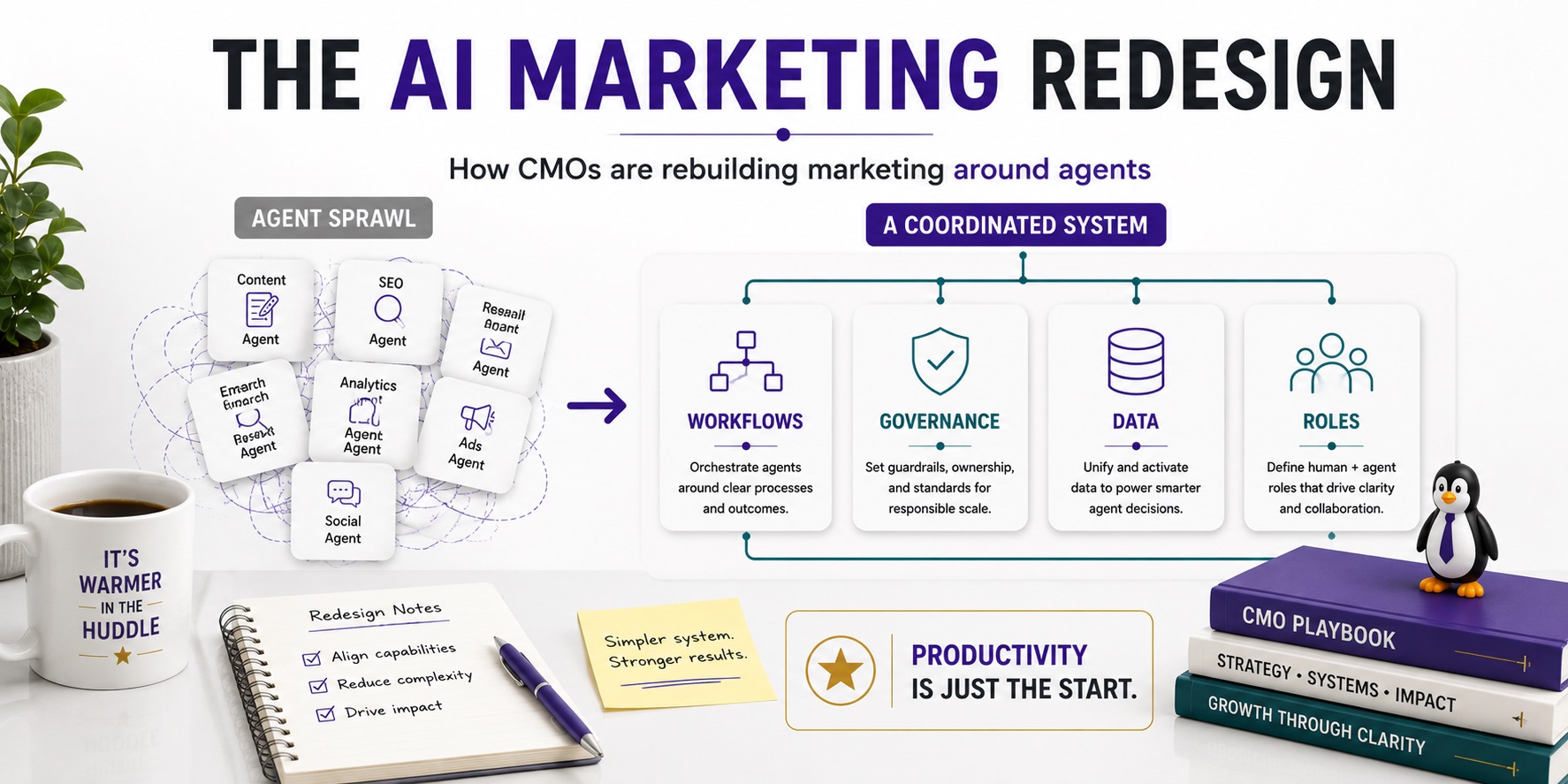
AI adoption is no longer the interesting part of the story. The harder question is what happens after everyone starts building.
That was the tension running through a recent webinar sponsored by Conversion that I moderated with Paige O’Neill, CMO of Culture Amp; Thalia Diedrick, CMO of GoTu; Colin Piper, CMO of BuildOps; and Neil Tewari, CEO of Conversion. Each is approaching agentic marketing from a different starting point, but all four are discovering the same thing: the hard part is not getting an agent to do something useful. It is redesigning the marketing system around agents without creating a costly, ungoverned mess.
And right now, that system is very much a work in progress.
The first wave of AI in marketing was largely personal productivity. Write this faster. Summarize that meeting. Analyze this spreadsheet. All valuable, but largely incremental.
Paige O’Neill’s team at Culture Amp decided to take a much more systematic approach. Instead of asking where an agent might help, they broke marketing down into roughly 5,000 units of work and organized those into 36 scenarios, then separated the work that should remain human-led from the work that could become AI-led. The first thing the exercise revealed, Paige said, was “hope for humans.”
That hope comes from a clearer division of labor. Paige believes Culture Amp can ultimately automate “about 50% of the work that marketing does today,” but the remaining work puts humans squarely in the areas where they create the most value: judgment, strategy, prioritization, governance, and shaping the quality of the output. AI can absorb more of the sorting, synthesis, repetitive execution, and data processing.
This distinction matters because simply automating the work exactly as it exists today risks doing mediocre things much faster. The larger opportunity is to reconsider whether the process should exist in its current form at all.
Colin Piper is seeing the same transition at BuildOps. His team has moved beyond individual AI use and toward what he described as “organizational AI,” connected to CRM, email, Slack, and first-party data. “We have to be moving to organizational level,” he said, because isolated agents sitting inside someone’s personal ChatGPT or Claude instance never create a coordinated system.
One example is deceptively simple. BuildOps built dashboards with AI and then embedded an agent that interprets those dashboards, surfacing the handful of insights that matter during pipeline reviews. When another marketer recently asked an agent to investigate whether a website pixel was firing correctly, it submitted a test lead, checked the implementation, and returned an analysis in roughly 30 seconds.
That is a lot more interesting than “AI helped me write an email.”
The democratization of building is one of AI’s greatest gifts and one of its biggest risks.
Thalia Diedrick’s team at GoTu built Sprint, an autonomous project-management agent with its own Google Workspace account, inbox, calendar, Drive access, Slack presence, and connection to the company’s project-management system. Sprint listens to meetings, extracts tasks, watches Slack conversations, updates projects, and relentlessly follows up with owners.
The experiment has worked so well that Sprint has started to feel less like software and more like a colleague. Thalia noticed one employee actually apologizing to Sprint for needing to push a deadline. More importantly, the agent has changed team behavior because people now state responsibilities and deadlines more explicitly in meetings, knowing Sprint is listening.
There is also an unexpectedly useful management benefit. “Sprint doesn’t have any relationship capital to spend,” Thalia explained. A human project manager may hesitate to nag a colleague repeatedly, while Sprint has no such social constraint and can keep pushing until the work gets done.
But building something like Sprint also exposes the hidden complexity of agentic systems.
Thalia has personally experienced what happens when an agent is badly architected, including burning roughly $200 worth of tokens in about 20 minutes. With Sprint, her team has had to think about prompt caching, model routing, evals, context, tools, sub-agents, and exactly what outcomes the agent is supposed to deliver.
Her description of the alternative was memorable. When teams throw an agent at an ill-defined aspiration instead of a clear process, Thalia warned, they can end up with “vibe like cost,” where the system keeps spending resources while trying to work out what problem it was supposed to solve in the first place.
That is how agent sprawl begins.
GoTu has responded with some useful discipline. Each team member gets five slots for ongoing projects they are building or maintaining, and a project must reach a point of needing no major maintenance after 60 days before it can graduate to evergreen status. Every build also has to roll up to a core KPI or strategic bet.
The future danger is not simply having too many agents. It is having too many undocumented, overlapping, poorly maintained agents running against inconsistent data and quietly consuming money.
Martech debt, meet agent debt.
Agent sprawl is not something CMOs can solve by reminding everyone to be careful.
Both Culture Amp and BuildOps are putting formal structures around AI. Colin described a corporate AI Center of Excellence responsible for policy, governance, agent documentation, and enablement across BuildOps’ roughly 600-person organization. Marketing has also invested in a dedicated AI innovation role working closely with that central team.
Paige has taken a similar hub-and-spoke approach. Culture Amp has a corporate AI Center of Excellence, departmental representatives, policies and guidelines, safeguards built into agents, and an AI transformation team inside marketing responsible for making sure the organization takes a holistic approach.
The irony is worth noting. AI promises to eliminate work, yet mature AI adoption is also creating entirely new jobs.
Paige has already built an AI transformation team, and Colin has added dedicated AI innovation talent. That doesn’t mean the economics fail. It does mean the simplistic assumption that AI immediately equals lower headcount and lower costs does not match what these leaders are experiencing.
Paige was especially candid about the economics. As agents move off individual desktops and begin operating across complex workflows and departments, “in the short term, it is going to be more expensive” than continuing to have humans do some of that work. Her expectation is that costs and efficiencies will improve over time, but organizations need an appetite to fund that transition first.
CMOs therefore need to think about AI investment more like infrastructure than software experimentation. Infrastructure needs owners, standards, maintenance, and governance.
And somebody eventually gets the bill.
Sprint makes a powerful argument for building.
It is deeply tailored to GoTu’s organization. It understands their workflows, systems, communication patterns, and even individual team members. Sprint maintains communication profiles so it can tailor how it follows up with different people, a degree of personalization that would be difficult to get from a generic project-management product.
But bespoke also means responsibility. GoTu built Sprint on Anthropic’s SDK, with Supabase, Railway, Claude Code, Slack, email, and other systems stitched together. The marketing team maintains it internally and is developing more formal technical audit and security processes around its AI work.
Neil Tewari makes the countercase from the platform side. His view is that one of the biggest barriers to effective agents is fragmented context, since marketing information lives across CRM, calls, webinars, email, warehouses, ad systems, and other applications.
Conversion.ai’s philosophy is to solve that foundation first. “How do we make the pipes robust enough so that we can actually do a lot of cool things?” Neil asked. For him, the value of an agentic platform starts with centralizing the data and context that allow agents to make better decisions in the first place.
There is no universal answer yet.
Building makes sense when the workflow is distinctive, strategically important, and specific enough that off-the-shelf technology cannot deliver what the organization needs. Buying makes sense when the underlying problem is common, infrastructure-heavy, or likely to become increasingly difficult to maintain internally.
The mistake is assuming that because something can be built quickly, it should be built.
The technology conversation often gets more attention than the people conversation. That may be backwards.
Paige’s analysis suggested that as much as 50% of today’s marketing work could eventually be automated, but she did not equate that to removing 50% of the marketing team. Instead, she sees work shifting toward judgment-intensive roles while entirely new AI-oriented roles emerge.
Colin sees a similar compression of traditional specialties. BuildOps has “about 20 people to do the work of many more than that,” and he expects the rise of what he calls the full-stack marketer: someone who understands the audience and strategy but can also move across campaign execution, demand generation, operations, and downstream workflows with AI assistance.
When I asked whether they were hiring differently now, Colin’s answer was an immediate yes. Paige was more emphatic: “Thousand percent different.”
There is a potential trap here. If every new marketing job description suddenly prizes systems thinking, who is left to make the unexpected creative leap?
Thalia offered perhaps the best counterweight, describing AI as “the middleware for the human imagination.” Her argument was not that marketers should simply become better operators of machines. It was that AI should help them challenge old assumptions and imagine processes that previously seemed impossible.
The future marketing team probably needs both: people who can design systems and people who can imagine entirely different ones.
Almost every CMO can find examples of AI saving time. The harder challenge is connecting those efficiencies to business performance.
BuildOps is beginning to cross that line. Colin described an end-to-end campaign that historically would have taken more than 20 weeks to move from concept to market. Using AI to pressure-test the idea, build research, develop campaign assets, and accelerate execution, his leaner team got it into market in roughly six weeks.
The important part is not simply that the team saved 14 weeks. Colin said the campaign is already producing pipeline during a period when, under the old process, “we’d be ideating on it and building it” rather than generating results.
Neil offered an even more advanced example from Conversion.ai itself. “About 80 to 85% of the pipeline that we bring in here through Conversion does come in through our Conversion agents,” he said, noting that most attendees at this webinar had themselves been reached through those agents.
Those examples matter because they demonstrate the potential end state.
They are also exceptional and aspirational for most marketing organizations.
For many CMOs, the journey still runs through individual productivity, experimentation, workflow automation, governance, and organizational redesign before those efforts reliably show up in pipeline or revenue. Pretending otherwise only adds to the AI hype cycle.
Perhaps the best evidence that this field is still evolving came in the panelists’ closing advice. They did not prescribe the same playbook.
Neil recommended identifying something that should be possible with AI, doing it manually a few times, and then reverse-engineering how to automate it. Colin pushed in almost the opposite direction, challenging CMOs to ask whether AI allows them to skip entire steps rather than merely accelerating the old ones.
Thalia urged leaders to challenge their limiting beliefs so they don’t get trapped “in an optimizer kind of wormhole of just optimizing what already exists.” Paige returned to the people side, warning leaders, “Don’t forget about bringing the team along on the journey,” because humans still need training, clarity, support, and clearly defined roles in the new operating model.
All four can be right because companies are starting from very different places.
A marketing organization still figuring out individual ChatGPT usage does not need the same next move as Culture Amp, where agents are being centralized and governed across complex workflows. A company building its first agent does not have the same problems as GoTu, which is already establishing rules for maintaining production-grade builds.
That is what makes the AI marketing redesign both exciting and frustrating. There is no finished blueprint to copy yet. The smartest CMOs are building, learning, breaking things, adding guardrails, redesigning work, and occasionally discovering that the thing they thought they were automating should not exist at all.
The destination may be clearer than the route.
Before deciding what your next move should be, find out where your organization actually sits on the journey. Our brand new AI Maturity Calculator can help you assess your current level of AI maturity and identify the questions you should be asking next. Shout out to Ray Rike at Benchmarkit for his help building this model.
CMO Huddles helps B2B marketing leaders win by bringing together peers, fresh perspectives, and opportunities to build stronger personal brands. Want to join the huddle? Learn more about CMO Huddles and apply to join the community.