
Back to Blogs
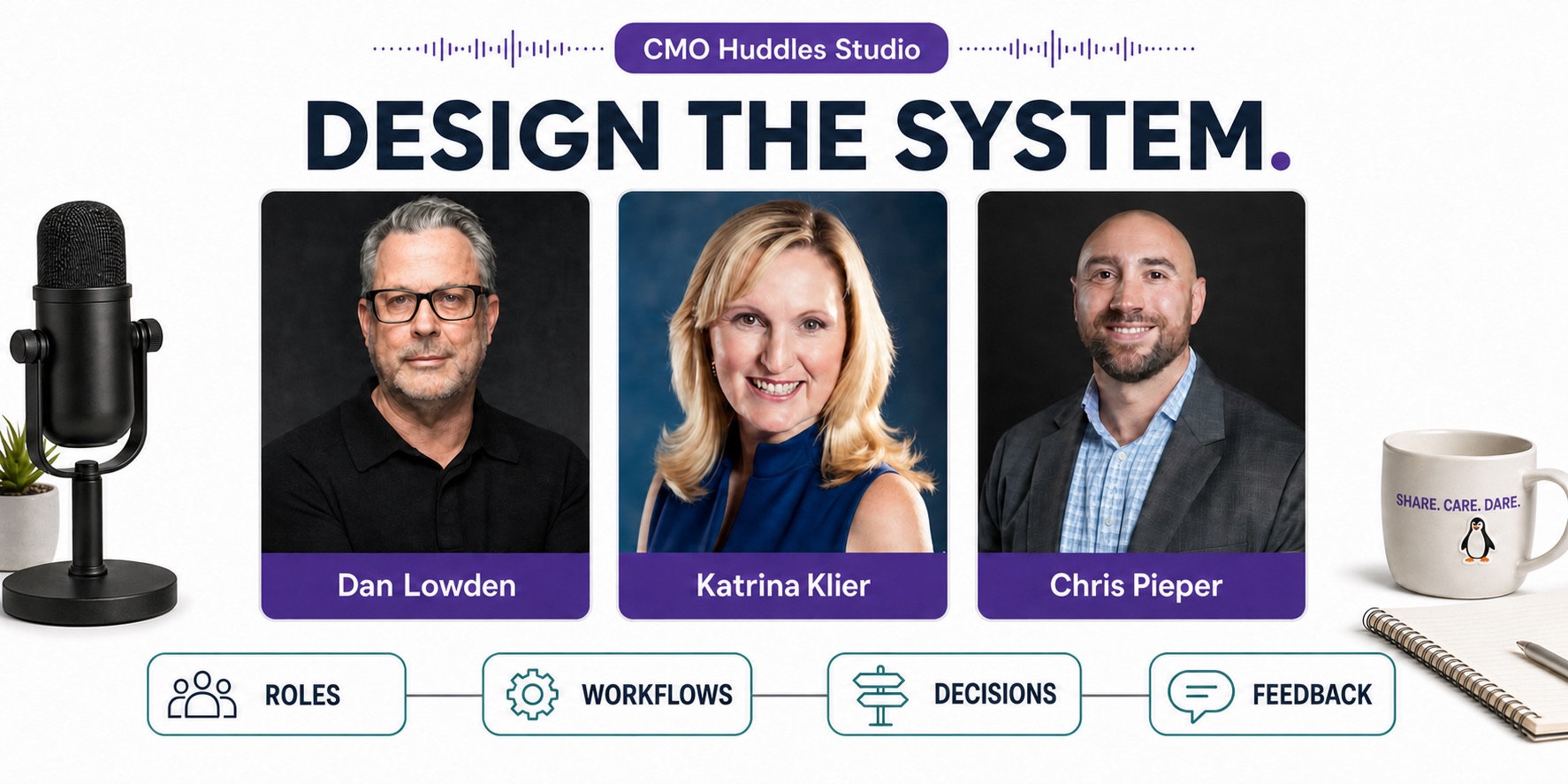
Marketing scales more reliably when success depends on a well-designed operating system rather than one heroic leader. Dan Lowden, Katrina Klier, and Chris Pieper describe systems that connect expertise, workflows, decision rights, AI, learning, and team health. Their examples show how repeatability can increase speed and quality while keeping people accountable for outcomes and judgment.
The hero leader has the answers, makes the difficult calls, fixes stalled work, and becomes the center of every important decision.
That model can feel effective until the team grows, the pace accelerates, or the leader’s calendar fills with decisions no one else feels authorized to make.
In The New CMO Superpower: System Design, Dan Lowden of Blackbird.AI, Katrina Klier of Sage Strategy Group, and Chris Pieper of ADP explore a different leadership model.
The system designer focuses on how work moves, where decisions happen, what gets measured, and how the team learns. The CMO remains accountable, but fewer outcomes depend on constant personal intervention.
At Blackbird.AI, Dan’s five-person marketing team works with narrative intelligence analysts who produce detailed primary research.
The expertise already existed. The scaling challenge was converting that work into useful external content without exposing customer information or creating an entirely separate production burden.
The team established a repeatable process. Analysts contribute findings, marketing anonymizes the material, and the insight becomes a report or article. Guidelines covering privacy, quality, editorial judgment, and approvals help internal experts participate without every decision returning to Dan.
The team published approximately 150 pieces of content in 12 months using this system.
Dan connected the approach to a larger opportunity:
“With AI, we’re going to enable our systems to win more consistently, be more repeatable, more scalable, and more valuable.”
AI assists the workflow, but source expertise, privacy boundaries, and human judgment remain part of the system.
Katrina describes the modern marketing system as a combination of people, technology, and AI.
This framing moves AI beyond the role of another tool. It becomes one category of capability within a broader operating model.
Existing platforms can provide a starting point. CRM, email, automation, and other systems may already contain AI-enabled functionality suitable for a contained pilot.
The larger differentiator is whether the system can learn. A workflow produces an output. A learning system also captures feedback, identifies weaknesses, and improves over time.
“The differentiator today is really more how well you design systems that can hold up beyond the one thing, or the group of things, that you need to do today.”
That distinction separates a clever experiment from an operating capability the team can continue using.
Chris brought the conversation back to leadership and operating rhythm.
“The job of a leader isn’t to win the game. It’s to design the machine that wins consistently.”
At ADP, that machine includes cross-functional pods, three-week sprints, a dedicated scrum master, regular standups, monthly performance reviews with sales leadership, and quarterly recalibration sessions.
The rhythm helps strategy move into execution while creating opportunities to identify what is working, what is stalled, and what needs to change.
This model does not remove leadership. It changes where leadership appears. Instead of solving every problem personally, the leader shapes the roles, decision paths, standards, and feedback loops that help the team solve more problems together.
All three perspectives resist treating AI as a separate side project.
AI can support research, synthesis, content production, analysis, and automation. Its value increases when it operates inside a defined process with approved inputs, human review, and a measurable outcome.
Teams also benefit from visibility into:
The objective is not AI activity. It is a more capable marketing system.
A marketing organization may still depend too heavily on one leader when:
These signals do not necessarily indicate weak leadership or weak employees. They can reveal that roles, decision rights, knowledge, or feedback are not visible enough.
Recurring bottlenecks become useful design information.
Dan’s content engine, Katrina’s people-technology-AI architecture, and Chris’s operating rhythms represent different parts of the same model.
The CMO still matters. The difference is that the leader’s contribution includes a system capable of producing, deciding, and learning without requiring the leader to occupy the center of every task.
That makes success less dependent on heroics and more likely to continue as the team, technology, and business evolve.
It means shaping workflows, decision paths, operating rhythms, and feedback loops so strong work can happen more consistently.
No. It shifts attention from resolving every issue personally to improving how the team operates.
AI can support defined workflows while people retain responsibility for goals, judgment, quality, access, and outcomes.
Repeated bottlenecks, private knowledge, stalled decisions, and work that pauses when one leader is unavailable.
Want to hear more? Listen to the full conversation on Renegade Marketers Unite.
CMO Huddles helps B2B marketing leaders win by bringing together peers, fresh perspectives, and opportunities to build stronger personal brands. Want to join the huddle? Learn more about CMO Huddles and apply to join the community.