
Back to Blogs
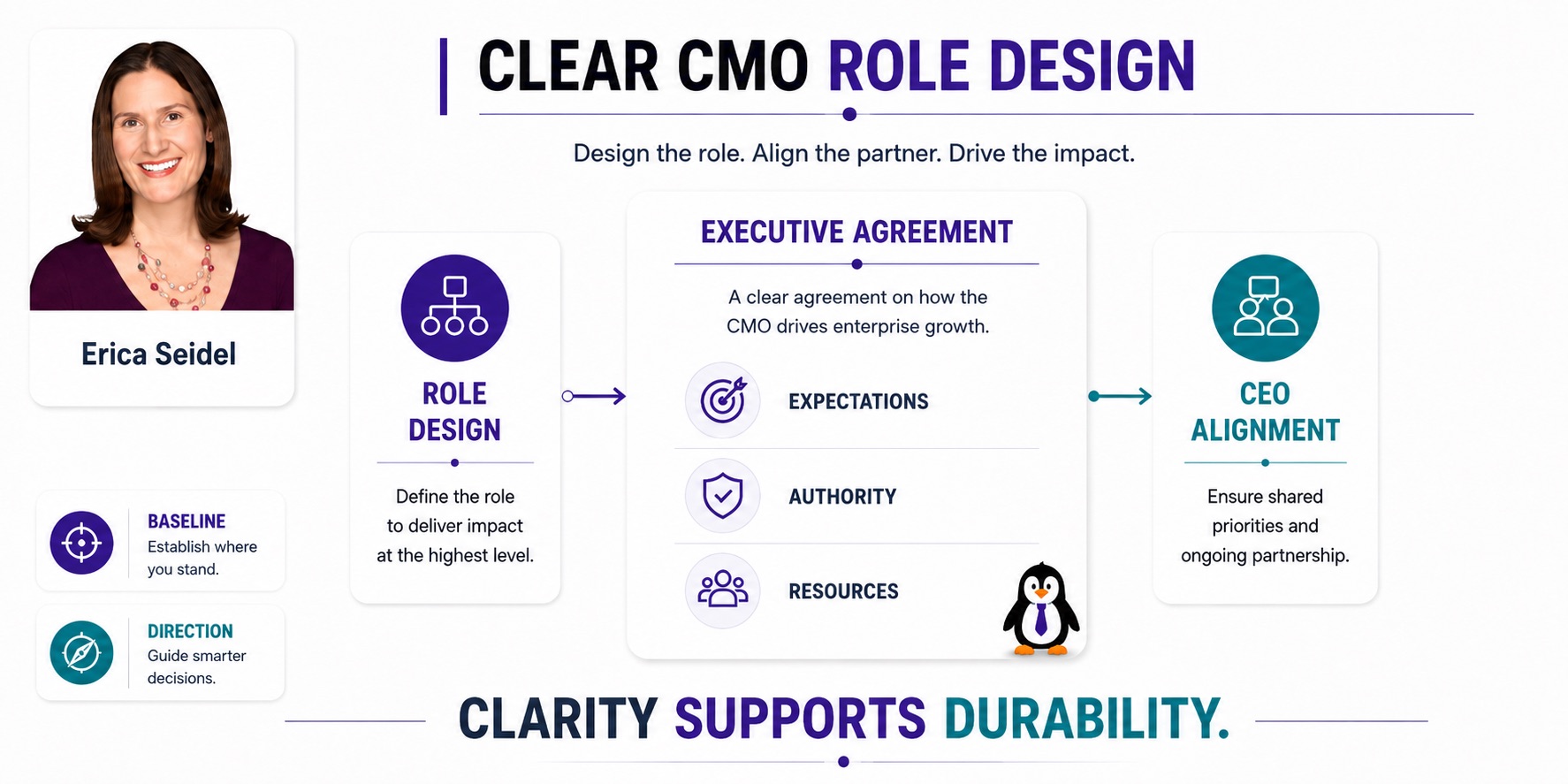
The CMO role becomes more durable when expectations, authority, resources, culture, and executive relationships align. Executive recruiter Erica Seidel explains why career management begins before transition. Marketing leaders can strengthen options by clarifying role design, expanding business fluency, developing trusted teams, maintaining networks, and choosing companies where the mandate has a realistic chance of success.
CMO career management is often treated as an activity that begins after a role ends. By then, important parts of the next search have already been shaped by the leader’s current relationships, reputation, experience, and visibility.
In a conversation about CMO career management, executive recruiter Erica Seidel, founder of The Connective Good, explored the conditions that shape CMO tenure and career durability.
“CMOs don’t fail for lack of talent or lack of effort. They fail for lack of clear role design and lack of alignment.”
This distinction moves the conversation beyond individual performance. An accomplished leader can struggle inside a mandate where expectations, authority, resources, timing, and business conditions do not support one another.
Career management therefore includes evaluating the system surrounding the role. The CMO’s ability matters, but so does the company’s readiness for the work it expects that leader to perform.
A CMO title can describe radically different jobs. One company may need category creation and brand transformation. Another expects immediate pipeline growth. A third combines marketing, sales development, customer success, communications, and partnerships under one leader.
The role becomes more workable when expectations connect with authority, budget, people, data, incentives, and time. If the company expects transformation but funds maintenance, the contradiction will eventually become visible.
Decision rights also matter. A CMO held responsible for growth may have limited influence over pricing, product, sales execution, or customer experience. Those boundaries do not automatically make success impossible, but they need to be understood.
The interview process creates an opportunity to investigate the system. Candidates can explore how the company defines marketing, what the board expects, which foundations already exist, and what previous leaders encountered. A detailed first-90-days discussion becomes more credible when it includes the resources and dependencies behind the plan.
The CEO’s understanding of marketing affects priorities, patience, investment, and the way performance is evaluated. Some CEOs see marketing primarily as a demand-generation function. Others expect it to shape product strategy, customer experience, corporate narrative, and growth. Neither expectation benefits from remaining implicit.
Questions about previous marketing leaders, board discussions, decision-making, and near-term pressures can reveal how the CEO defines the role. Erica suggested asking how the CEO sees marketing contributing to the company’s growth story and which marketing questions proved difficult during the last board meeting.
The answers can expose whether the CEO is open to a strategic marketing partner and whether the two leaders share a compatible view of the work.
Business fluency helps the CMO connect marketing choices with the issues the CEO already needs to solve. The conversation becomes stronger when it addresses growth, risk, margin, retention, customer behavior, and market position in addition to marketing activity.
“CMOs have to navigate this peacemaker-changemaker paradox. You are hired to make change, but to do it in a way that’s comfortable.”
A new leader may see urgent problems in positioning, structure, technology, talent, or measurement. Moving too slowly can preserve dysfunction. Moving too quickly can create resistance before the relationships needed for change exist.
The paradox requires judgment about sequence, trust, and organizational readiness. Listening gives the leader context, but it eventually needs to produce visible choices.
Early wins can demonstrate momentum while the CMO continues diagnosing larger issues. They may also create the credibility needed to address deeper structural problems.
The leader still needs to distinguish between healthy adaptation and avoiding necessary conflict. Peacemaking supports change when it builds understanding. It becomes limiting when comfort repeatedly overrides the mandate.
Modern CMO mandates often include brand, demand, product marketing, communications, customer marketing, operations, analytics, digital experience, and revenue collaboration. Erica described the result bluntly: “The role is breaking. It’s just too big.” Focus requires identifying which outcomes matter most, which capabilities the team needs, and which work will receive less attention.
A chief of staff, strong operations leader, or experienced functional team can help the CMO preserve time for cross-functional leadership and strategic decisions. Clear ownership prevents every issue from returning to the CMO.
Focus also makes expectations easier to manage. The CEO and board can see where marketing is concentrating its effort and what the organization is choosing to delay.
Budget allocation offers one place where career durability and enterprise leadership intersect. A CMO may occasionally see that the company’s most important investment belongs outside marketing.
“Radically collaborate even when it hurts. Giving a budget to another area, that hurts, but it could be the right thing for the company.”
That choice can feel uncomfortable because the CMO remains accountable for marketing outcomes. Yet an investment elsewhere may address the constraint preventing growth.
A product improvement may matter more than another campaign. Customer success capacity may strengthen retention and advocacy. Better sales enablement may help existing demand convert.
Collaboration of this kind demonstrates business judgment. It shows that the CMO can optimize for the company rather than defending marketing’s share of resources in every discussion.
CMOs strengthen their influence when they can discuss pricing, margin, capital allocation, sales productivity, retention, market risk, and product strategy without translating every issue back into marketing terminology.
That fluency supports the current role and broadens future possibilities. A leader may move into a larger CMO position, general management, an operating role, advisory work, or board service.
Career expansion becomes easier when the leader’s record demonstrates enterprise contribution. A list of marketing outputs may show functional competence. A record of helping the company make stronger choices shows leadership range.
Board relationships can contribute to that development. Engaging board members outside formal presentations, learning which measures they value, and offering a market perspective can turn the board into a resource instead of an audience to manage.
“I like to tell people that there’s a recency bias. Whatever you did yesterday, you are going to get more of a look than something totally different, unless you have a strong introduction in.”
A trusted introduction can help another person understand transferable experience that a résumé may not make obvious. It can also give a candidate credibility when moving between industries or role types.
Networks are strongest when maintained as relationships rather than emergency distribution lists. Sharing ideas, supporting peers, participating in communities, and remaining visible create familiarity before a search begins.
Those relationships provide value while the CMO is still employed. Trusted peers can help assess role conditions, interpret board dynamics, and consider options before a crisis forces the decision.
Senior leaders often have more experience than an interviewer can absorb in one conversation. Trying to recount the entire career can obscure the evidence most relevant to the role.
“The interview process, it’s like Italian cooking. What you leave out is just as important as what you put in. Don’t puke up your whole history. Practice your story so it doesn’t sound rehearsed, but it sounds natural.”
A focused narrative connects the candidate’s experience with the company’s present challenge. It gives enough detail to demonstrate judgment while leaving room for a genuine conversation.
The same discipline applies to career visibility. A clear point of view and a few well-developed areas of expertise are easier to remember than an attempt to appear equally qualified for every possible mandate.
It determines whether expectations align with authority, resources, incentives, and the time available to produce results.
Questions about marketing expectations, board priorities, decision rights, previous leaders, and investment can reveal how the CEO understands the role.
It helps the CMO connect marketing with enterprise decisions and expands future leadership possibilities.
Before a transition. Relationships, visibility, skills, and career options develop more effectively when maintained continuously.
Listen to the full conversation with Erica Seidel.
CMO Huddles helps B2B marketing leaders win by bringing together peers, fresh perspectives, and opportunities to build stronger personal brands. Want to join the huddle? Learn more about CMO Huddles and join CMO Huddles Starter.