
Back to Blogs
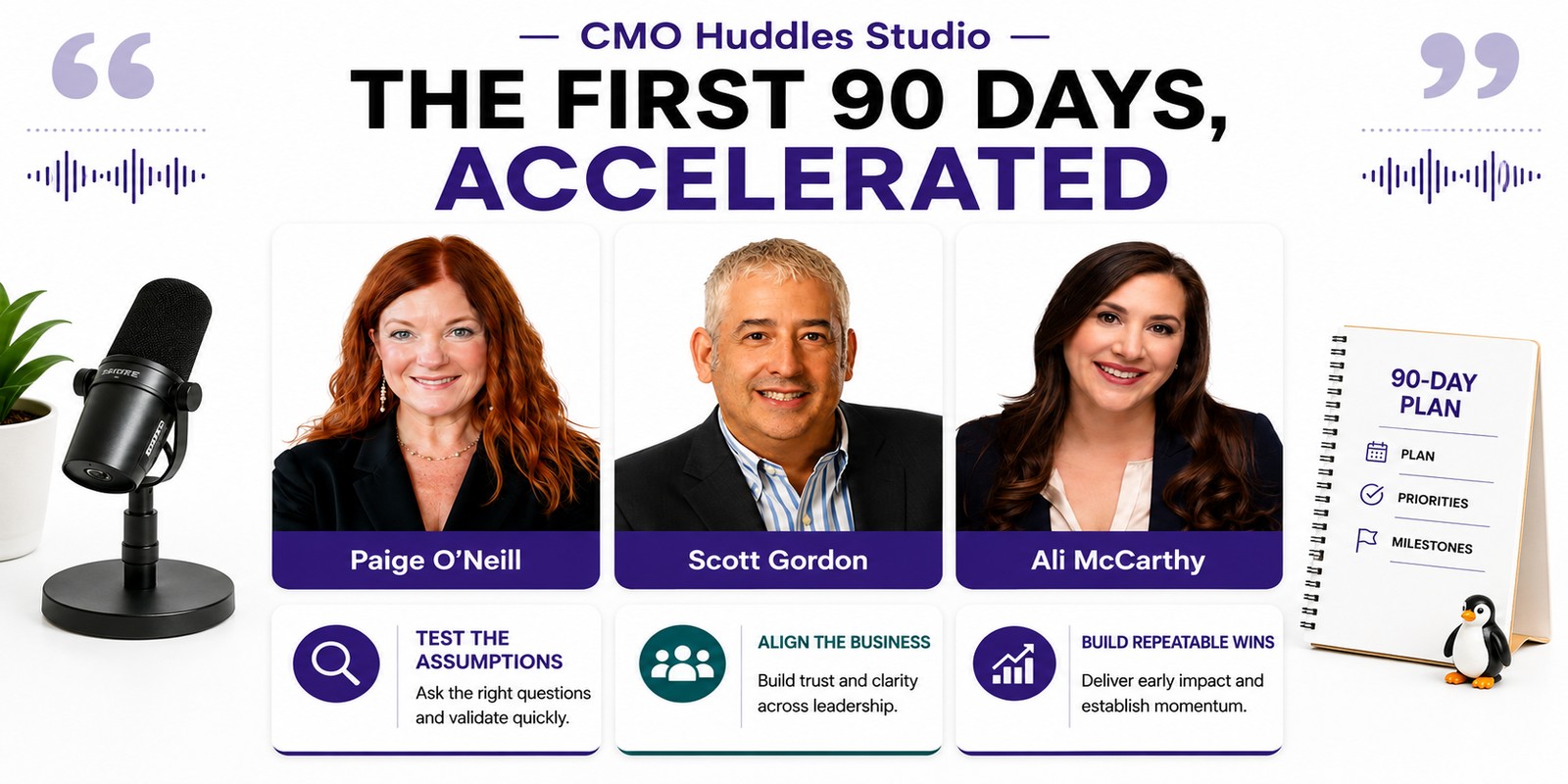
The first 90 days of a CMO role are accelerating as AI speeds research, onboarding, testing, and execution. Paige O’Neill, Scott Gordon, and Ali McCarthy connect faster tools with careful listening, business alignment, team assessment, focused market choices, and repeatable early wins. Their experiences show why increased speed makes judgment and trust even more important.
AI can compress research, synthesis, planning, and experimentation during a CMO’s first 90 days. That speed creates more capacity, but it can also create pressure to act before the new leader understands the business.
In a 2026 CMO Huddles Studio conversation, Paige O’Neill of Culture Amp, Scott Gordon of HG Insights, and Ali McCarthy of Asset-Map discussed how listening, validation, and focus remain essential even as execution accelerates.
A new CMO enters with a version of the company assembled during the interview process. The first weeks create an opportunity to test that story against employee, customer, financial, and operational evidence.
Paige pointed to the unusual influence that accompanies a new leader’s fresh perspective:
“You’ll never have a better opportunity to propose a radical idea.”
Fresh perspective carries influence, but it becomes more credible when paired with listening and evidence.
Scott summarized his entry assessment in four parts:
“What’s the real business objectives and the pipeline commits, what’s the budget allocation and is there a demand gen model, what’s the team initiatives and their sentiment, and really getting alignment with sales and rev ops.”
Together, those areas create a baseline spanning business expectations, resources, people, and revenue alignment.
AI can help organize interviews, summarize documents, compare performance data, and accelerate research. Executive conversations still provide the context required to interpret that information.
New marketing leaders often inherit multiple audiences, product stories, campaign ideas, and urgent internal requests. Early focus can help the organization understand where marketing will begin creating value.
Ali used research to clarify which market problem deserved attention first. That choice did not eliminate every other opportunity. It established a practical sequence.
Research can also create alignment by giving stakeholders common evidence. AI may accelerate analysis, but the leadership decision still involves market relevance, business priority, and organizational readiness.
A highly visible project can create momentum, but isolated success may be difficult to build upon.
“The quick win in my mind is one that’s repeatable.”
Repeatable wins can establish a process, operating rhythm, data foundation, or team capability that continues producing value after the first 90 days.
They also help the new CMO build trust without dismissing work that was already succeeding.
A team assessment now includes more than roles and performance. It may also examine how employees learn, experiment, document workflows, review AI output, and share successful practices.
Scott emphasized keeping people central to AI-related change. Faster tools do not remove the need for clear expectations, coaching, psychological safety, and thoughtful role design.
AI can accelerate research, synthesis, onboarding, experimentation, and planning, increasing both capacity and performance expectations.
Business objectives, pipeline commitments, budget allocation, team sentiment, sales alignment, and the assumptions formed during interviews all provide useful context.
An early win is more valuable when it builds trust, supports a business priority, and creates a repeatable capability.
No. Increased speed makes context and judgment more important because teams can act on incomplete assumptions more quickly.
Listen to the full 2026 conversation.
CMO Huddles helps B2B marketing leaders win by bringing together peers, fresh perspectives, and opportunities to build stronger personal brands. Want to join the huddle? Learn more about CMO Huddles and apply to join the community.