
Back to Blogs
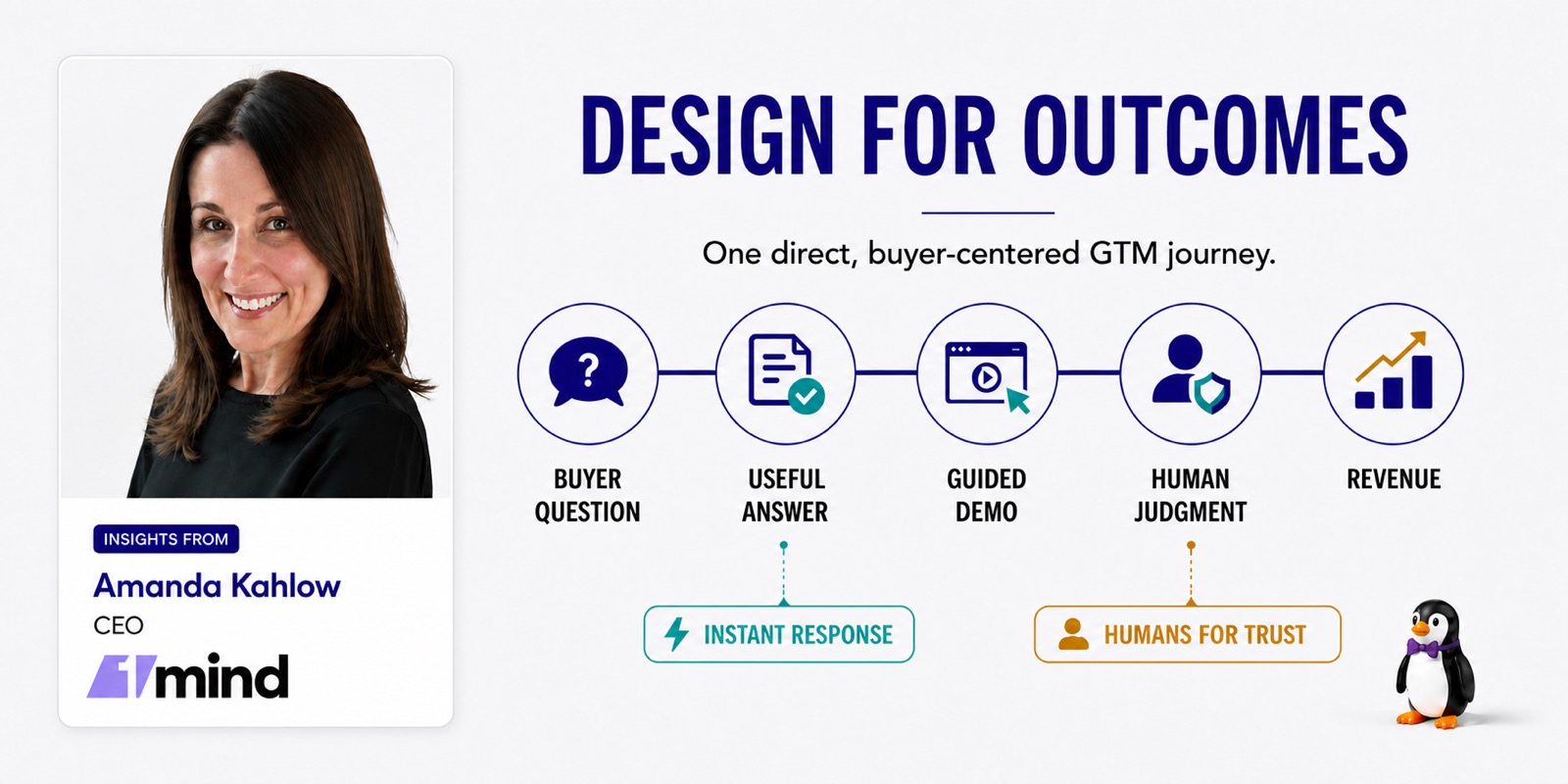
An AI-first GTM engine replaces slow internal handoffs with a buyer-centered path from interest to value. The opportunity for CMOs is to design around revenue outcomes, make useful responses immediate, reserve people for trust and complex judgment, and test the model on overlooked demand before changing the broader organization, roles, metrics, or technology stack itself.
A buyer raises a hand. Marketing scores the lead. An SDR qualifies it. An account executive repeats discovery. A solutions consultant schedules a demonstration.
Every transition may make sense internally. Together, they can create a relay race the buyer never volunteered to run.
In AI, SDRs, and the New GTM Engine, Amanda Kahlow, founder of 1mind, explores what happens when a GTM organization starts with the buyer’s desired outcome instead of its existing roles.
The question is not simply how AI can make the SDR process faster, but which steps would still exist if the buying experience were designed today.
Many GTM systems were built to record, route, and manage human activity. Teams and metrics then formed around those systems.
Amanda sees an opportunity to organize the experience differently:
“We want to think about outcomes being the center.”
A buyer may want to determine fit, get an accurate answer, compare approaches, see a demo, or understand implementation. Those needs do not map neatly to marketing, SDR, sales, and solutions-consulting boundaries.
Starting with the desired outcome creates room to reconsider which steps can be automated, which can be combined, and where a person adds meaningful value.
A journey review can reveal friction that funnel reporting misses. At each stage, a team can examine:
The work may fall into four categories:
Automate: Scheduling, routing, enrichment, and approved information delivery. Augment: Research, conversation preparation, summaries, and next-step recommendation. Redesign: Fragmented sequences that could become one direct experience. Keep human: Trust, negotiation, empathy, politics, and complex judgment
This is less about removing people than concentrating human attention where it contributes most.
Speed to lead traditionally measures how quickly a representative responds after someone submits a form. Speed to value asks how quickly that person receives something useful.
Amanda put the distinction plainly:
“Speed to lead is not 10 minutes. It’s instant.”
An automated acknowledgement does not create much value. An interaction that answers a technical question, explains an integration, or provides a relevant demonstration can.
That expands the scorecard beyond response time. Conversion, sales-cycle length, revenue, accuracy, buyer satisfaction, and escalation quality also become relevant.
Changing an established revenue motion across the entire organization would carry significant risk. Amanda described a more contained starting point: Demand the current organization cannot economically serve.
That might include smaller accounts, inactive trials, uncovered regions, older event leads, or prospects receiving limited follow-up.
A pilot can focus on one segment, one buyer problem, and one measurable outcome:
Because Amanda leads an AI GTM company, the episode reflects a vendor perspective and reported customer experiences. Every organization has its own buying journey, technology environment, economics, and risk requirements.
The SDR role has long provided an entry point into B2B sales and marketing. If AI absorbs more research, qualification, response, and demonstration work, early-career development may take different forms.
Amanda acknowledged that open question:
“We’re going to have to train people a new way.”
Emerging responsibilities could include reviewing AI conversations, improving knowledge sources, studying objections, researching accounts, and assisting with complex discovery.
The larger leadership question is not only how much work AI can absorb. It is also how people can develop the judgment needed to supervise, improve, and complement these systems.
AI creates an opportunity to reconsider GTM assumptions once constrained by human capacity.
The goal is not merely making the relay race faster. It is reducing how much of that race the buyer experiences at all.
A buyer-centered model shortens the distance between interest and value while reserving people for the moments where trust and judgment matter most.
AI may absorb some research, qualification, response, and demonstration tasks. The effect will vary by market, product complexity, and buyer expectations.
It is a GTM model organized around buyer and revenue outcomes instead of a fixed series of internal handoffs.
Overlooked demand, such as inactive trials or uncovered segments, can provide a contained testing environment.
Relevant measures include response quality, conversion, sales-cycle length, revenue, accuracy, and escalation quality.
Want to hear more? Listen to the full conversation on Renegade Marketers Unite.
CMO Huddles helps B2B marketing leaders win by bringing together peers, fresh perspectives, and opportunities to build stronger personal brands. Want to join the huddle? Learn more about CMO Huddles and apply to join the community.