
Back to Blogs
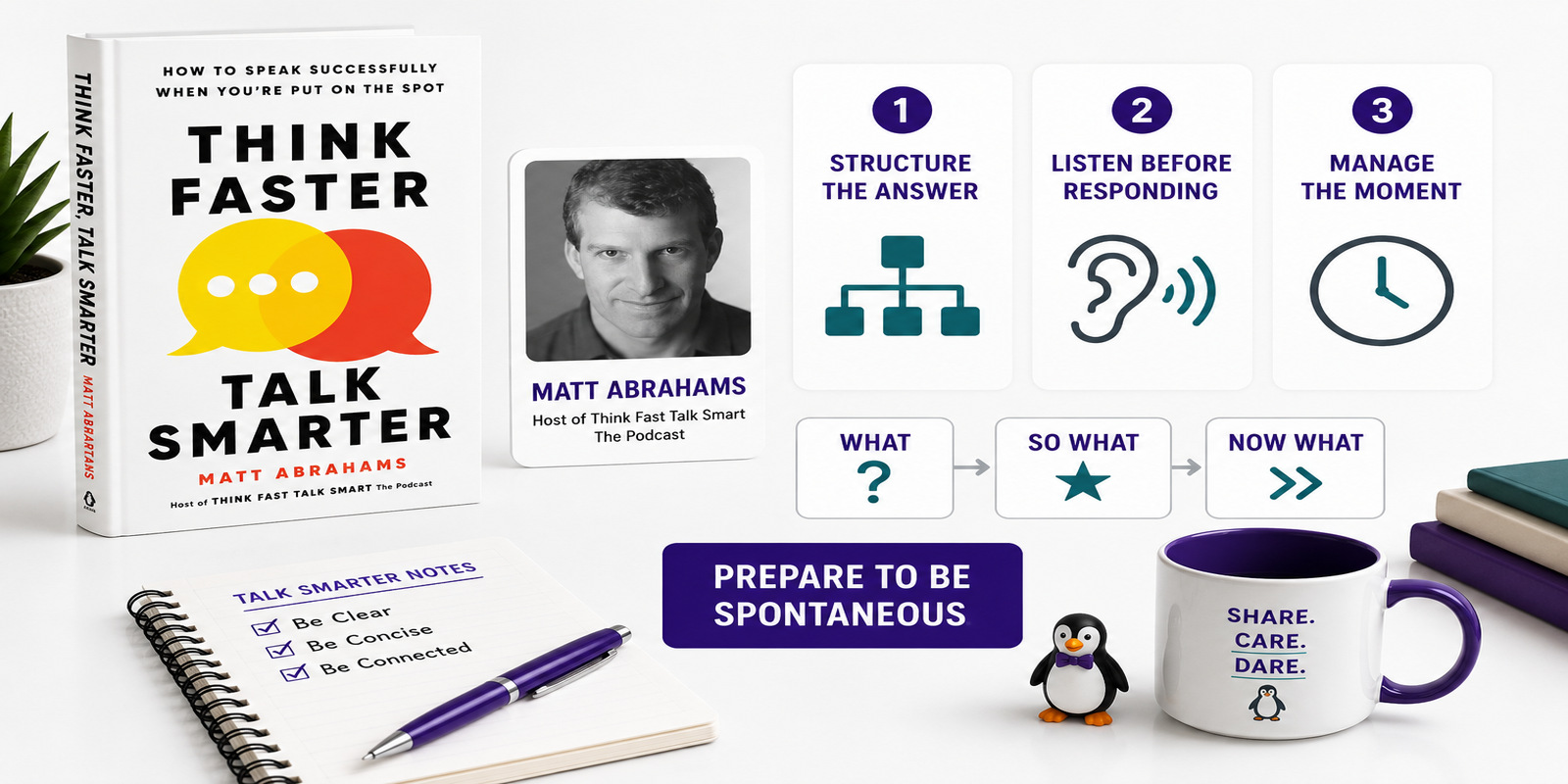
High-stakes communication becomes easier when CMOs use simple structures, listen before answering, manage anxiety, and prioritize the message their audience needs. Stanford lecturer and author Matt Abrahams offers techniques for interviews, board meetings, executive discussions, feedback, and media questions. His methods help leaders respond spontaneously with clarity without sounding rehearsed or filling silence with detail.
CMOs spend much of the day in conversations they cannot completely script. A board member challenges a forecast, a journalist asks an unexpected question, a candidate raises a concern, or an employee needs difficult feedback.
Preparation still matters, but it takes a different form. Instead of memorizing sentences, leaders can practice structures that help them organize a response in real time.
Matt Abrahams, Stanford Graduate School of Business lecturer and author of Think Faster, Talk Smarter, teaches approaches that reduce the cognitive burden of spontaneous communication.
One of Matt’s most adaptable structures divides a response into three parts:
“The What, So What, Now What structure is the Swiss Army knife of communication.”
The structure works because it gives the speaker somewhere to go. Instead of discovering the answer aloud, the CMO can organize the response around meaning and action.
In a board meeting, “what” may be a shift in pipeline quality. “So what” explains the business implication. “Now what” identifies the response, decision, or support required.
The same structure can support media interviews, team updates, customer conversations, and executive Q&A.
Subject-matter expertise can make concise communication harder. The speaker sees caveats, context, history, and competing interpretations, all of which may feel necessary.
Matt uses a memorable warning:
“Tell the time, don’t build the clock.”
The listener usually needs the answer before the explanation. A CMO can state the central point, observe the audience’s response, and add detail where it improves understanding.
This is particularly useful in interviews and board meetings, where a long preamble can sound evasive even when the speaker is trying to be precise.
Concision does not require oversimplification. It requires sequencing: answer first, then provide the context necessary to support it.
A memorized answer may collapse when the question changes slightly. A structure is more flexible because it helps the speaker assemble relevant information in the moment.
Matt recommends the ADD structure for interview responses:
Behavioral questions about mistakes require special attention. Candidates often spend most of the response describing what went wrong.
“The problem is that people will give great detail about the mistake they made, but they don’t spend time explaining how they fixed it and what they learned.”
The repair and learning demonstrate judgment. The mistake supplies context, but the response becomes valuable when it shows how the person acted afterward.
High-stakes communication naturally creates anxiety. Matt cites research suggesting that a large majority of people feel nervous during planned or spontaneous speaking.
He distinguishes managing anxiety from overcoming it. Some nervous energy can improve focus and signal that the interaction matters.
The task is to keep that energy from consuming the mental capacity needed to listen and respond. Helpful practices may include slowing the exhale, grounding physically, reframing the exchange as a conversation, and focusing attention on the audience’s needs.
A leader who expects to feel nothing may become more anxious when physical symptoms appear. A leader who expects manageable activation can direct more attention toward the discussion.
Many people begin composing an answer while the other person is still speaking. That habit creates responses to the expected question rather than the actual one.
Matt recommends giving the listener pace, space, and grace. Paraphrasing the question before answering can confirm understanding and create a brief moment to organize the response.
In a board setting, the CMO might say, “It sounds like the concern is whether the pipeline change reflects execution or the market. Is that the question?”
The paraphrase can expose a mistaken interpretation before the speaker commits to an answer. It also demonstrates that the concern has been heard.
A challenging question can feel like an attack, especially when the speaker interprets disagreement as opposition to the entire strategy.
Matt offers another starting point:
“Even if somebody is hostile to your point of view, at least they care about the same thing you do. You can start from that place.”
A board member questioning brand investment may still care deeply about durable growth. A sales leader challenging lead quality may share marketing’s interest in stronger conversion. Beginning with the shared concern can lower defensiveness without pretending that the disagreement has disappeared.
The response can then address the evidence, assumptions, and tradeoffs separating the two positions.
Standard introductions often begin with a name and title, followed by a chronological professional history. That sequence may provide facts without giving the listener a reason to care.
Matt recommends beginning with a declarative sentence that communicates passion, purpose, or relevance before supplying the usual identifiers.
“When you introduce yourself, what is one phrase or sentence you could use before you start saying who you are, what you do, etc.?”
A CMO might begin, “I build marketing systems that help technical companies turn complex products into clear customer value.” The name and current role can follow.
The opening works when it is specific enough to create a useful frame. A generic claim about driving growth is less likely to distinguish the speaker.
Even an experienced communicator can lose the thread. Recovery is better than continuing to search for the point.
A speaker can pause and say:
These phrases reset the structure without requiring an apology or lengthy explanation.
The willingness to stop and reorganize can increase confidence. It shows that the speaker is responsible for making the answer useful, not merely for continuing to talk.
Spontaneous communication improves through repetition. Everyday conversations, team meetings, short updates, introductions, and written messages provide frequent opportunities.
Matt recommends reviewing recent texts to identify where the message could have been more concise. Written exchanges expose habits that also appear in speech: delayed answers, unnecessary context, weak requests, and unclear next steps.
A CMO can also practice answering likely board or media questions using a timer and one selected structure. The goal is not to memorize the response. It is to make organization feel familiar under pressure.
Preparation can focus on flexible structures such as What, So What, Now What rather than memorized scripts.
Matt recommends ADD: answer the question, provide a relevant detail, and describe why the example matters.
State the answer first, use a structure, identify the audience’s main need, and add only the detail required to support the point.
Pause and restate the central point. Phrases such as “Let me answer that more directly” can reset the response cleanly.
Listen to the full conversation with Matt Abrahams.
CMO Huddles helps B2B marketing leaders win by bringing together peers, fresh perspectives, and opportunities to build stronger personal brands. Want to join the huddle? Learn more about CMO Huddles and join CMO Huddles Starter.