
Back to Blogs
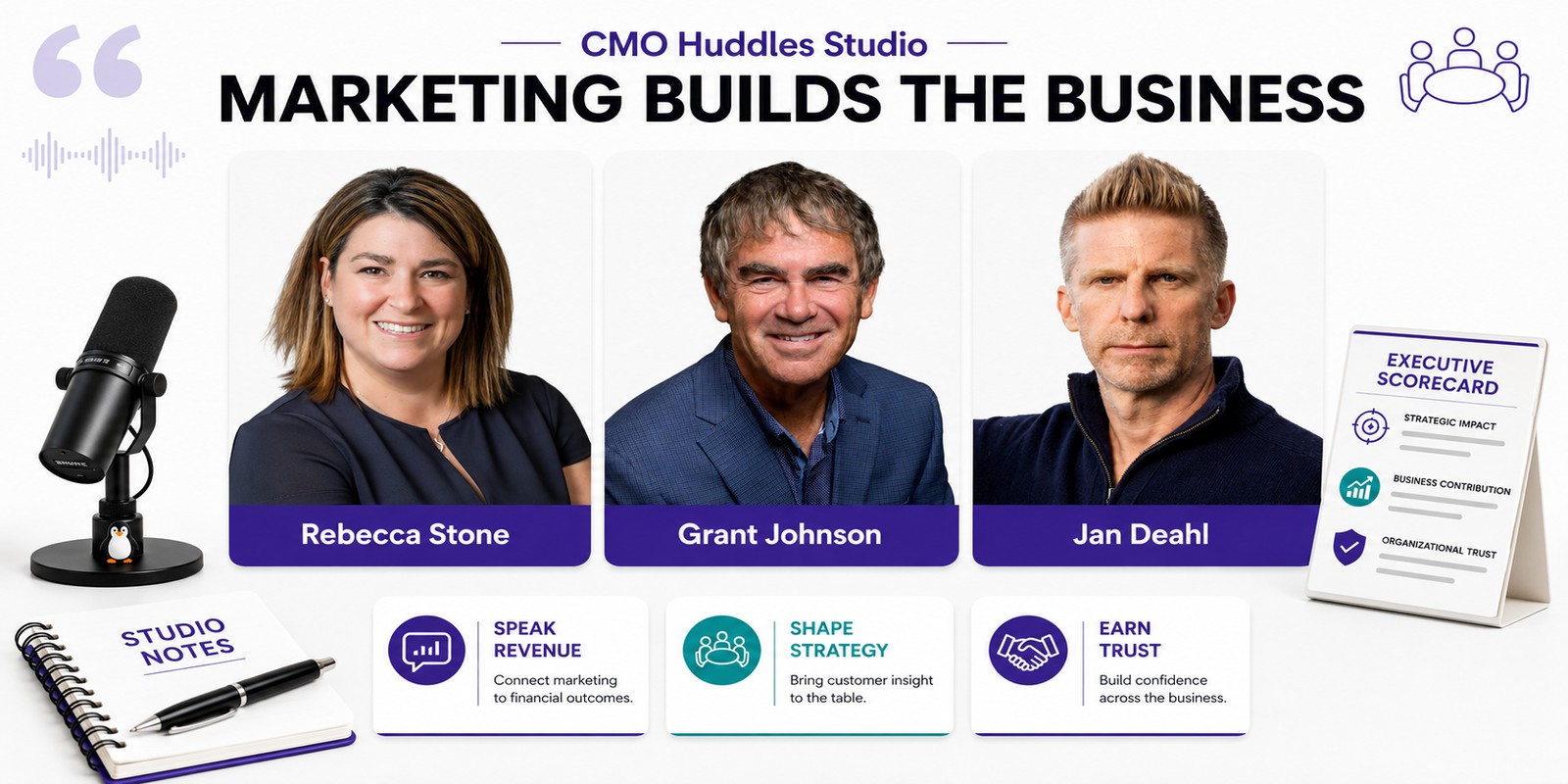
Marketing creates business value by shaping markets, strengthening differentiation, guiding buyers, improving conversion, and supporting durable growth. Rebecca Stone, Grant Johnson, and Jan Deahl explain how CEOs and CMOs can build a shared language around revenue, strategy, customer insight, and company outcomes so marketing operates as a business partner rather than an order-taking support function.
Marketing helps a company understand customers, choose markets, build differentiation, create demand, improve conversion, and protect future growth.
Yet CEOs and CMOs can enter the relationship with different assumptions about what marketing owns and how its contribution should be measured.
In this CMO Huddles Studio conversation, Rebecca Stone of Plume, Grant Johnson of Chief Outsiders, and Jan Deahl of Drake Star explore how a shared business language can close that gap.
The value of marketing can become difficult to defend when it is described only through activities or channel metrics.
Rebecca described how the conversation can become more relevant to the CEO:
“Take the time to speak about the marketing contribution to the business to your CEO in a way that they understand, which always comes down to revenue and dollars.”
That does not require claiming that every marketing activity creates immediate revenue. It means explaining the connection between the work and outcomes such as:
Time horizon matters. Some marketing activity supports the current quarter. Other work makes future quarters more productive.
A single presentation rarely resolves every disagreement about marketing.
Grant explained how credibility develops over time:
“It’s an ongoing conversation. You have to do it piece by piece like you’re building a case.”
The case becomes stronger when it combines leading indicators, financial outcomes, customer evidence, and clear explanations of how marketing and sales contributed together.
Regular conversations can also prevent the CEO-CMO relationship from becoming a quarterly defense of spending.
The CEO’s input is most valuable when it helps shape the business direction, priorities, and definition of success.
That can happen early through questions such as:
Once the strategic foundation is agreed upon, the CMO can manage execution without turning every creative choice into an executive debate.
Jan offered a direct description of the role:
“We’re not the pictures and colors department. We’re here to build the business with you.”
Building the business can include product positioning, market selection, customer insight, sales enablement, retention, brand strength, demand creation, and executive communication.
The scope depends on the company’s stage and needs. The essential point is that marketing participates in business decisions rather than waiting for requests.
Marketing can support market selection, positioning, customer insight, pricing power, sales productivity, retention, reputation, and future demand.
Connect marketing activity to business outcomes, explain the time horizon, and use financial and customer evidence.
A combination of recurring one-to-one conversations, quarterly business reviews, and timely strategic discussions can keep expectations current.
Useful questions include where the company is winning, which growth constraint matters most, what customers are signaling, and how the organization can support the strategy.
Listen to the full CEO and CMO conversation.
CMO Huddles helps B2B marketing leaders win by bringing together peers, fresh perspectives, and opportunities to build stronger personal brands. Want to join the huddle? Learn more about CMO Huddles and apply to join the community.