
Back to Blogs
Drew Neisser is the founder of CMO Huddles and a globally recognized authority on B2B marketing. He’s an AdAge columnist, LinkedIn TopVoice, leading CMO coach, podcast host & friend of penguins everywhere.
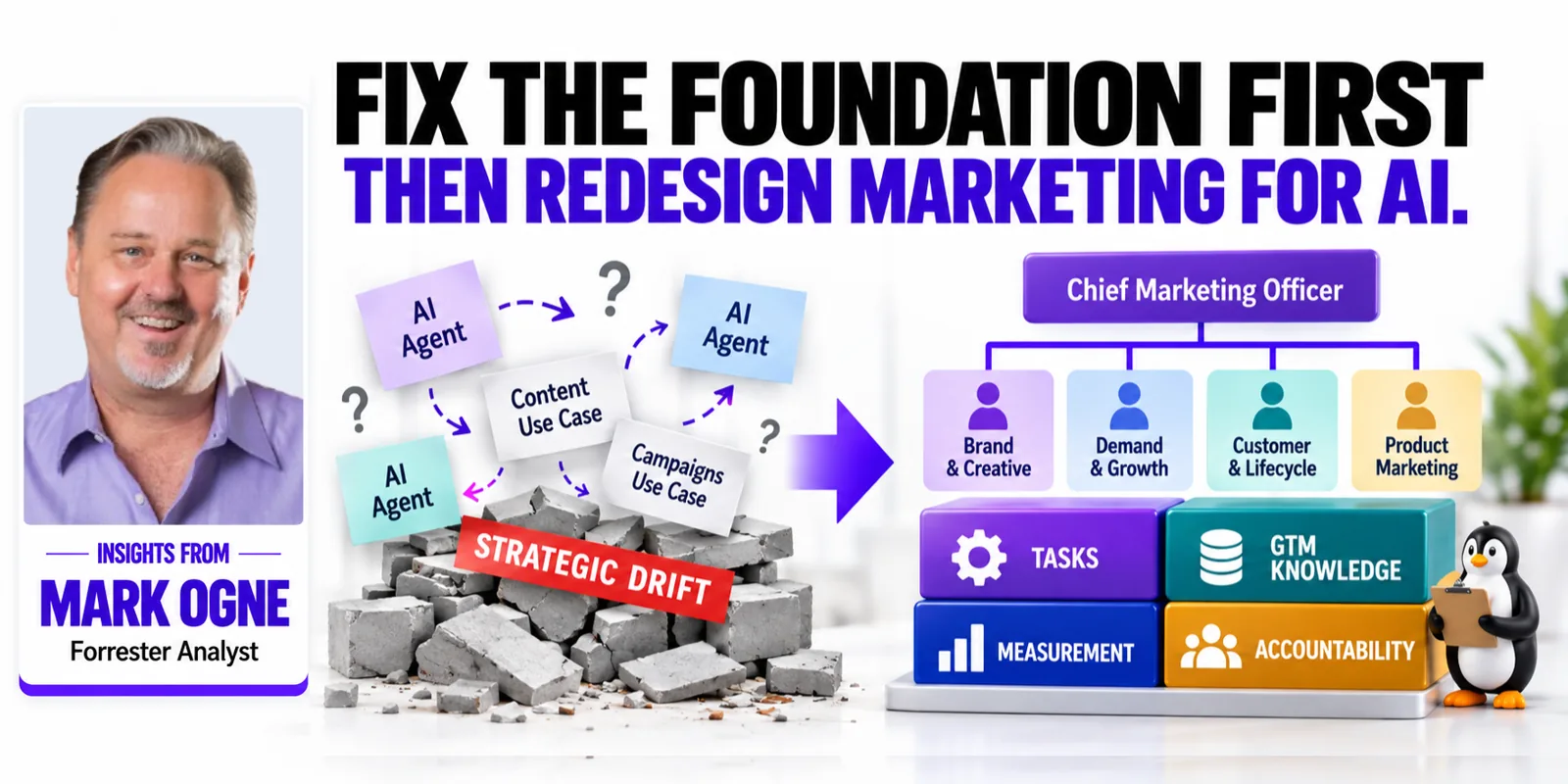
CMOs are being pushed to redesign marketing around AI before they understand the work, knowledge, economics, and risks involved. Forrester analyst Mark Ogne argues that org design must follow stronger foundations: task-level analysis, proprietary GTM knowledge, and clear measurement and accountability. Otherwise, AI can automate flawed assumptions, increase costs, and lock in strategic drift prematurely.
Pressure on CMOs comes from every direction. CEOs want an AI strategy. Boards want efficiency. Investors want more revenue per employee. Teams want clarity about their futures. Meanwhile, the org chart sits in the middle of the room looking like the obvious place to start.
Mark Ogne, Principal Analyst at Forrester, believes that is a mistake. “This is really a strategy and transformation challenge,” Mark told me. The organization may eventually change, but first CMOs need to understand the work, the knowledge required to perform it, the consequences of automating it, and the business outcomes the new operating model is supposed to improve.
That sequence matters because tactical decisions can quietly narrow future options. Mark calls this “strategic drift,” explaining that organizations are “making decisions on the fly” while collectively “closing down future decisions.” AI will change marketing organizations, but CMOs should design that change deliberately rather than allowing dozens of disconnected experiments to design it for them.
Mark compares this moment with the early adoption of marketing automation. Teams made individual decisions about scoring, routing, nurturing, and data structures. Each choice seemed reasonable in isolation, but together they embedded assumptions that became difficult and expensive to unwind.
AI can accelerate the same pattern. One team builds a content agent. Another automates prospecting. Marketing operations creates reporting workflows. Product marketing builds a messaging assistant. Everyone appears productive, but the agents may rely on different definitions, conflicting knowledge, disconnected systems, and incompatible measures of success.
The result is more automation without a coherent operating model. A useful prototype can be built in an afternoon, which creates the impression that the organizational decision behind it is equally simple. It rarely is.
An agent that drafts an internal summary presents limited risk. An agent that sends a customer-facing email, changes campaign spending, recommends a product claim, or influences hiring decisions carries much greater consequences. As Mark noted, “Because you can send the message doesn’t mean that you should. You can’t unsend the email. You’ve created that brand impression.”
Automating a bad assumption only gives it better distribution.
Before redesigning the organization around AI, CMOs need foundations strong enough to support automation without institutionalizing yesterday’s mistakes.
Mark’s first principle is that AI changes tasks before it replaces roles. “You do not replace—generally do not replace—roles,” he said. “You replace tasks within roles.” A marketing role may contain more than 100 recurring tasks, some highly structured and ripe for automation, others dependent on judgment, customer context, creativity, negotiation, or institutional memory.
This is why broad declarations such as “AI can replace 30% of the marketing team” are nearly useless. Thirty percent of which work? Performed by whom? With what inputs? At what quality level? Reviewed by whom? Connected to which business outcome?
Culture Amp offers a more disciplined example. As described in our article on how B2B CMOs are using AI to rebuild the marketing function, CMO Paige O’Neill’s team broke marketing into about 5,000 units of work and organized them into 36 scenarios. The exercise helped identify what should remain human-led, what could become AI-led, and where existing workflows duplicated work or broke down collaboration.
That analysis produced a hypothesis that roughly half of the marketing function could eventually be automated, but that didn't automatically mean half the people should disappear. If AI removes 70% of a role's production time, the remaining capacity could support better editorial judgment, stronger customer insight, more experimentation, or increased accountability for outcomes. The role may become more valuable even as many of its original tasks disappear.
Before changing roles, CMOs should map the recurring tasks, required inputs, decisions, approvals, current costs, cycle times, quality standards, consequences of failure, and moments where human judgment creates value. This creates evidence for responsible workflow and organizational redesign instead of executive guesswork wearing an AI nametag.
The second foundation is knowledge. Public AI models know a great deal about marketing in general, but they do not inherently understand your company’s audiences, capabilities, differentiation, buying signals, customer evidence, competitive assumptions, messaging, or go-to-market strategy.
In his Forrester article, “Private AI Will Beat Public AI for B2B Marketing Use Cases,” Mark argues that proprietary knowledge will become an enduring source of differentiation. Competitors can access similar models, tools, and prompts. They cannot easily replicate decades of accumulated customer understanding, commercial intelligence, decision-making experience, and institutional learning.
Thomson Reuters and Wolters Kluwer illustrate the larger opportunity. Their valuable knowledge existed long before generative AI, but AI made that knowledge easier to operationalize at scale. Every B2B marketing organization has its own version of that asset, although it is usually scattered across research reports, sales calls, win-loss interviews, campaign results, messaging documents, account plans, product expertise, customer conversations, and the heads of experienced employees.
Mark specializes in turning this material into canonical go-to-market knowledge that supports multiple applications. The aim is not merely to feed more documents into a chatbot. The organization needs a maintained source of truth that defines the relationships among audiences, capabilities, functionality, messaging, customer needs, and other strategic elements.
In one demonstration, structured knowledge generated challenge-and-value statements across five personas and 37 capabilities in approximately 35 seconds. The speed was impressive, but the reusable knowledge system was the bigger story. As Mark put it, “That’s a capability. That capability can support many use cases.”
A one-off digital twin, chatbot, or prompt library may create incremental value. A structured GTM knowledge system can improve sales preparation, content development, messaging consistency, competitive response, campaign planning, and market analysis. In his MarTech article on AI ROI, Mark makes the distinction clearly: broad LLM knowledge is generic, while a company’s GTM strategy is narrow and deep.
CMOs need to treat that proprietary knowledge as intellectual property: curated, maintained, versioned, governed, and deployed across workflows. If the company’s strategic knowledge remains scattered, its AI-enabled organization will simply scale inconsistency.
The third foundation is measurement. Many companies can show that employees are using AI, but far fewer can demonstrate bottom-line impact. Mark sees two paths to value: efficiency from process optimization and effectiveness from better insights, decisions, targeting, messaging, and customer experiences.
Efficiency measures include the cost and time removed from a complete workflow, error-rate reductions, fewer handoffs, and increased capacity without proportional hiring. Effectiveness measures include better conversion, stronger pipeline quality, faster responses to market signals, more relevant customer experiences, and more confident decisions. CEOs need both sides of the equation.
The baseline must come first. A CMO cannot credibly claim that AI improved a workflow without understanding its prior cost, speed, quality, and results. Otherwise, productivity anecdotes become a substitute for evidence.
Culture Amp’s experience provides another useful caveat. Mapping and automating work can create meaningful productivity gains, but scaled AI also introduces model-consumption costs, implementation expenses, governance requirements, and new operational roles. Paige has warned that, in the short term, the cost of scaled automation may outweigh the people cost.
An automation percentage is not an ROI calculation.
CMOs should measure the economics of the entire redesigned workflow, including technology, integration, data preparation, monitoring, human review, maintenance, and failure. They should also ask whether saved capacity creates growth, improves quality, or merely invites the organization to produce more material that nobody needs.
Accountability remains human throughout this process. Mark captured the principle perfectly: “You can give autonomy for something to be done, but you can’t give accountability for it.” An autonomous agent may complete the work, but a person must still own the outcome.
Organizations often express enormous AI ambition until the conversation turns to failure. Then their risk tolerance becomes considerably less adventurous. “Their aspiration is here, but the reality is there,” Mark observed.
This does not mean CMOs should lower their ambitions. It means matching each use case to the organization’s maturity and the consequences of getting it wrong. Leaders need to consider whether the output can be reviewed, whether an action can be reversed, whether the underlying knowledge is reliable, whether governance and monitoring exist, and whether a human is clearly accountable.
A low-risk internal research assistant may suit an organization early in its AI journey. Fully autonomous customer communication requires stronger knowledge, oversight, measurement, and escalation paths. “You could do the same kinds of use cases,” Mark explained, “but it requires much more maturity.”
Mature AI organizations are not necessarily slower or less ambitious. They have built the structures that allow them to move further without gambling the brand on every deployment.
The pressure to connect AI with headcount reduction is understandable. Marketing leaders are being asked to do more with less, and investors increasingly expect automation to increase revenue per employee. The danger comes when the headcount decision precedes the work analysis, knowledge infrastructure, and measurement model.
“If you’re being forced to make a decision on headcount in a situation where you don’t have the foundations to justify or rationalize it properly,” Mark warned, “there are a lot of stories that are painful.” You can't responsibly eliminate a role just because an AI tool performs several visible tasks. Leaders need to know which less-visible tasks remain, who will handle exceptions, how quality will be maintained, what new work the automation creates, and whether the economics hold at production scale.
AI may ultimately support smaller teams, merged functions, new orchestration roles, and a different balance between specialists and generalists. Those changes should follow evidence about how the work is changing.
Start with the tasks. Build the knowledge. Measure the system. Then redesign the organization.
Identify the growth, customer, cost, quality, or speed problem AI should help solve. Tool adoption and use-case counts can support the analysis, but neither qualifies as a strategic outcome.
Break priority workflows into inputs, actions, decisions, approvals, outputs, and accountability. Then determine what to automate, augment, eliminate, or redesign.
Locate the customer insights, strategic assumptions, messaging, proof points, competitive intelligence, and institutional expertise that public models cannot provide. Identify which knowledge is current, trustworthy, and reusable.
Organize proprietary knowledge into maintained structures that can support multiple workflows. Avoid rebuilding context independently for every agent or experiment.
Document current workflow costs, cycle times, quality measures, and business results before automation. After deployment, track both efficiency and effectiveness against those baselines.
Increase AI autonomy only when knowledge, governance, monitoring, reversibility, and human accountability match the consequences. Customer-facing and difficult-to-reverse actions deserve a higher bar.
Use task-level data and workflow results to determine which roles should evolve, merge, expand, or disappear. Don't make the org chart carry assumptions the operating model hasn't yet proven.
Mark will bring this perspective to the CMO Super Huddle in Palo Alto on Friday, October 23, 2026. His challenge to CMOs is timely: before deciding what the AI-ready marketing organization should look like, build the foundations that make responsible redesign possible.
The goal is to leave with more than another list of tools. CMOs need a clearer understanding of the work, knowledge, measurement, risk, and accountability required to become genuinely AI-empowered.
CMOs should first define the business outcomes, map priority work at the task level, organize proprietary GTM knowledge, establish performance baselines, and match autonomy to risk. Those foundations show where AI can create real value and provide evidence for later changes to roles, workflows, and organizational structure.
Most roles contain a mix of repeatable production work and judgment-intensive responsibilities. Task-level analysis reveals which activities can be automated, augmented, eliminated, or redesigned without assuming that an entire job should disappear. It also exposes the inputs, approvals, exceptions, and accountability that automation must preserve.
Proprietary GTM knowledge includes customer insights, buying signals, strategic assumptions, messaging, competitive intelligence, proof points, product expertise, and institutional learning that public AI models do not inherently possess. Structuring and maintaining this knowledge gives AI systems company-specific context and creates an advantage competitors cannot reproduce with the same tools or prompts.
Start with the workflow’s current cost, cycle time, quality, and business results. Then include technology, integration, data preparation, monitoring, maintenance, human review, and failure costs in the redesigned model. Headcount decisions should follow demonstrated improvements in efficiency and effectiveness rather than estimates of the percentage of work that could be automated.
A person remains accountable for the outcome. CMOs should assign clear ownership for the agent’s purpose, knowledge sources, permissions, quality standards, costs, monitoring, escalation, and retirement. Greater autonomy requires stronger governance, especially when an action is customer-facing, difficult to reverse, or capable of damaging the brand.