
Back to Blogs
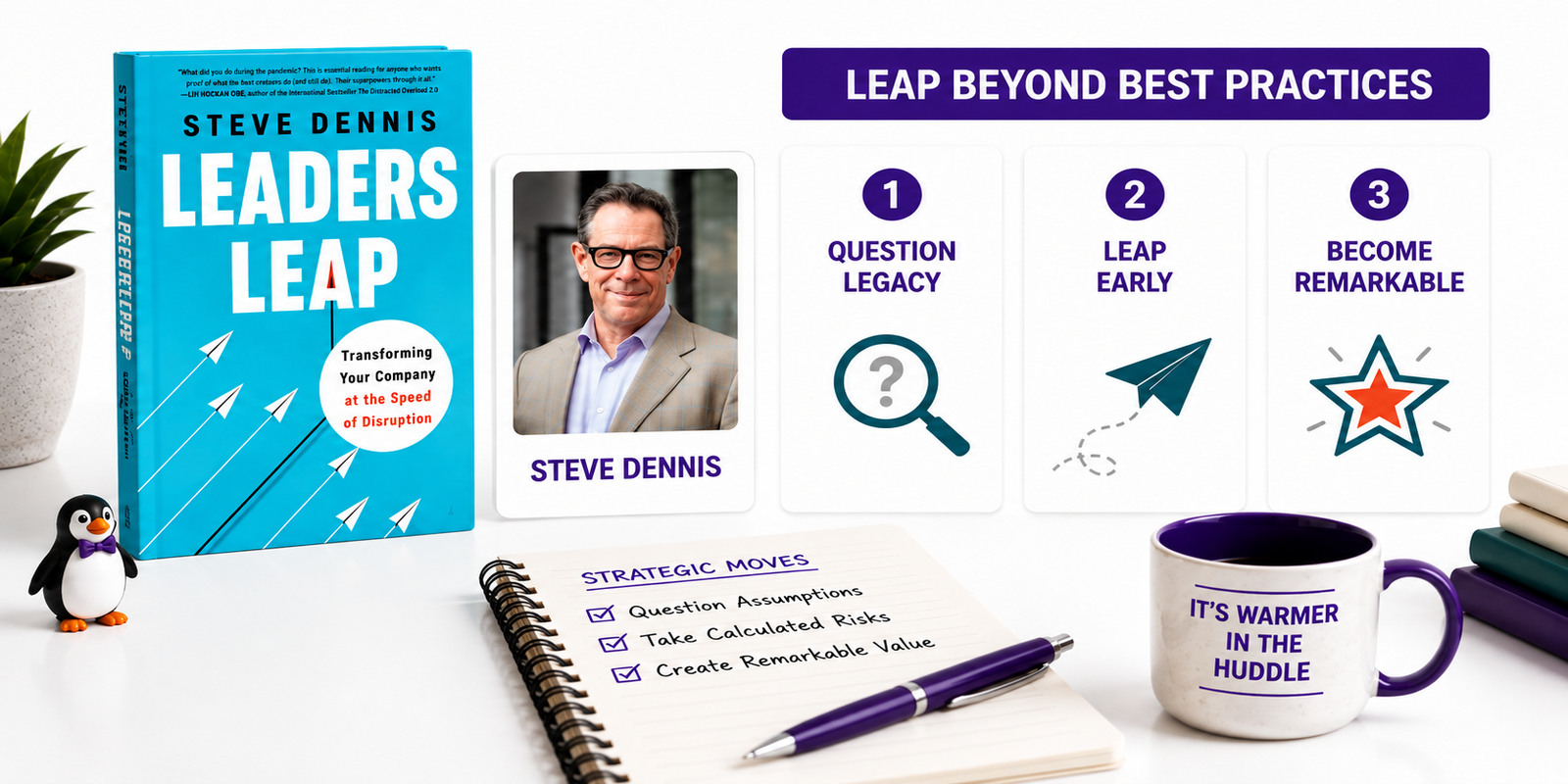
Best practices become liabilities when they preserve a model built for conditions that no longer exist. Leaders Leap author Steve Dennis explores how leaders can recognize disruption, pursue remarkability, learn through experimentation, and stop work that drains capacity. Transformation gains traction when customer evidence guides choices and yesterday’s success no longer controls tomorrow’s operating decisions.
Best practices are evidence that something worked under a particular set of conditions. They are less useful when customers, competitors, technologies, or buying behaviors have changed while the organization continues operating from an older model.
In a Book Huddle conversation about Leaders Leap, Steve Dennis, strategic advisor, author, and president of SageBerry Consulting, explored what makes meaningful transformation so difficult.
“If the world has changed so much, why have you changed so little?”
The gap between external change and internal response can remain hidden for years. Leaders may acknowledge disruption in presentations while continuing to fund the same programs, use the same measures, and protect the same operating assumptions.
For marketing leaders, that gap can appear in positioning that no longer distinguishes the company, campaigns built around outdated buyer behavior, or channel investments preserved mainly because they performed well before. Experience remains valuable, but its lessons need to be separated from the circumstances in which they were learned.
Established companies rarely lack expertise. The harder problem is determining which parts of that expertise still apply.
Steve captured the tension succinctly: “What got you here isn’t likely to get you where you need to go.” Previous success can create attachment to familiar capabilities, organizational structures, and definitions of performance. Those choices may continue to feel sensible because they once earned trust and produced growth.
A demand program that succeeded in a fast-growing category may weaken when buyers become more cautious. A positioning strategy that once sounded distinctive may become generic as competitors copy it. An operating model designed for a smaller company may slow decisions after the organization expands.
None of those changes automatically make the earlier approach wrong. They change the questions leadership needs to ask. Which strengths remain valuable? Which activities survive because they are familiar? Which assumptions have gone untested because challenging them would disrupt a comfortable system? This kind of diagnosis gives transformation a more useful starting point than a broad declaration that the company needs to innovate.
Steve raised the standard by which organizations might evaluate incremental improvement.
“A slightly better version of mediocre is not likely to be a winning strategy.”
Remarkability does not require theatrical branding or constant reinvention. It describes value distinctive enough for customers to notice, choose, and discuss. That distinction might come from the product, customer experience, expertise, service model, business model, or commitment to a narrowly defined audience.
Marketing can help reveal where the current offer feels interchangeable. Customer interviews, win-loss analysis, competitive research, search behavior, and sales conversations can expose needs the category has accepted without solving well.
The resulting promise also needs operational support. Communications can amplify a meaningful advantage, but they cannot sustain a distinction customers do not experience. When the message and the operating reality diverge, the market usually notices.
The conversation also turned to a term that appears throughout modern company strategies. “What I see a lot is people say they’re customer-centric, say their organization is customer-centric. And usually that’s a bunch of nonsense,” Steve said. The distinction becomes visible in the decisions an organization makes.
Customer centricity becomes visible in decisions. It influences which product problems receive investment, which friction points get addressed, how teams define success, and whether leaders will discontinue work customers no longer value.
Research alone does not establish customer focus. The findings need to affect priorities and tradeoffs. When internal convenience repeatedly wins over customer value, the stated commitment remains decorative.
Marketing leaders can contribute by connecting customer evidence to decisions beyond the marketing plan. That may include product priorities, service design, sales enablement, pricing, or the audience the company is best equipped to serve. The work becomes strategic when insight changes where the organization places its attention.
Transformation is often introduced as a coordinated journey with a clear destination. Most organizations, however, cannot know every step in advance. They need a way to move while continuing to learn.
“The companies that consistently innovate and are transforming for the future haven’t come up with some magical process. The most distinguishing characteristic is that they try more stuff, and they sort through it fast.”
A transformation portfolio can include improvements to current performance, tests responding to emerging customer needs, experiments with new experiences, and research into forces that may reshape the category. It can also identify work that the organization may stop.
This structure lowers the pressure to discover one perfect bet. Learning becomes an expected output. An early experiment can reveal an incorrect assumption, narrow the opportunity, or show that further investment is unwarranted.
Experiments still benefit from a strategic boundary. Each one can explore a meaningful customer or business question, with evidence determining what happens next. Random activity produces motion. A disciplined portfolio builds knowledge.
Marketing leaders still face quarterly targets, pipeline expectations, launches, and customer commitments while transformation is underway. Ignoring current performance in pursuit of an abstract future can destabilize the business.
Steve framed the other side of that balance plainly: “If you don’t aim higher and move faster, you’re actually falling behind.” Maintaining current performance protects the business today, but it cannot consume all the capacity needed to prepare for tomorrow.
A portfolio creates room for different kinds of work and different definitions of progress. A mature demand program can be evaluated against conversion and revenue goals. An early experiment may be judged by what the company learned and whether the evidence supports another round of investment.
Separate expectations protect emerging ideas from rejection because they do not have to perform like established programs. They also prevent experimental language from becoming cover for work that never generates useful evidence.
Resourcing matters here. Teams cannot sustain exploration when every person and dollar is already committed to immediate delivery. A small, protected allocation can be more productive than a large innovation mandate with no capacity behind it.
“This idea that winners never quit? That’s nonsense. Quitting is underrated. There are lots of things you should quit. It opens you up to do other stuff because capacity is limited.”
Stopping work can feel like admitting failure, especially when teams have invested heavily in it or built professional identities around it. Yet every legacy program occupies time, money, technology, and attention. Even an initiative with modest value can prevent a more promising idea from receiving meaningful support.
A more useful test considers whether the work supports the future the organization is trying to create. A program may still produce activity while contributing little to the company’s direction. Ending it can release capacity and signal that strategy has consequences.
Transformation becomes more credible when leaders identify what will change, what will remain, and what the organization is prepared to stop. Otherwise, every new priority simply lands on top of the old ones.
Past success can become a constraint when leaders continue relying on assumptions formed under different customer, competitive, or market conditions.
Remarkability means creating value distinctive enough that customers notice, choose, and discuss it.
Focused experiments help an organization test assumptions, gather evidence, and explore possibilities without placing the entire transformation on one unproven idea.
Ending outdated or low-value activity releases capacity for priorities that better reflect the company’s future.
Listen to the full conversation with Steve Dennis.
CMO Huddles helps B2B marketing leaders win by bringing together peers, fresh perspectives, and opportunities to build stronger personal brands. Want to join the huddle? Learn more about CMO Huddles and join CMO Huddles Starter.