
Back to Blogs
Drew Neisser is the founder of CMO Huddles and a globally recognized authority on B2B marketing. He’s an AdAge columnist, LinkedIn TopVoice, leading CMO coach, podcast host & friend of penguins everywhere.
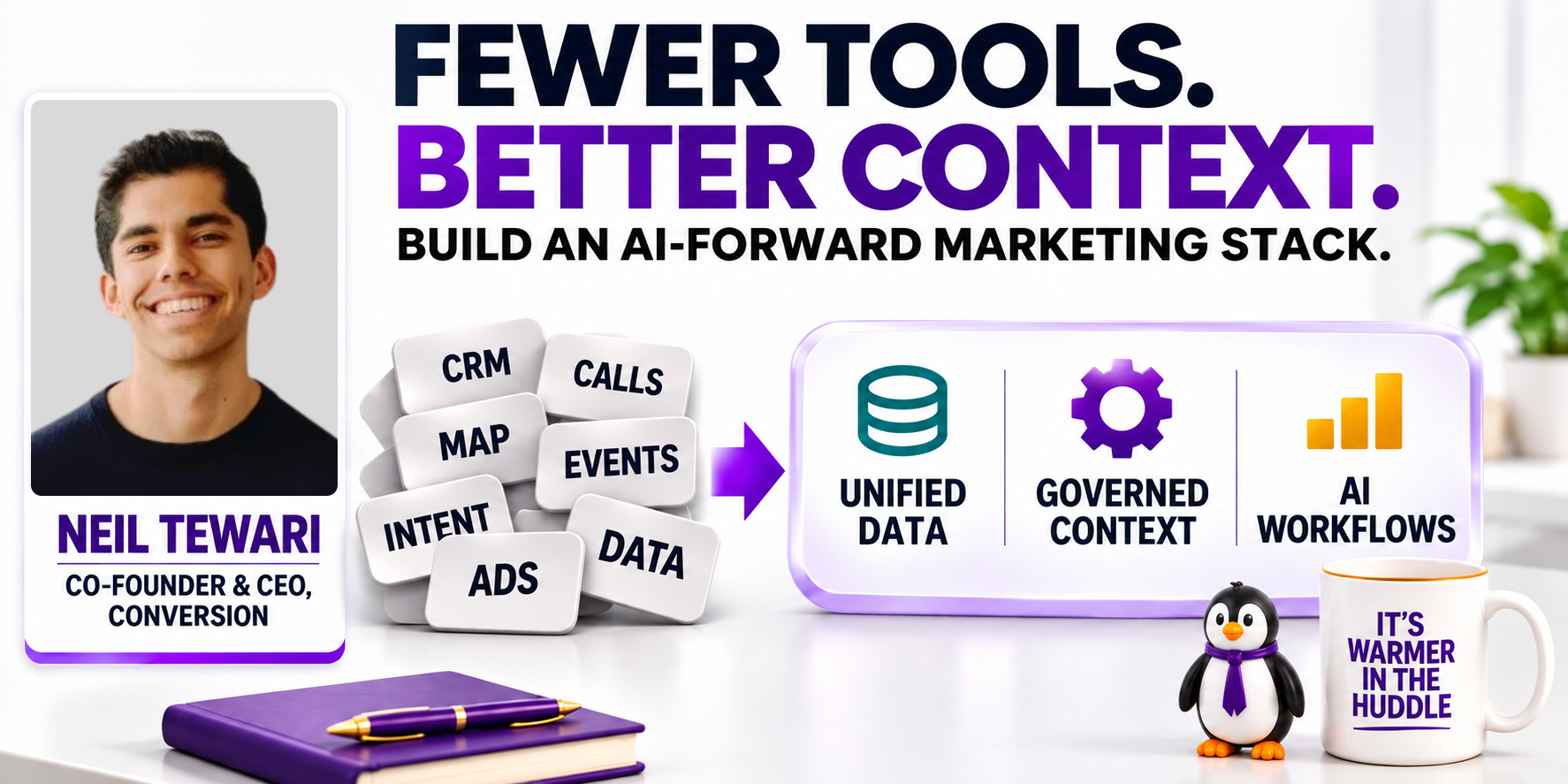
The rush to adopt AI is making many marketing stacks larger, costlier, and even more fragmented. Neil Tewari, co-founder and CEO of Conversion, argues that the most AI-forward marketing organizations are moving in the opposite direction: consolidating tools, establishing a trusted context layer, and giving AI governed access to the customer information required to do useful work.
His workshops at the CMO Super Huddle revealed how difficult that transition can be. CMOs described fragmented data, overlapping platforms, procurement constraints, unreliable CRM inputs, and the pressure to modernize the stack without disrupting pipeline. Their experiences point toward a practical path: start with the business outcome, define the context AI needs, eliminate redundant tools, and decide carefully where to build, buy, or wait.
The promise attached to every new AI marketing tool is remarkably consistent. Add this platform, deploy these agents, and your team will move faster, personalize more effectively, and generate better results with fewer resources.
Then reality arrives carrying another integration request.
“AI becomes another silo,” Neil Tewari told CMOs during his workshops at the CMO Super Huddle. Teams buy an AI tool, struggle to connect it with the information required to perform, and then discover that only a handful of employees are using it. The platform underperforms, leadership questions the ROI, and marketing returns to the same overloaded stack with one more invoice.
Adding AI to a fragmented stack can produce faster, more expensive silos.
Neil’s counterintuitive observation is that the most AI-forward organizations he encounters often have fewer tools. “The most AI-forward teams have by far the fewest tools in their GTM stack,” he said, contrasting those organizations with similarly sized companies managing dozens of overlapping applications.
The difference is not simply lower software spending. Fewer tools make it easier to establish a trusted source of context, develop internal expertise, connect workflows, govern access, and understand what is producing value.
Traditional marketing automation could function with a relatively limited view of the customer. An email platform needed a contact record, selected fields, a list, and instructions about what to send.
AI agents are being asked to do far more. A useful agent may need to understand account history, buying-group activity, product usage, sales conversations, webinar participation, support interactions, competitive interests, and previous marketing engagement. Without that context, the agent may produce fluent work that is irrelevant, contradictory, or simply embarrassing.
Neil explained that organizations need “a place where I can query” the available customer information and trust the answer. That trusted context layer could be centered in a data warehouse, CRM, marketing automation platform, or a governed internal architecture. The exact technology matters less than giving approved workflows a consistent view of the information required to make good decisions.
One CMO described having reasonably clean customer-success data but limited ability to combine it with sales and marketing information. The organization could see valuable signals inside individual systems, yet asking a basic cross-functional question still required manual work, restricted access, and several teams.
Another CMO summarized the problem more bluntly: “I don’t have a single view.” Their team had assembled an assortment of CRM, prospecting, intent, automation, and analytics tools while still depending on outside technical help to keep the connections functioning.
A stack can contain all the right data and still prevent the organization from using it.
Neil has noticed another difference among more advanced organizations: senior marketing leaders are directly involved in the architecture. A few years ago, he rarely encountered a CMO during early platform discussions. Today, CMOs are joining discovery calls, questioning data models, evaluating integrations, and helping determine which tools should remain.
This does not mean every CMO needs to become an engineer. It does mean that AI architecture now influences customer experience, operating costs, organizational design, campaign velocity, and pipeline. Those decisions are too consequential to delegate entirely.
One enterprise CMO described how difficult this becomes inside a highly matrixed company. Data ownership may sit with one group, platforms with another, security with IT, and purchasing authority with procurement. “I can have a strategy or an idea,” the CMO explained, “but working through the organization and winning over hearts and minds is the challenge.”
The technical architecture is only half the project. The other half is organizational permission.
For CMOs, the job is to connect the architecture to a compelling business outcome. Consolidation cannot become an IT cleanup exercise that consumes a year while marketing misses the number. The CMO needs to explain which customer or revenue problem the new model solves, what will improve, and how the organization will manage the transition.
Before auditing platforms, define what the improved system must make possible. Possible outcomes include:
One CMO from a complex organization described a large cross-sell opportunity that remained difficult to pursue because customer information was divided across business units and systems. The growth opportunity was obvious. The architecture required to activate it was not.
That example points toward the right sequence. Start with the commercial opportunity, identify the information and workflow required to capture it, and then evaluate the stack. Otherwise, the audit becomes a feature-comparison contest in which every platform appears to be indispensable.
Once the business outcome is clear, map the complete workflow and its information requirements. If the goal is account expansion, for example, the workflow might need:
This exercise frequently reveals that the problem is larger than marketing automation. The customer story may be divided among CRM, warehouse, customer-success, product, finance, event, and conversation-intelligence platforms.
One CMO described building an internal customer view because the existing systems did not communicate effectively and extending licenses to every user would have been prohibitively expensive. The solution worked because the company treated it as a formal initiative rather than a side project.
“If you build it, you have to work it like a client project,” another workshop participant noted. That means assigning a project manager, establishing change-management responsibility, funding maintenance, and defining who owns the system after launch.
A weekend prototype can demonstrate possibility. It cannot serve as an enterprise operating model indefinitely.
Neil often used the phrase “source of truth,” although the workshop discussions revealed why that phrase can be slippery. The CRM may own sales records, the warehouse may hold historical behavioral data, and a customer-success platform may contain the cleanest view of product adoption.
The goal does not have to be forcing every piece of data into one monolithic platform. It is creating a governed context layer through which approved people, workflows, and agents can retrieve consistent information.
CMOs should be able to answer:
Trust also extends to the vendors touching the data. One CMO raised a concern that deserves more attention: What happens if a promising AI company is acquired by an organization you would not have selected as a data partner?
The stack architecture needs to account for ownership changes, permissions, portability, security, and exit options. Convenience today cannot become captivity tomorrow.
With the desired outcome and context layer defined, CMOs can evaluate the existing stack more objectively. For each platform, document:
Several CMOs in the workshops were already removing technology. Some wanted to reduce cost, while others were responding to the administrative burden of maintaining many specialized platforms.
One marketing leader described a team that had become substantially smaller over time. The old stack assumed dedicated specialists and individual platform owners, a staffing model the organization could no longer support. “I can’t have 10 or 15 tools that each require someone to own and manage them,” the CMO explained.
That is the hidden cost of tool sprawl. Every platform brings training, administration, integration, governance, data-quality, and continuity requirements. License cost is merely the most visible line.
The workshops did not produce a universal answer about whether CMOs should build or buy. They exposed the factors that make the decision different for every organization.
Building may be appropriate when the capability is highly specific, proprietary data creates a meaningful advantage, or existing platforms cannot support the workflow. Buying may be smarter when speed matters, the problem is broadly shared, maintenance would become a distraction, or a vendor can deliver the required governance and integrations more effectively.
One CMO offered a refreshingly candid warning: “We are not good at building.” The organization might create a working application, but supporting, securing, and improving it would introduce responsibilities the team was not equipped to sustain.
Another leader noted that building only works when the initiative is staffed and governed like a customer-facing project. Employees cannot be expected to maintain critical infrastructure whenever they happen to have free time.
Industry, ownership structure, company size, regulatory obligations, internal engineering capacity, and urgency all influence the answer. The CMOs in Neil’s workshops were appropriately skeptical of simplistic rules.
A tailored internal system can fit the business perfectly. A commercial platform can evolve faster than the internal roadmap. Either choice can become expensive when leaders ignore maintenance, migration, integration, and change management.
Perhaps the most difficult issue came from a CMO who asked how to rebuild the engine while continuing to deliver pipeline. Replacing architecture at a large company is a major undertaking, and the ROI may take time to appear.
That argues for a staged approach:
This approach avoids the fantasy of a clean-sheet transformation while reducing the risk of endlessly adding tools around a broken core.
The stack does not need to become perfect before it becomes simpler.
Neil’s vision is a marketing system in which agents can use governed customer context to build audiences, draft campaigns, personalize messages, route leads, conduct quality checks, and help marketers understand performance. Humans continue to approve consequential decisions and own the business outcome.
The architecture supporting that vision is likely to include fewer platforms with broader responsibilities. The remaining tools need strong integrations, accessible data models, appropriate permissions, and enough flexibility to support new workflows as AI capabilities evolve.
That model asks more of the CMO. Leaders need to understand the customer data, participate in architecture decisions, manage change across functions, evaluate build-versus-buy tradeoffs, and connect consolidation to growth.
It also promises something better than another AI feature layered onto yesterday’s stack: a marketing system that can move faster because it finally understands what it is working with.
Conversion was a Founding Sponsor of the 2026 CMO Super Huddle, where Neil led the workshops informing this article. That relationship gave our community access to Neil’s perspective and candid discussions among the CMOs in attendance.
CMO Huddles members should evaluate Conversion independently against their organization’s requirements. For members currently considering replacing Marketo, Pardot, Eloqua, or HubSpot Marketing Hub, Conversion has created a limited Huddle Fund offer.
For the first 20 qualifying CMO Huddles members who execute an agreement by December 31, 2026, Conversion may apply up to $250,000 of verified remaining contract value as a credit against first-year Conversion fees. Eligible contract value can include the legacy marketing automation platform and certain additional tools Conversion replaces, such as reverse ETL, engagement, scoring, or forms platforms.
The credit is not a cash payment, cannot exceed the first-year Conversion agreement, and is confirmed through Conversion’s standard evaluation and contract-verification process. Booking an evaluation does not reserve one of the 20 available slots.
CMO Huddles members can review the complete eligibility requirements, terms, credit estimator, and scheduling information at Conversion’s Huddle Fund page.
AI agents need reliable context across customer, sales, product, and engagement data. Fewer, better-integrated platforms can reduce data fragmentation, duplicated capabilities, administration, and governance problems.
A trusted context layer gives approved people and AI workflows consistent access to the data required for a task. It may connect multiple systems rather than replacing them with a single database, but ownership, permissions, quality, and reconciliation rules must be clear.
Start with a measurable business outcome and map the complete workflow supporting it. Then identify the data and tools required, duplicated capabilities, unused platforms, integration costs, and systems that no longer justify their operational burden.
Build when the workflow is sufficiently distinctive, proprietary context creates an advantage, and the organization can fund ongoing maintenance and governance. Buy when a vendor can solve a common problem faster and more reliably than the company can sustain internally.
Use a staged workflow approach. Improve one valuable process, establish a baseline, test the new architecture, and retire redundant platforms only after the replacement has demonstrated reliability and business value.