
Back to Blogs
Drew Neisser is the founder of CMO Huddles and a globally recognized authority on B2B marketing. He’s an AdAge columnist, LinkedIn TopVoice, leading CMO coach, podcast host & friend of penguins everywhere.
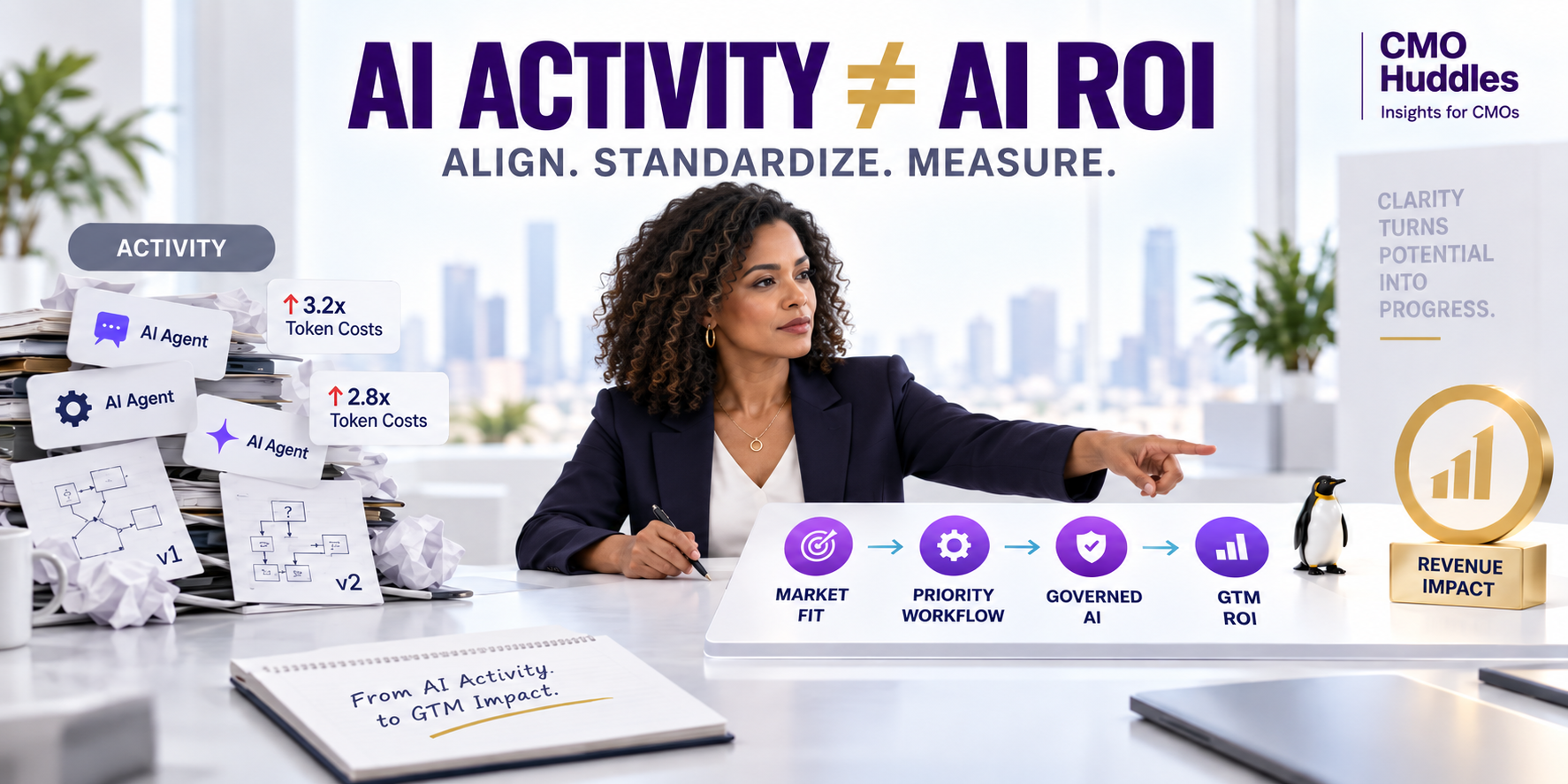
Many B2B companies are investing in AI without producing meaningful go-to-market returns. Insights from Michelle Killebrew and Amanda Kahlow suggest why: leaders are optimizing outdated work, encouraging duplicated experimentation, and ignoring full operating costs. CMOs need stronger market alignment, executive priorities, standardized workflows, governance, and measurement tied directly to business outcomes before scaling further ahead.
On the same afternoon, I had back-to-back conversations with two brilliant women who spend their days helping companies turn AI possibilities into business realities. The first was Michelle Killebrew, Founder and Chief Go-to-Market Strategist at Pegasus Strategy Co., whom I have known and admired for years. The second was Amanda Kahlow, Founder and CEO of 1mind and previously Founder and CEO of 6sense.
Both are AI optimists who see enormous opportunities ahead. Neither believes handing every employee a chatbot and shouting “innovate” constitutes a transformation strategy. Quite an afternoon.
Their observations helped explain a question many CMOs are struggling to answer: Why is all this AI activity producing so little measurable go-to-market return? Many organizations are optimizing work before confirming that it is the right work, allowing disconnected experiments without deciding which workflows matter most, and calculating productivity gains without accounting for the maintenance, governance, token consumption, quality assurance, and organizational change required to sustain them.
AI keeps getting more capable. The management surrounding it needs to catch up.
Michelle’s sharpest observation was that companies have become so focused on AI efficiency that they are neglecting one of marketing’s most fundamental responsibilities: matching the offering to the market. “Everybody’s so focused on AI efficiency that nobody’s actually looking at their offerings and audience alignment,” she said. “Does your solution still work? Everybody’s needs have changed.”
That question should stop a few leadership meetings in their tracks. A company can use AI to produce campaigns faster, generate content more cheaply, automate sales follow-up, and deploy agents across the funnel, but none of those efficiencies matter much if the buyer’s priorities have changed or the company’s offering no longer solves an urgent problem.
Michelle framed the strategic choice clearly when she asked, “Do you need to evolve your offerings for your current client, or do you need to evolve your audience to your current offering?” Product marketing has rarely sounded so urgent.
AI can accelerate an aligned go-to-market strategy. It can also help an outdated offering reach the wrong audience with unprecedented efficiency, an outcome that may look impressive on a productivity dashboard right up until someone asks about revenue.
Speed is helpful once you know where you are going.
When I asked Michelle whether she was seeing significant ROI wins from clients’ AI implementations, her answer was immediate: “No. Not yet.” She sees companies building agents, connecting systems, and experimenting across sales and marketing, but much of that activity remains fragmented and has not been incorporated into a coherent operating model.
During the first rush of adoption, functional leaders were often given broad AI mandates and left to figure out the details themselves. As Michelle observed, “You’re not going to try and figure it out across functions if you don’t have your own house in order.” Rather than creating enterprise transformation, those separate mandates sometimes deepened existing silos.
The measurement foundations were shaky too. Companies launched experiments without baselines, complete cost models, or a clear definition of the business outcome. They could point to hours saved or assets created but struggled to explain whether pipeline improved, revenue accelerated, customers stayed longer, or operating leverage increased.
AI activity is easy to find. AI impact takes considerably more work.
Amanda approached the same problem from an organizational-management perspective. She supports broad AI literacy, saying, “We need to teach all of our employees at every level how to embrace AI.” But she does not believe individual contributors should carry responsibility for independently finding the productivity and growth gains the board expects.
“What we’re getting wrong is we’re expecting our employees to have the efficiency and growth gains and have the impact from AI that the board is demanding,” Amanda said. In her view, “The imperative is on the C level. It’s not on our ICs.”
Amanda described a public company that trained its workforce to build agents and reportedly emerged with 15,000 of them. She estimated that 80% had significant overlap and asked, “How much wasted time across that company to build all of those duplicative agents?”
The story captures the risk of confusing democratization with orchestration. Giving employees freedom to experiment can generate useful discoveries, but asking thousands of people to independently reinvent recurring work can also produce duplicated agents, inconsistent answers, untracked costs, and an impressive collection of systems that somebody will eventually need to maintain.
Amanda believes leadership should identify the most efficient approach and make it reusable across the organization. As she put it, “There’s gotta be one of them that is the most efficient right way to do it and everybody should be doing that.”
Without that discipline, the hackathon becomes the operating model.
Amanda offered a practical vision for executive-led AI enablement. Leadership should identify recurring workflows and prescribe the best available process instead of expecting each employee to assemble a personal collection of prompts, tools, and agents.
“This is the right tool, this is the right process to get A, B, and C done in your day,” Amanda explained. She extended the idea to the rhythm of customer-facing work: “This is how you create your prep docs for the meetings. This is how you go into a call. This is how you look at your coaching afterwards.”
That level of specificity turns AI from an interesting employee benefit into an organizational capability. It creates a shared workflow that can be measured, improved, secured, and taught to new employees.
Marketing leaders have managed this transition before. Companies did not scale CRM by telling every seller to design a personal customer database. They selected a system, established processes, defined the required fields, trained the team, and assigned owners.
Execution was rarely flawless, as anyone who has inspected a CRM recently can confirm. At least the organization had a common architecture, and AI-enabled work needs the same discipline despite the added challenge of models, costs, and capabilities that keep changing.
Amanda also identified an AI use case that deserves more attention: keeping customer-facing teams current as products change. “Nobody’s brain has the capacity to keep up with the pace of our product innovation today,” she said.
Software companies no longer release exclusively on quarterly or even monthly schedules. As Amanda explained, “It’s on a weekly, daily cycle that there’s new features humans can’t keep up.” Even founders, product leaders, sales engineers, and customer-success teams can struggle to absorb every change and translate it accurately for buyers.
Amanda experiences the problem herself. “I can’t even keep up,” she admitted. “On the weekends I just try to keep up. I can’t do it unless I have my superhuman along on calls with me to keep me up to speed.”
A well-designed AI system can connect to product documentation, release information, and the product experience itself. It can then answer detailed questions, support live demonstrations, and explain new capabilities while they are still new. As Amanda put it, “AI can focus on understanding the features, understanding the depth and talking to that next level of detail that buyers are looking for.”
That creates a more meaningful return than merely producing additional marketing assets. The AI system closes the gap between product innovation and the organization’s ability to explain, sell, support, and monetize it.
Michelle raised another issue that rarely makes it into breathless AI presentations: agents require maintenance. A model update can change how an agent behaves, data sources drift, instructions become outdated, and costs rise as usage increases. When the employee who built the workflow changes jobs, Agent #14 can become an archaeological artifact with access to customer information.
Michelle referenced SaaStr’s public discussion of deploying AI agents in marketing and customer service. The team was transparent about the upside and operational burden, including the need to monitor drift, perform quality assurance, and manage cybersecurity. “You have to manage drift,” Michelle said. “It’s not a set it and forget it.”
The people responsible for those systems effectively become part-time developers, QA managers, and governance officers, often while retaining their original jobs. Before declaring an AI efficiency win, CMOs need to include model fees, token usage, integration work, engineering support, monitoring, maintenance, security, human review, and the opportunity cost of employees managing the system.
I learned the cost lesson personally after building eight agents that consumed the available tokens across six accounts in a single day. Seven were pleasant conveniences rather than mission-critical workflows, so I turned them off and made the remaining system economically tolerable again.
The experiment worked. So did the electric chair.
A fuller cost analysis may still reveal a compelling return. At least it will be a return that the CFO recognizes.
The ease of building agents has encouraged some organizations to treat custom development like weekend home improvement. As Michelle and I discussed, building an agent can feel deceptively simple, while building a dependable AI-enabled operating system resembles building a house.
You need an architect, foundations, and specialists who understand plumbing, electricity, structural integrity, and the local equivalent of AI building codes. Handing everyone a hammer does not create a neighborhood.
Michelle sees companies reconsidering where buying a managed solution makes more sense than building internally. Customization can be valuable, but organizations need to weigh that benefit against maintenance, reliability, governance, and the availability of in-house expertise.
This is part of the work Pegasus Strategy Co. is helping clients navigate. Michelle and her team begin with diagnostics, then help companies transform revenue and go-to-market functions across marketing, sales, technology, and implementation. That cross-functional view matters because AI transformation cannot succeed inside a marketing silo while sales, service, finance, and IT follow different operating assumptions.
Amanda repeatedly returned to one especially useful phrase: “Where there’s no business model for a human.” Her example involves early sales conversations, where a strong sales engineer could materially improve a technical buyer experience but assigning an expensive sales engineer to every first call would be economically unrealistic.
As Amanda noted, putting a sales engineer on an AE’s first call “doesn’t happen.” They usually join later, after the opportunity has earned the investment. A GTM superhuman capable of answering technical questions, tailoring the conversation, demonstrating the product, taking notes, and handling objections could bring sales-engineer-level support to interactions that would otherwise never receive it.
Amanda summarized the opportunity simply: “Put a sales engineer on every single SDR call.” For commercial and SMB prospects, she sees a similar gap between self-service product-led growth and a fully human sales process. “The product isn’t mature enough to be able to support that downmarket motion, but you can’t have a human because it’s too expensive,” she explained.
A superhuman could create a third option: a rich, two-way, tailored conversation without the staffing economics of a human seller. “Something like a superhuman can come in and play the commercial closer, the SMB closer,” Amanda said.
That is a stronger AI use case than shaving three minutes off a routine email. It introduces a valuable capability where staffing it with humans would be financially impossible. If the result is better qualification, higher conversion, faster progression, or larger deal values, the business case becomes measurable.
Amanda expects go-to-market jobs to change substantially. “Jobs are gonna fundamentally change,” she said, predicting that many roles as currently defined will be mostly gone within the next 12 to 24 months. She also believes AI will ultimately create more jobs, even as component tasks and traditional handoffs disappear.
She was especially direct about BDR and SDR work, while seeing an opportunity for sales engineers to move toward more complex deal strategy, RFPs, security responses, and the expertise required to guide AI systems. Humans may increasingly provide “full life cycle support,” from first contact through close, cross-sell, upsell, and account management.
That does not mean sidelining the seller. Amanda said 1mind’s goal is to make the salesperson “the hero” by allowing the superhuman to handle factual and technical depth while the person focuses on relationships, context, judgment, and “the craft of selling.”
She described the experience with a touch of delight: “I’m just sipping my coffee as Nigel, our superhuman, is doing his job.” The seller can listen, connect ideas, read the buyer, and guide the conversation while the AI supports the details.
For Amanda, the result ultimately comes down to trust. “We’re building trust between the buyer and the seller,” she said. That is a useful reminder for CMOs: efficiency may fund the business case, but a better human experience should justify it.
One conclusion I shared with Amanda is that AI is not a strategy. AI is a means to an end.
The end might be improving win rates, reducing acquisition costs, accelerating pipeline, increasing retention, creating a better buying experience, or scaling revenue without proportional headcount. Once the objective is clear, leadership can determine whether AI is the right lever, which workflow should change, where humans remain accountable, and what success will look like.
Amanda agreed on the need for governance, especially as more powerful and expensive capabilities become available. “There is gonna be some amazing things that we can do, but we need to put controls on this,” she said.
Those controls should cover data access, approved tools, human review, cost thresholds, ownership, quality standards, maintenance, and retirement criteria. They should also make room for structured experimentation because today’s best process will not remain the best process forever.
Governance should help the company scale what works instead of merely producing a longer list of forbidden activities.
Start with Michelle’s question: Do current buyers still need what the company is selling? Review changing buyer priorities, lost deals, customer conversations, product usage, competitive movement, and the company’s value proposition. Decide whether the offering needs to evolve, the target audience needs to change, or both.
Ask the leadership team to select a small number of outcomes that AI should improve. Pipeline velocity, win rate, retention, cost per opportunity, customer satisfaction, and revenue per employee are legitimate candidates. “Use more AI” is an instruction in search of a strategy.
Map the recurring work behind each outcome and identify where delays, manual effort, inconsistent quality, unavailable expertise, or broken handoffs constrain performance. The strongest use cases will often extend across functions, which is why executive sponsorship matters.
Allow teams to experiment, then compare the results and select the strongest approach. Document the workflow, approved tool, data sources, owner, human-review points, cost expectations, and measurement plan. Give employees a reliable path instead of requiring every person to become an amateur AI architect.
Measure labor savings and productivity, but include model consumption, integrations, engineering, maintenance, governance, security, and quality assurance. Compare those costs with the financial value of the business outcome rather than simply counting the number of tasks completed.
Use AI to expand capacity, provide capabilities that could not be staffed economically, and remove tedious work. Keep people responsible for strategy, empathy, high-stakes decisions, customer trust, exception handling, and determining whether the system is producing the right outcome.
CMOs who want a clearer view of their current readiness can use the free CMO Huddles AI Maturity Calculator, developed with Benchmarkit. It assesses strategy and leadership, workflow operationalization, talent and change readiness, governance and investment discipline, and measurement and business impact.
The goal is to discover where enthusiasm has run ahead of the operating model. For companies that need help aligning marketing, sales, technology, and revenue strategy before scaling AI, Pegasus Strategy Co. offers a diagnostic-first approach that is especially relevant when leaders suspect they may be accelerating before confirming that their offering, audience, and workflows still fit.
Qualified B2B marketing leaders can also meet Amanda Kahlow and learn from her directly at the CMO Super Huddle, October 22–23, 2026, in Palo Alto. In the interest of transparency, 1mind is a Founding Sponsor of the event. I was already a huge fan of Amanda and Mindy, 1mind’s GTM Superhuman, before the sponsorship, and repeated exposure has done nothing to reduce my enthusiasm.
AI may be a means to an end. Leadership determines whether anyone reaches it.
Many initiatives began without baselines, complete cost models, defined owners, or a business metric they were expected to improve. Companies can often quantify hours saved or content produced but cannot connect those gains to revenue, customer experience, or sustainable operating leverage.
Both approaches have a role. Employees should experiment and surface promising ideas, while executives establish business priorities, approved tools, shared workflows, governance, and investment criteria. Bottom-up discovery becomes more valuable when the organization has a method for selecting and scaling what works.
Maintain an inventory of agents and AI-enabled workflows with a named owner, purpose, users, data sources, operating costs, maintenance requirements, and performance metrics. Review the inventory regularly and consolidate systems that perform similar jobs.
Start with an important business outcome and identify the workflow constraining it. Favor use cases that remove a meaningful bottleneck, improve a measurable customer or revenue outcome, or provide a valuable capability that would be uneconomical to staff with people.
Include software and model fees, token consumption, integrations, engineering, data preparation, security, human review, training, maintenance, monitoring, and the time employees spend managing the system. Compare the total with measurable financial gains or avoided costs over a defined period.