
Back to Blogs
Drew Neisser is the founder of CMO Huddles and a globally recognized authority on B2B marketing. He’s an AdAge columnist, LinkedIn TopVoice, leading CMO coach, podcast host & friend of penguins everywhere.
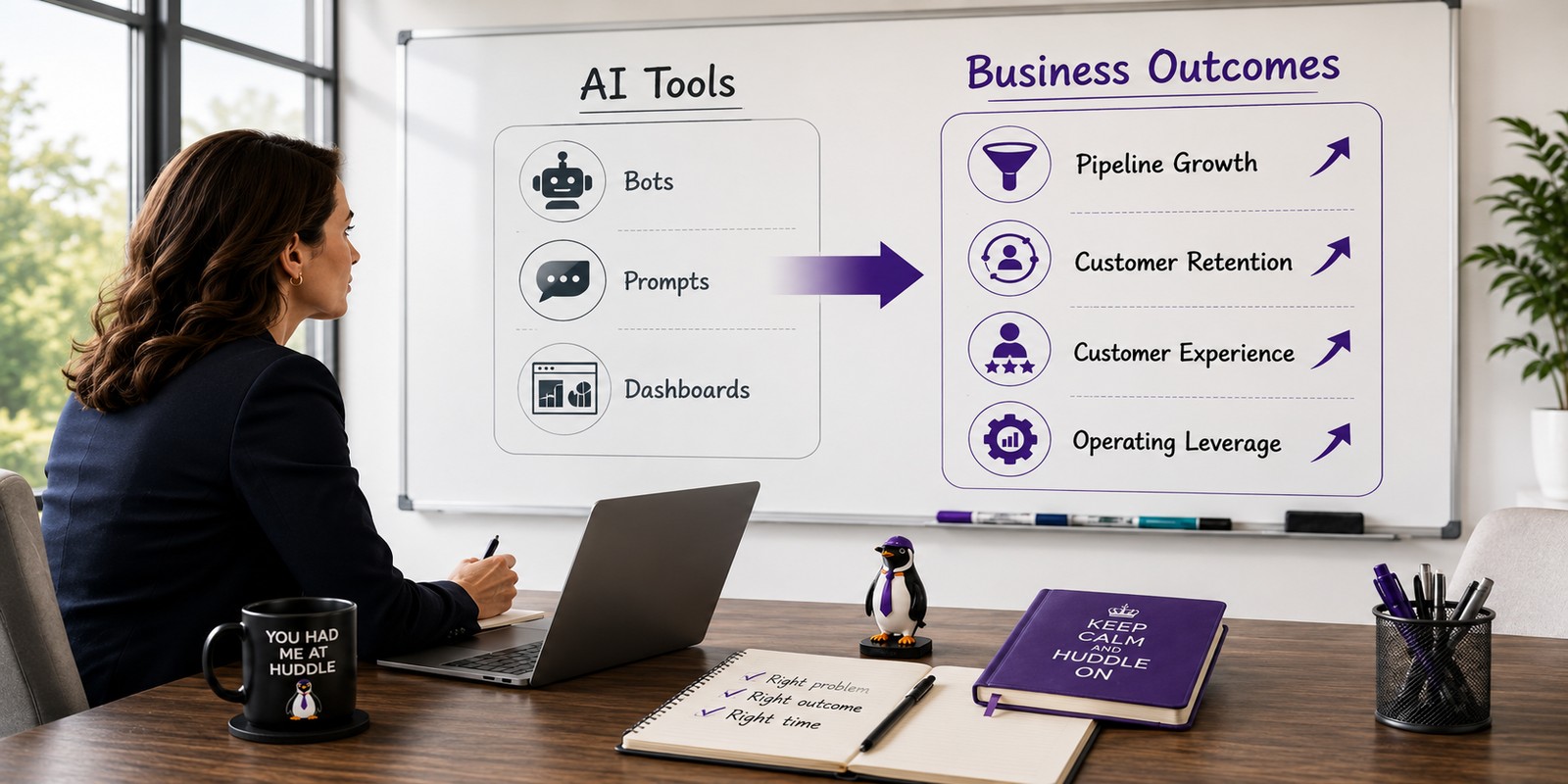
B2B CMOs are under pressure to explain their AI strategy, but that may be the wrong question. AI is not the objective. It is an accelerant. The smarter conversation starts with business outcomes: Lower acquisition costs, better retention, higher sales productivity, stronger customer experience, and growth without proportional headcount.
“My team was going wild using AI all over the place, and as power users, we were flagged by our AI task force,” shared a CMO from a $250 million tech company.
Then he added, almost sheepishly, “A whole entire policy came out of that.”
I laughed. Not because it was ridiculous. Because it felt familiar.
Across our recent huddles, I kept hearing versions of the same story. AI experimentation is spreading rapidly, oversight committees are springing up everywhere, and executives keep asking the same question:
“What’s our AI strategy?”
There’s just one problem.
I think it’s the wrong question.
No one asks about their Salesforce strategy. No one asks about their Zoom strategy. And thankfully, no one asks about their spreadsheet strategy.
Jamie Gier captured the absurdity perfectly in a LinkedIn comment: “‘Spreadsheet strategy.’ 😂 My sip of coffee almost ended up in my lap.”
Exactly.
These are tools. Powerful tools, yes. Expensive tools, sometimes. Organizationally disruptive tools, absolutely. But still tools.
The strategy comes first. The tools come second.
If your objective is to reduce customer acquisition costs, AI can help. If your objective is to improve customer retention, AI can help. If your objective is to scale revenue without adding proportional headcount, AI can definitely help.
But AI isn’t the objective.
It’s the accelerant.
Norman Guadagno offered a painfully funny reminder in another LinkedIn comment: “Sadly, your post reminded me of conversations I have been in about the Salesforce strategy….Seems we never learn.”
Ouch. Also, fair.
We have a habit in marketing of mistaking a major technology shift for a strategy shift. The tool arrives. The budget follows. The steering committee forms. The deck gets written. Somewhere in the process, the business problem quietly sneaks out the side door wearing a fake mustache.
That’s why I worry when organizations spend more time debating AI policies than business outcomes.
To be clear, governance and security matter. A lot. CMOs do not need rogue AI experiments leaking customer data, violating brand standards, inventing product claims, or sending prospects into a compliance-themed escape room.
But governance isn’t strategy.
A policy tells people what they can’t do.
A strategy tells people what they should do.
Those are very different conversations.
The CMO whose team was flagged by the AI task force was not describing a bad team. Quite the opposite. His team was experimenting. They were learning. They were trying to find leverage.
The issue was that experimentation outran the organization’s ability to define outcomes, boundaries, and decision rights.
That is not unusual. In fact, it may be the default state of enterprise AI adoption right now: Usage rising faster than strategy, policy chasing behavior, and measurement trailing somewhere in the distance asking for the meeting invite.
One CMO noted that AI is enabling their team to launch more campaigns, content, and workflows than ever before.
That sounds promising.
The problem is that measurement hasn’t kept up.
Another admitted they can point to individual productivity wins but still struggle to quantify the impact on the overall function.
That is a warning sign.
Sooner or later, every CFO asks the same question:
“So what?”
Saving six hours is nice. Growing faster without increasing expense is better.
The most mature AI conversations I heard weren’t about prompts, agents, or model selection. They were about pipeline, acquisition costs, sales productivity, customer experience, and operating leverage.
In other words, they were talking about business outcomes first and AI second.
That is the right order.
Strategy first. AI second.
If AI helps a campaign manager produce five times as many emails, that may or may not matter. If those emails improve conversion, shorten sales cycles, or reduce cost per opportunity, now we have something worth discussing. If AI helps SDRs prepare better, sales respond faster, customer marketing spot churn risk earlier, or marketing ops reduce cycle time without sacrificing quality, we are now in the land of outcomes.
That is where CMOs need to plant the flag.
Bill Strawderman added a practical and increasingly important layer in his LinkedIn comment: “The other interesting problem is that token costs are accelerating as usage rises, while value being created is murky for less strategically focused use cases.”
This deserves more attention.
Right now, a lot of AI experimentation feels inexpensive because many models, tools, and pilots are priced to encourage adoption. But as usage grows, the bill will grow too. Token costs may not show up like headcount, but they are still costs. And if the value is murky, the CFO will eventually notice the fog.
Isabelle Papoulias built on Bill’s point: “Once we move beyond subsidized models for adoption to higher token costs the conversations around what/when/how much to use AI will change. Maybe that will push organizations to a well articulated strategy instead of the tools being the strategy.”
That feels right.
Cheap experimentation can be useful. It lowers the barrier to learning. But cheap experimentation can also create lazy habits. If every team can use every AI tool for every task without a clear sense of business value, the organization may confuse activity with progress.
Higher costs will force better questions.
Should AI be used here?
What outcome are we improving?
What is the cost of this workflow now?
What is the cost after AI?
What quality standard must be maintained?
What human judgment is still required?
What happens if usage triples?
This is where “AI strategy” becomes too vague to be useful. CMOs need AI economics, AI operating principles, and AI-enabled growth priorities. That is less catchy, admittedly. It also has the advantage of meaning something.
My favorite observation this month came from Noah Brier during Scott Stedman’s Imaginarium summit. Noah described AI as “a mirror, not a crystal ball.”
That one stuck.
If your processes are messy, AI exposes them. If your data is fragmented, AI exposes that too. If your brand voice is unclear, AI will kindly generate twelve versions of confusion in seconds. And if your strategic priorities aren’t clear, AI will expose that faster than anything.
Maybe that’s the real issue.
Asking for an AI strategy sounds sophisticated.
Clarifying the business strategy is harder.
AI has a way of revealing what was already broken. The handoffs were already slow. The data was already scattered. The messaging was already inconsistent. The reporting was already more theatrical than useful. AI didn’t create those problems. It just removed the excuse that they could stay hidden.
This is why CMOs should resist the urge to treat AI as a standalone initiative. AI should be threaded into the business priorities that already matter.
Pipeline.
Retention.
Customer experience.
Operating leverage.
Sales productivity.
Content effectiveness.
Market insight.
Brand consistency.
Speed to learning.
Those are strategy conversations. AI belongs inside them.
If someone banned the phrase “AI strategy” from your next leadership meeting, would your team still know exactly what business outcomes you’re trying to achieve?
Or has the tool become the strategy?
Here are five better questions for CMOs to bring to the next executive conversation.
Start with outcomes, not tools. Pick the metrics that matter most: Pipeline, CAC, conversion, retention, expansion, sales productivity, campaign cycle time, customer satisfaction, or cost per opportunity.
Look for workflows where AI can meaningfully improve speed, quality, scale, personalization, insight, or cost. Avoid use cases that are interesting but strategically decorative.
Saving time matters, but it is not enough. CMOs need to connect productivity gains to organizational capacity, business performance, or operating leverage.
Policy should enable responsible action, not freeze the organization in place. Define approved tools, data boundaries, quality expectations, and human review requirements.
This is the question too many AI conversations skip. If AI lets the team do more, that does not mean the team should do everything. The highest-leverage CMOs will use AI to eliminate low-value work, not just accelerate it.
At CMO Super Huddle, Ray Rike will be presenting the results of our AI Maturity Study, giving CMOs a clearer benchmark for how B2B companies are turning AI activity into measurable business progress.
That distinction matters.
Because the winners will not be the companies with the most AI usage. They will be the companies with the clearest business priorities, the strongest operating discipline, and the sharpest understanding of where AI can create leverage.
Strategy first.
AI second.
Penguins always optional, but highly encouraged.
Because AI is a tool, not the business objective. CMOs should first define the outcomes they need to improve, then decide where AI can accelerate progress against those outcomes.
Ask: “Which business outcomes are we trying to improve, and where can AI create leverage?” This keeps the conversation grounded in pipeline, retention, customer experience, productivity, and operating efficiency.
CMOs should measure functional impact, not just individual time savings. Useful metrics include cost per opportunity, campaign cycle time, conversion lift, sales productivity, customer retention, content effectiveness, and reduced manual effort in high-friction workflows.
As AI usage scales, token costs and platform costs can rise quickly. If teams cannot connect usage to business value, AI can become another expensive tool with unclear ROI.
Governance should define safe boundaries for action. It should not replace strategy. The best governance helps teams move faster responsibly by clarifying approved tools, data rules, human review points, and quality standards.
CMO Huddles helps B2B marketing leaders win by bringing together peers, fresh perspectives, and opportunities to build stronger personal brands. Want to join the huddle? Learn more about CMO Huddles and apply to join the community.