
Back to Blogs
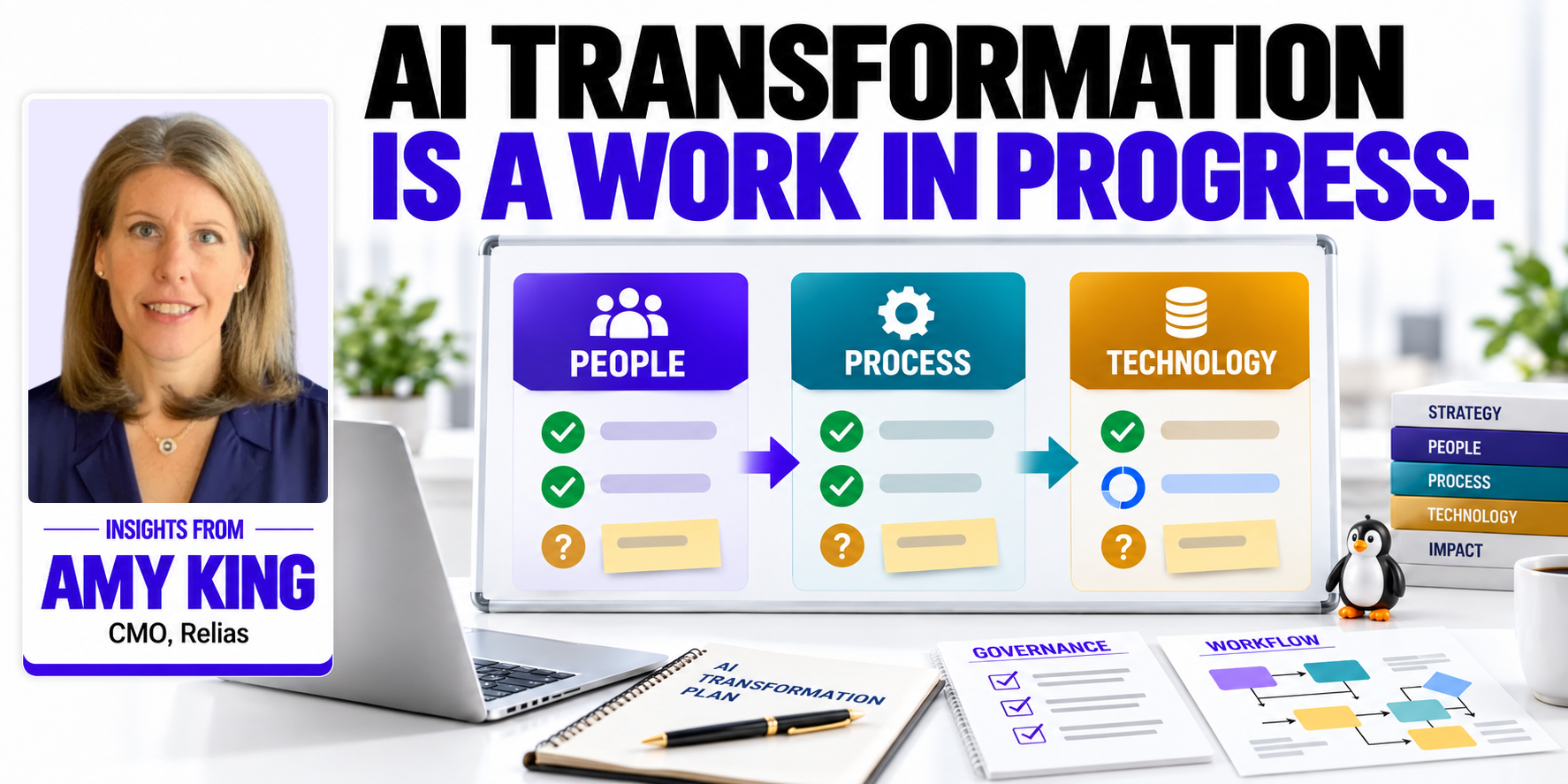
After 18 months on an organization-wide AI task force, Relias CMO Amy King has learned that meaningful AI transformation depends on people, process, and technology moving together. Her experience shows CMOs how to connect pilots to business outcomes, redesign workflows, manage costs, and lead employees through change without pretending every answer is settled.
After 18 months on an organization-wide AI task force, Amy King, CMO of Relias, has helped shift the conversation from theoretical enthusiasm to strategic deployment. Her experience offers an instructive framework for other CMOs, but it does not produce a tidy collection of definitive answers.
That may be the most useful lesson of all.
AI technology, pricing, employee expectations, and vendor capabilities are changing too quickly for any company to declare its transformation complete. Instead, Amy and her colleagues have developed a more disciplined way to evaluate opportunities and uncertainties through the familiar framework of people, process, and technology.
Many companies began their AI journeys by acquiring tools and encouraging experimentation. They assumed that layering powerful technology onto existing marketing operations would make everything faster and better.
Amy described that period as “a fun summer experiment,” but one that exposed how much foundational work was missing. Technology alone could not solve problems created by disconnected data, poorly designed workflows, unclear ownership, or teams unprepared for new ways of working.
The experiments were still valuable. They helped teams see what AI could do while revealing the organizational conditions required to generate meaningful results.
Unfortunately, adding AI to a broken process won't fix it and risks making it move faster.
Amy’s framework helps CMOs move past experimentation by asking three interconnected questions. Is the technology secure, scalable, and commercially viable? Has the underlying process been redesigned around the desired outcome? Do the people have the skills, roles, and confidence to operate the new system?
The technology discussion quickly leads to data. AI cannot generate reliable insights, personalization, or automation if the necessary information is fragmented, inaccessible, or poorly governed.
Amy said companies must consider “how do you architect your data and integration so that what you want your AI to make amazing is available to you.” For many organizations, that realization has been a sobering response to the initial excitement. The vision may be compelling, but the data required to support it is often scattered across CRM systems, marketing platforms, product databases, and local spreadsheets.
Governance adds another layer. Companies need to decide which information can enter which models, who can build and deploy agents, how they'll monitor output quality, and what happens when tools use inaccurate or outdated data.
They must also govern consumption. Amy offered the memorable example of “a really ambitious data scientist that uses up 8 million credits in a day.” Consumption-based pricing introduces a variable expense that many marketing leaders are not equipped to forecast or control.
The old martech model was expensive, but at least the invoice was predictable. AI can turn every productive interaction into a metered event.
Another early consequence of experimentation was what Amy called “pilot sprawl.” As established vendors added AI capabilities and new providers offered free trials, companies accumulated overlapping tools without a clear view of where each capability belonged.
That leaves CMOs facing consequential build-versus-buy decisions. Amy’s organization began creating some solutions internally, only to watch software partners introduce similar capabilities faster than expected. “Things we were planning on building ourselves we now can get through a vendor,” she explained, which forces the governance team to reassess the architecture continually.
An internally developed capability may offer greater control and tighter alignment with proprietary data. A vendor solution may deploy faster, be easier to maintain, and be more capable six months from now. Neither answer is automatically right, especially when vendors cannot explain what their new capabilities will cost at scale.
Amy encountered this problem while evaluating emerging campaign-automation capabilities. The promised functionality was impressive, including channel recommendations, content derivatives, real-time performance monitoring, and optimization suggestions. Yet the vendor could not estimate the credit consumption required to deliver those outcomes.
“You’re going in kind of totally blind,” Amy said.
A dazzling demo is not a business case. CMOs still need to understand total cost, implementation requirements, maintenance, adoption, and the business value the system is expected to create.
The more commercially grounded approach begins with the business objective rather than the technology. Amy recommends identifying the outcome, mapping the workflow that produces it, and then determining what technology and organizational capabilities will enable that workflow.
This distinction matters because efficiency is not the same as impact. A platform that launches campaigns faster may create a genuine operational advantage, but speed alone does not guarantee better conversion, retention, or revenue.
Amy sees several areas where AI could create significant value, including pricing and packaging, channel optimization, and personalization. Each opportunity becomes more credible when connected to a measurable business objective.
Relias has already demonstrated what this can look like. Each year, the company produces a nurses’ salary report based on responses from thousands of nurses. A member of Amy’s team built an agent that could combine the report with information about 100 priority enterprise accounts and produce a highly personalized microsite for each one.
The system created 100 microsites in about an hour, something Amy said “would have been impossible for us before.” The team could then use its account-based marketing capabilities to put each tailored experience in front of the relevant organization.
That is more than faster content production. It creates account-level personalization the team could not previously execute at that scale.
The example also comes with an important caveat. Amy still needs marketers prepared to distribute the microsites, review their accuracy, engage the accounts, and measure the results. “As long as you have thought through the workflow behind it,” she cautioned, the new capability can support the desired outcome.
Another Relias experiment illustrates what happens when the workflow is ignored. A team member built a derivative generator that could turn one core content asset into seven formats. Technically, it worked.
Operationally, the existing process still sent the core asset to different teams responsible for creating those derivatives. Dropping the generator into that structure didn't resolve ownership, approvals, quality control, distribution, or the existing teams' future responsibilities.
“We can’t just be like, ‘Here’s the derivative generator,’” Amy explained. “We have to actually rethink the whole way we do asset creation.”
The tool may eliminate several handoffs, but that means the operating model must change. Someone needs to decide who initiates the workflow, where human review occurs, who owns the final output, and how affected specialists will spend the time automation frees up.
Without those decisions, a useful tool becomes one more object sitting beside the process it was supposed to improve. As Amy noted, if leaders do not engage the teams and managers involved and redesign the process, “all you’ve done is slap something on an old process, and no one’s going to use it.”
Workflow redesign inevitably becomes role redesign. Amy sees campaign roles evolving toward marketing engineering, with more emphasis on strategy, performance, and orchestration and less time spent managing repetitive production details.
That shift creates new talent questions. Do marketing organizations need automation builders, agent developers, data-quality owners, or performance analysts? Which existing employees can be trained for those responsibilities, and which capabilities require new hires or partners?
It also creates understandable anxiety. Some employees object to AI for environmental, ethical, or quality reasons. Others may be expressing a deeper fear that the technology will eliminate their roles.
Amy’s message to her team is candid. AI is changing customer behavior and the nature of marketing work regardless of whether any individual company embraces it. Relias wants employees to develop these capabilities inside the organization, but resisting them entirely is unlikely to offer long-term security elsewhere.
That message works best when leadership provides more than a warning. Employees need clear priorities, approved tools, time to learn, practical training, and a view of how their roles could become more valuable. Otherwise, “learn AI” sounds less like professional development and more like an implied threat.
One of the largest unanswered questions is also one of the most practical: Who pays for all this?
AI introduces new software fees, consumption costs, implementation work, data preparation, training, and governance. Companies may eventually fund those investments by reducing legacy martech expenses, leaving some positions unfilled, lowering agency costs, or generating incremental revenue. In the meantime, CMOs need to justify a new category of spending without reliable benchmarks.
Amy drew an interesting parallel to healthcare. AI can recommend additional tests that physicians might not otherwise order. Some will identify genuine problems; others may simply increase costs. Marketing faces a similar challenge as AI makes it easier to produce more campaigns, assets, analyses, and personalized experiences.
More activity is not automatically more value.
Amy argues for proving commercial viability before making large commitments. Whether the company calls it a pilot or something else, the test should begin with a defined outcome and evaluate the full workflow, total cost, adoption requirements, and measurable impact.
Amy’s experience suggests that CMOs should treat people, process, and technology as an interconnected diagnostic rather than three independent workstreams.
This diagnostic will not resolve every uncertainty. It will help CMOs avoid expensive experiments disconnected from the work, people, and outcomes that determine whether AI creates value.
Relias has accomplished a lot in 18 months. Its AI task force has evolved from a theoretical forum into a strategic governance body helping the company evaluate architecture, vendors, workflows, costs, and organizational implications. Amy’s team has also created practical capabilities that would have been impossible only a few years ago.
At the same time, critical questions remain unanswered. Costs are difficult to forecast. Vendor roadmaps complicate build-versus-buy decisions. New workflows require organizational redesign, and employees need help navigating what these changes mean for their careers.
That combination of progress and uncertainty is the reality of AI transformation. The strongest leaders are not those claiming to have solved it. They are the ones creating enough structure to learn quickly without confusing experimentation with business impact.
Amy King will share more of what Relias has learned at the CMO Super Huddle. B2B marketing leaders can also use the CMO Huddles AI Maturity Calculator to assess whether their own people, processes, technology, and leadership practices are ready to support the outcomes they expect from AI.
AI technology, pricing, vendor capabilities, and employee expectations are changing too quickly for most organizations to treat transformation as a finished project. CMOs need a disciplined system for learning, governing costs, redesigning workflows, and measuring business impact.
Start with a measurable business outcome, map the complete workflow behind it, and then assess the people, process, data, governance, and technology required to deliver that outcome. A compelling demo is not enough without a credible operating model and cost structure.
Build when proprietary data, control, or a highly specific workflow creates a meaningful advantage. Buy when a vendor can deliver the capability faster, maintain it more effectively, and explain the total cost and integration requirements. The decision should be reviewed as vendor capabilities evolve.
Give employees clear priorities, approved tools, time to learn, practical training, and an honest view of how roles may change. Adoption becomes more credible when leaders connect AI to better work and business outcomes rather than presenting it as a vague efficiency mandate.