
Back to Blogs
Drew Neisser is the founder of CMO Huddles and a globally recognized authority on B2B marketing. He’s an AdAge columnist, LinkedIn TopVoice, leading CMO coach, podcast host & friend of penguins everywhere.
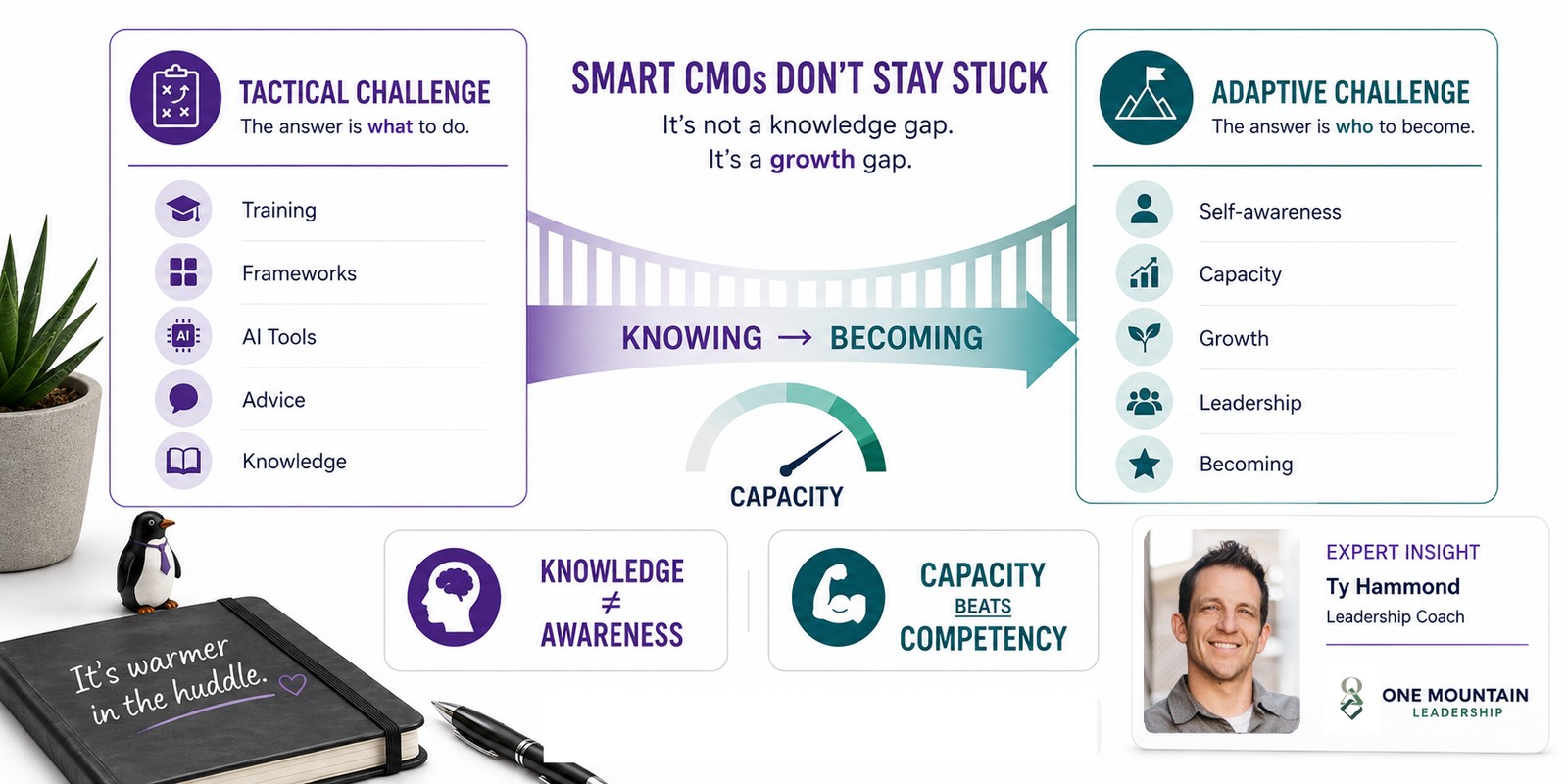
Smart CMOs usually do not stay stuck because they lack information. Leadership coach Ty Hammond argues that many of the hardest CMO challenges are adaptive, not tactical: The issue is not what to do, but who to become. In the AI era, the “Chief” in CMO matters more than ever.
Most CMOs do not need another article telling them to delegate more, network more, develop their teams, build executive presence, make hard personnel calls, or invest in their own growth. They already know. That is precisely the problem.
Knowing is not doing. And for CMOs, the gap between the two can become a career-limiting canyon with a very nice LinkedIn profile.
This year at CMO Huddles, we have focused heavily on leadership in our Expert Huddles because we believe the AI era makes strong, effective leadership more important, not less. Tools will change. Org charts will shift. But if CMOs want to keep earning the “Chief” in Chief Marketing Officer, they need more than technical fluency and prompt dexterity.
They need leadership capacity.
That was the heart of my conversation with Ty Hammond, leadership coach and creator of the True Leadership Approach. Ty’s core argument is both simple and uncomfortable: Many leadership problems are not knowledge problems. They are growth problems.
Ty spent the first decade of his career delivering what he calls traditional leadership development: Rooms full of smart people, strong reviews, useful frameworks, and then not nearly enough behavior change. “Everybody saying that it was the best training that they ever had,” he recalled, “me coming back a month later saying, what’s changed, and everybody saying nothing.”
That is a little too familiar. CMOs attend the offsite, read the book, nod vigorously at the keynote, write down three action items, and then return to the inbox avalanche where good intentions go to compost.
Ty’s diagnosis is that leadership development has over-indexed on learning and under-delivered on development. “In general learning and development,” he said, “we’ve been nailing the L, and we’ve been completely failing the D.”
That line should sting a little. Especially for CMOs who can explain exactly what they need to change and still not change it.
Ty makes a critical distinction between tactical and adaptive challenges. “What makes a challenge tactical is a gap in knowledge and skill,” he said. If the issue is tactical, training helps. Advice helps. A framework, expert, course, or even AI can help.
Adaptive challenges are different. “The answer isn’t what to do,” Ty said. “It’s who to become.”
That is a very different assignment. It is also where many CMOs get stuck, because the leadership issues that nag the longest are rarely the ones with missing instructions.
Ty offered three signs of an adaptive challenge: “I already know what to do, but I’m just not doing it,” or “I know it needs to be done, I do it, but it always feels like a foot on the gas, a foot on the brake.” He also includes challenges where the thing someone is trying to do “actually cannot be done” from their current way of being.
For CMOs, this shows up everywhere. You know you need to make time for personal development. You know you need to build your external network before you need it. You know someone on the team is not working out, and yet there they are, still generating meetings, friction, and interpretive dance in the org chart.
Not every stuck place is a strategy problem. Sometimes the stuck place is you.
When leaders face adaptive challenges, the default advice is almost always tactical. Build discipline. Read the book. Get accountability. Take the course. Make a plan. Put it on the calendar, preferably in a shade of blue that implies virtue.
Ty calls this “the big trap,” which he defines as “attempting to solve for adaptive challenges with tactical solutions.” His verdict is blunt: “You cannot do it.”
This is where the Drew-rant portion of our program begins. If you have known for three years that you need to delegate more and your solution is another time-management hack, congratulations, you may now own the deluxe edition of the wrong tool.
Ty uses a memorable metaphor: “Giving a toolbox to a baby.” His point is that we often hand leaders more tools without helping them grow “the musculature and the capacity to actually use the tools and do what they know needs to be done.”
That is why so much leadership content feels useful and still fails to change behavior. The CMO was not short on instructions. The CMO was short on capacity.
Ty is not anti-training. If the problem is tactical, by all means, bring in the expert and learn the skill. But if the problem is adaptive, “you don’t want to waste your time, effort, and resources teaching people skills and giving them knowledge that they’re not going to use.”
His work focuses less on competency and more on capacity. “What our focus is,” he said, “is capacity. How do we actually begin to develop capacity? It’s actually the D of L&D. It’s growth, not learning.”
This matters for CMOs because the AI era is turning up the volume on ambiguity. The job is no longer just to manage campaigns, budgets, agencies, pipeline expectations, brand strategy, board questions, tech stacks, and the occasional rogue webinar. Now CMOs must also lead teams through automation anxiety, role redesign, new buyer behavior, and the uncomfortable fact that nobody has the whole map yet.
Competency still matters. But competency alone is not enough when the role requires becoming a different kind of leader.
Ty’s sharpest line may be this one: “Knowledge is not awareness.” He said it more than once, which was good, because it deserves to be taped to every leadership development binder ever printed.
“Awareness is not something that can be given to you,” Ty explained. “I can give you feedback from now until the end of your days. I can tell you where to look, but I can’t make you see.”
That is the hard part. You can know your blind spots intellectually and still not see them while they are running the meeting, shaping the decision, delaying the hard conversation, or turning your leadership style into a weather system.
“You cannot outsource self-awareness,” Ty said. “It is not possible.”
For CMOs, this may be the difference between acting confident and being grounded, between talking about executive presence and actually having presence, between knowing you should lead differently and catching yourself in the moment when you are not.
As Ty put it, traditional approaches tend to put “a foot on the gas” by saying, “here’s what to do, and do it harder and faster.” His approach is about “becoming aware of where your foot is on the brake.”
You cannot remove a brake you refuse to see.
Ty’s framework fits nicely alongside several leadership experts we have brought into CMO Huddles this year, but it also pushes the conversation in a different direction. Liz Wiseman, for example, challenged CMOs to think like impact players who do not wait for perfect clarity or formal authority.
Liz told us that impact players distinguish themselves when “the world got messy” by developing “this ability to figure out what needs to be done, to step up and take the lead.” She also warned that many ordinary contributors are “so heads down doing their job, that they don’t see what’s happening around them.”
Ty would likely agree, then ask a follow-up: What stops a smart leader from doing that even when they know they should? The answer may not be role clarity, skill, or desire. It may be an adaptive challenge hiding under tactical clothing.
Amy Edmondson brought another useful lens: Intelligent failure and psychological safety. She reminded us that “most people, most of the time, are playing not to lose,” and urged leaders to create the conditions for “playing to win instead.” She also said the micro-habit that builds psychological safety is simple: “ask more questions.”
Ty’s work complements that, too. If a CMO intellectually agrees that curiosity matters but still shuts down dissent, avoids uncomfortable feedback, or needs to be right in every meeting, the missing piece is not the concept. It is awareness in the moment.
Rita McGrath, Anne Morriss, and Thomas Barta have all pushed related ideas in our leadership-focused curriculum: See around corners, move fast while fixing real constraints, and earn influence as a business leader. Ty’s contribution is to point at the inner bottleneck: The place where the leader already knows the move but cannot yet make it consistently.
CMO Huddles has focused on leadership all year for a reason. In the AI era, it is tempting to think that the winners will simply be the leaders with the best tools, cleanest data, and most adventurous experimentation budget.
Those things help. But they do not replace leadership.
A CMO now has to help teams unlearn old workflows, test new ones, rethink roles, protect morale, confront fear, and make decisions in markets that keep changing their costume. This is not just a technical transformation. It is a human one.
Which brings us back to the “Chief” in CMO. The Chief is the person who sees what matters, says what needs to be said, acts when avoidance would be easier, and develops the capacity to lead through mess without becoming the mess.
That means taking personal development seriously before a crisis forces the issue. It means firing or reassigning the person everyone knows is not working out. It means delegating for real, not delegating and then hovering like a nervous drone. It means admitting that the reason you keep postponing the same leadership move may not be time, budget, or “the business.”
It may be an adaptive challenge.
Smart CMOs stay stuck because knowing what to do is not the same as having the capacity to do it. Tactical challenges need knowledge and skill. Adaptive challenges need awareness, growth, and a willingness to become the kind of leader who can take the action that keeps getting deferred.
Ty’s framing is a useful gut check. If you have consumed the advice, taken the training, heard the feedback, made the plan, and still have not changed the behavior, stop looking for another tool. Look for the brake.
In the AI era, CMOs cannot afford to be leadership hobbyists. The tools will keep evolving, but the hard work of becoming a stronger leader remains stubbornly human.
If this resonates, join us for an upcoming CMO Huddles Expert Huddle with Ty Hammond, date TBD. We will dig into tactical versus adaptive challenges, why knowledge is not awareness, and how CMOs can build the leadership capacity to act on what they already know.
Because many leadership challenges are adaptive, not tactical. The issue is not missing knowledge or skill. The issue is often a gap in awareness and capacity that prevents the leader from acting consistently.
A tactical challenge involves a gap in knowledge or skill, so training, advice, or expertise can help. An adaptive challenge shows up when the leader already knows what to do but still does not do it, or does it with constant internal resistance.
Traditional training often assumes the problem is knowledge. Ty Hammond argues that many stuck leadership behaviors require growth, not more information. As he puts it, “Knowledge is not awareness.”
AI increases ambiguity, role pressure, and organizational change. CMOs need more than tool fluency. They need the leadership capacity to guide teams through uncertainty, make hard decisions, and act before avoidance becomes the strategy.
Start by treating it as a possible adaptive challenge. Ask what you already know, what you are still not doing, and what you may not be seeing in the moment. The goal is not another checklist. The goal is awareness that creates the possibility of different action.
CMO Huddles helps B2B marketing leaders win by bringing together peers, fresh perspectives, and opportunities to build stronger personal brands. Want to join the huddle? Learn more about CMO Huddles and apply to join the community.