
Back to Blogs
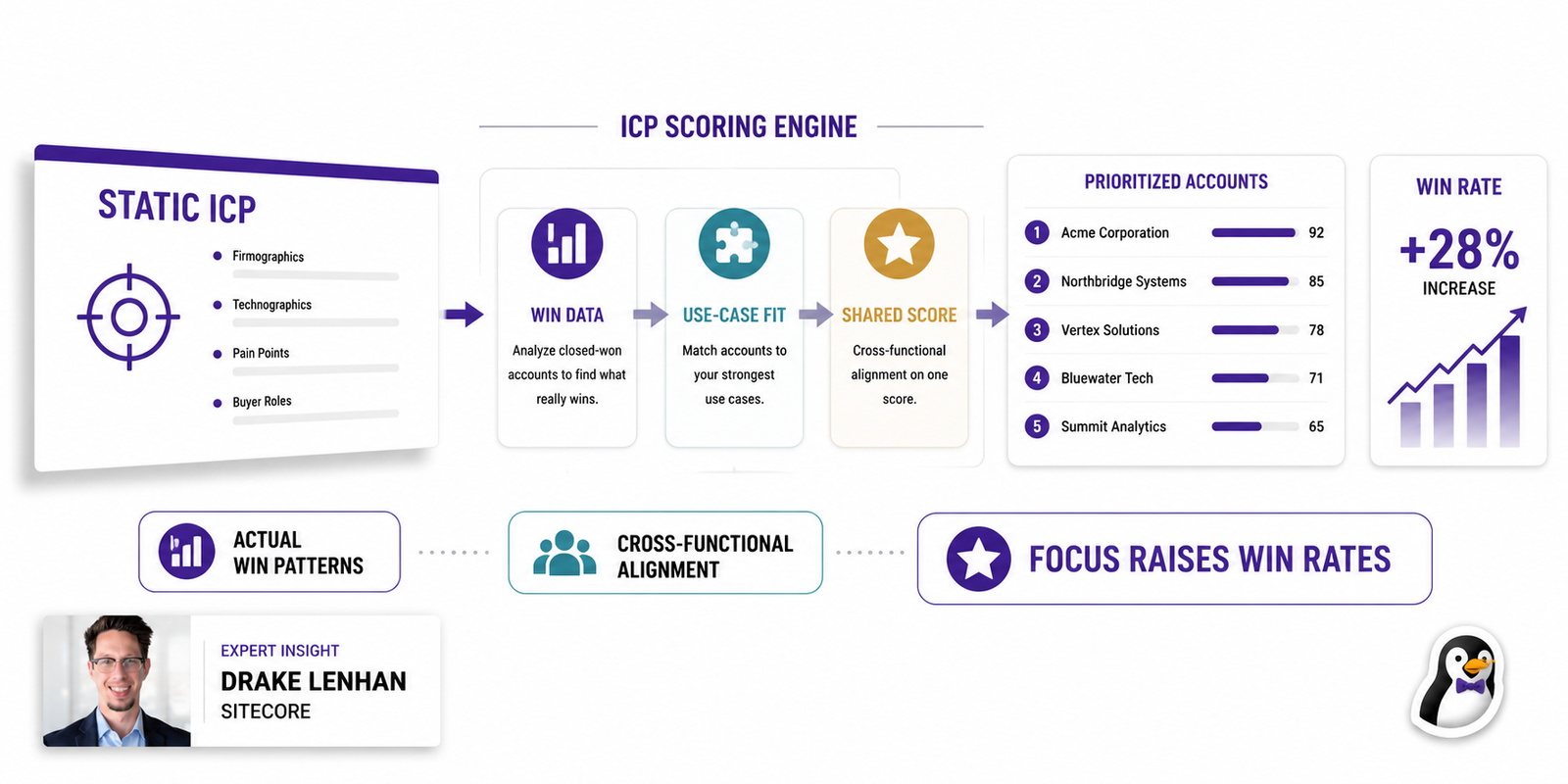
An ideal customer profile improves win rates only when teams apply it consistently. Start with evidence from actual wins and losses, distinguish company fit from use-case fit, convert the findings into a transparent scoring model, and embed it across marketing, sales, product, and operations. Then maintain the model without rewriting it after every market fluctuation.
Many ICP exercises end with a polished slide and very little operating change.
The profile describes a large company in a preferred industry with the right technology. Sales interprets it one way, demand generation another, and revenue operations uses whatever fields happen to exist in the CRM.
The audience becomes broad enough to support almost any campaign and too vague to improve prioritization.
In a CMO Huddles Expert Huddle, Drake Lenhan of Sitecore described a more useful progression: validate where the company wins, identify the difference between assumed and actual fit, build a practical scoring model, align the teams that will use it, and create a system that can evolve.
The gap became visible when his team compared its assumptions with performance data:
“We saw a gap between where we thought we won and where we actually won.”
That discovery is the reason operational ICP work must begin with evidence rather than consensus.
The goal is not a more polished definition. It is better go-to-market decisions.
The first question is not “Who would we like to sell to?” It is “Where do we demonstrably win?”
Review recent closed-won and closed-lost opportunities. Look beyond industry and company size for combinations of traits associated with strong performance:
Win data helps separate attractive assumptions from patterns the business can defend.
At Sitecore, the team compared win rate, average deal size, sales velocity, churn, customer satisfaction, and expansion across three regions. It then layered in qualitative win-loss sentiment and sales feedback. The resulting model identified sub-verticals with materially stronger performance and translated the findings into a simple A-through-D account score.
Firmographics determine whether an account belongs in the neighborhood. Use-case fit determines whether anyone inside the account has a compelling reason to act.
Two companies may share the same industry, revenue, and technology. One faces an urgent transformation initiative that aligns with the offering. The other is satisfied with the status quo. A firmographic-only model scores them equally. An operational ICP does not.
This distinction also improves messaging. Marketing can speak to the conditions that create demand instead of merely repeating the characteristics of the account.
Convert the strongest indicators into a model the go-to-market team can use and explain.
The first version does not need advanced predictive technology. A weighted score can be useful if each factor has a clear relationship to winning.
A practical model might include:
Document why each factor matters, what evidence supports it, and how missing information should be treated.
A mysterious score will not create alignment. It will create arguments.
Marketing cannot operationalize ICP alone.
Sales understands access, objections, buying committees, and deal momentum. Customer success knows which customers reach value and which arrive with expectations the product cannot meet. Product clarifies where capability and roadmap align. Revenue operations determines whether the model can function in real systems.
As Drake explained, "We didn't just present the model. We tied it directly to the business impact." Cross-functional alignment comes more easily when the model is tied to business outcomes.
Rather than presenting a new framework, show how it would have changed pipeline, win rates, or revenue if it had been used earlier.
As Drake challenged his executive team, "What would your fiscal finish look like last year had you done this?"
The CMO’s role is to bring those perspectives together around evidence. The goal is not to negotiate a profile broad enough to satisfy every function.
The model matters only when it changes decisions. Embed it in:
Define what happens at each score. If Tier 1 accounts receive the same treatment as every other account, the tier is decorative.
A sharper ICP improves more than targeting. It strengthens messaging, content, sales plays, customer success, and competitive positioning because every team starts from the same definition of the right customer.
Track results by ICP tier and major scoring component:
The purpose is not just to prove the model correct. It is to learn which assumptions hold and which need revision.
An ICP should be stable enough to guide coordinated execution and flexible enough to reflect meaningful change.
Review it on a defined cadence and after material events such as a new product, acquisition, pricing change, or repeated evidence that a segment behaves differently than expected.
Do not rebuild the model because one large prospect appeared or one executive discovered a new favorite industry. Label exceptions as experiments instead of quietly redefining the ICP.
An ICP is operational when marketing, sales, product, customer success, and operations can use the same evidence to rank accounts, explain the ranking, and adjust execution.
The outcome is not a better slide. It is a business that consistently spends more time with the customers it is most likely to win.
An ICP is operational when teams use shared criteria to prioritize accounts and when each level of fit changes marketing, sales, or customer action.
An ICP identifies the organizations most likely to become valuable customers. Buyer personas describe the relevant people, roles, priorities, and behaviors inside those organizations.
Yes. Firmographic fit without a meaningful use case can create large target lists with weak purchase intent and low win probability.
Use a scheduled review cadence and revisit the model after material strategic changes. Avoid constant revisions based on isolated deals or executive anecdotes.
Want to hear more? Listen to the full conversation on Renegade Marketers Unite.
CMO Huddles helps B2B marketing leaders win by bringing together peers, fresh perspectives, and opportunities to build stronger personal brands. Want to join the huddle? Learn more about CMO Huddles and apply to join the community.