
Back to Blogs
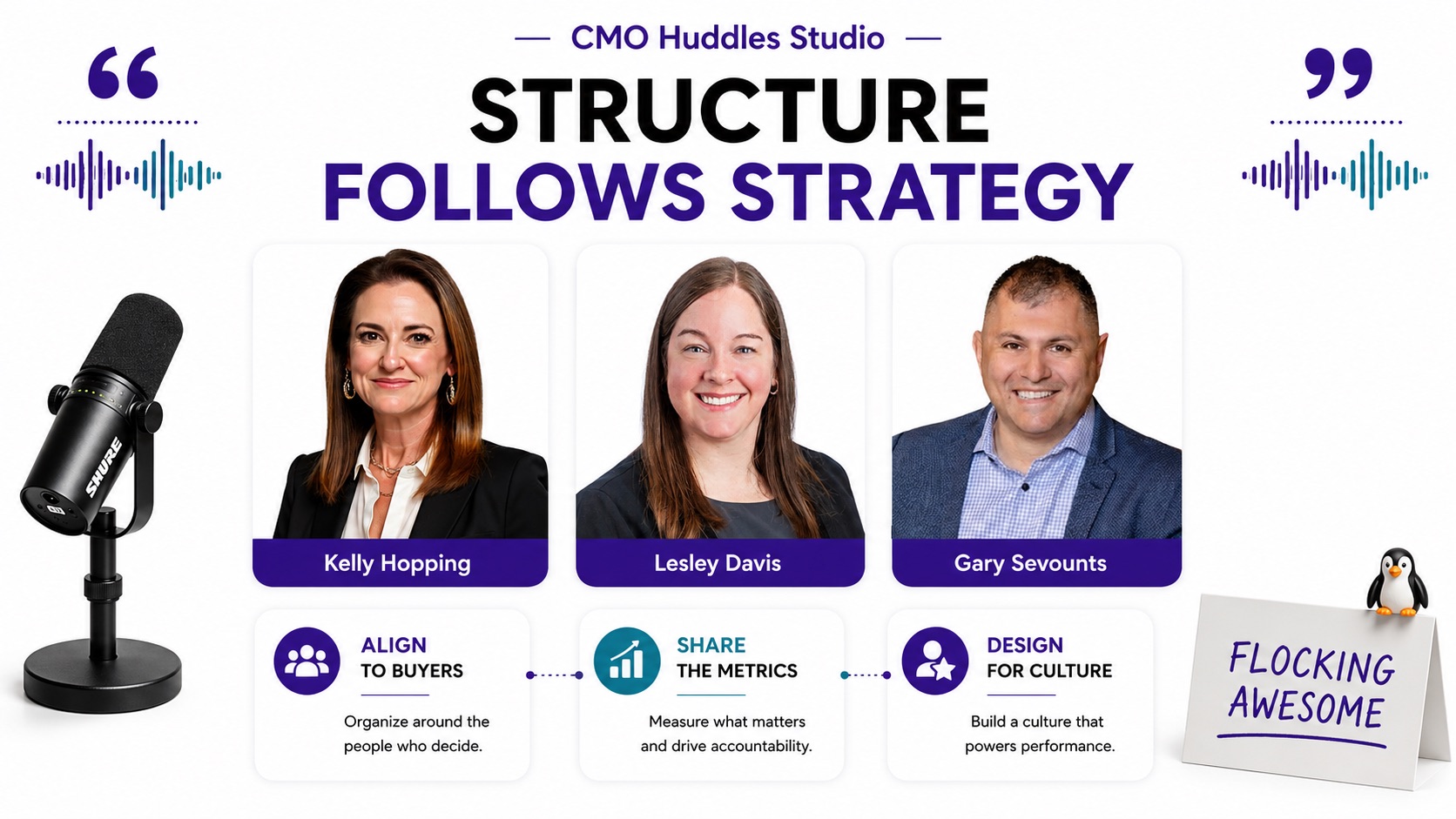
A marketing org chart reveals what the company values, how it serves buyers, and where decisions live. Kelly Hopping, Lesley Davis, and Gary Sevounts explain why team design follows business priorities rather than a universal template. Shared outcomes, cultural fit, revenue-team trust, operational strength, and evolving AI roles matter more than copying another company’s structure.
An org chart appears to describe reporting relationships. It also communicates which capabilities matter, where accountability sits, and how the company expects marketing to contribute.
A CMO Huddles Studio conversation about marketing team design brought together Kelly Hopping, Lesley Davis, and Gary Sevounts.
“You’ve really got to look at your industry, the team you have, and what you’re trying to achieve. I don’t think there’s a one-size-fits-all.”
Lesley’s observation shifts the discussion away from finding a perfect template. Effective design depends on the company’s strategy, stage, buyers, talent, and immediate business priorities.
Kelly’s redesign at Demandbase began with an inherited functional structure that “felt dated a little bit” and “didn’t feel like it aligned to kind of a modern SaaS marketing environment.” Examining the message sent by that structure led to a model more closely connected with customers, sales, content, growth, and revenue.
Functional structures organize specialists in brand, demand, product marketing, communications, customer marketing, and operations. Segment or journey-based structures organize teams around audiences, markets, or stages of the customer experience.
Each model creates strengths and coordination costs. Functional depth can improve expertise but increase handoffs. Segment alignment can improve customer focus but duplicate capabilities.
The design reflects the outcomes the company needs and the dependencies required to produce them. It also reflects company stage. A small team may need versatile generalists, while a larger organization can support deeper specialization.
Team design therefore begins with questions about the work. Which capabilities create the most leverage? Where do decisions slow? Which handoffs cause confusion? What does the strategy require the team to do repeatedly and well?
Buyers experience one company even when internal responsibilities sit across several departments. Their research, sales conversations, implementation, and customer experience do not fit neatly into separate internal boxes.
A team structured entirely around channels may struggle to coordinate that journey. Designing around buyer behavior can create closer relationships among product marketing, demand, sales, customer success, and marketing operations.
The exact reporting lines matter less than whether the operating model connects the work. Shared planning, clear decision rights, and common measures can make a functional organization behave more like one customer-centered system.
Product marketing often plays an important connecting role because it translates customer needs, product capabilities, competitive context, and market positioning across departments.
“My number one goal is for sales to love us. We give them a brand that they love, pricing that’s simple to understand, content that’s easy to consume and share, and events they’re proud to invite their customers to.”
Kelly’s standard does not mean accepting every sales request or reducing marketing to bottom-of-funnel support. It means designing a function whose work makes customer conversations more effective.
That can influence the structure. Product marketing may sit closer to enablement. Operations may support account-level visibility. Demand and field teams may coordinate around territories, segments, or target accounts.
A shared pipeline goal can connect functions whose individual contributions appear different. Content, brand, events, product marketing, and growth may each influence revenue through distinct parts of the journey.
Sales trust develops when marketing’s outputs are useful, its commitments are credible, and the two functions share a practical definition of success.
Marketing operations can connect data, workflows, measurement, technology, and revenue processes. Its contribution becomes strategic when it helps the organization see where opportunities stall and where work slows.
Gary described an operations model that helped revive stalled opportunities and connect marketing activity with pipeline. The example moves operations beyond systems administration.
A strong operations capability can create shared reporting, clarify ownership, coordinate handoffs, and reveal whether the team’s structure supports the intended customer journey.
Operations becomes even more important as AI introduces agents, integrations, automated workflows, and governance requirements. The technology may change individual tasks, but it also creates new dependencies that someone needs to understand.
“I’m looking for people that fit the right culture of my team. People that are aggressive, hungry, eager to learn, and, of course, have the experience.”
Gary’s criteria combine capability with behavior. Experience matters, but team design also depends on how people collaborate, learn, and operate under ambiguity.
Cultural fit does not require hiring people who think alike. It requires clarity about the behaviors that help the team challenge one another, make decisions, and deliver.
A strategy involving transformation may place greater value on adaptability and systems thinking. A company entering a specialized market may require deeper category expertise. A distributed team may need stronger documentation and communication habits.
The org chart determines where a person sits. Culture influences whether the structure works once people begin making decisions together.
Titles can obscure the actual responsibilities a strategy requires. Two companies may use the same title for jobs with very different scopes, authority, and measures.
A clearer role design defines the outcomes, recurring decisions, critical relationships, and capabilities attached to the position. It also reveals when one role contains too many competing responsibilities.
This matters when teams reorganize. Moving boxes without clarifying the work may preserve the same problems under different reporting lines.
Role clarity also improves hiring. Candidates can understand what success involves, and leaders can evaluate whether the person’s experience matches the actual mandate.
AI can accelerate writing, analysis, research, production, and operations. That does not mean every new capability immediately requires a new role.
The more useful starting point is the work itself. Which tasks can be automated? Which responsibilities require greater human judgment? Which workflows become possible? Where does accountability remain?
Some teams may add AI operations or enablement expertise. Others may distribute the responsibility across existing roles or identify internal system thinkers who can connect workflows across functions.
The structure can evolve after the organization understands the work clearly enough to design around it. Creating titles before that understanding may add complexity without improving capability.
No org chart remains ideal indefinitely. New markets, products, leadership expectations, technologies, and customer behaviors can change what the business needs from marketing.
That does not require constant restructuring. Frequent reorganizations can exhaust employees and disrupt accountability.
A periodic design review can examine whether the structure still supports the strategy, whether responsibilities remain clear, and where recurring coordination problems have appeared.
The useful question is not whether the chart looks modern. It is whether the team can make decisions, serve buyers, support revenue, and adapt without relying on heroics.
It reveals priorities, capabilities, accountability, decision rights, and how the company expects marketing to contribute.
No. The appropriate structure depends on strategy, stage, industry, buyers, existing talent, and desired outcomes.
It can connect marketing capabilities with shared measures, account visibility, sales needs, and useful customer-facing outputs.
AI changes tasks, workflows, skill requirements, and the balance between execution and judgment before it necessarily creates new titles.
Listen to the full marketing-team-design conversation.
CMO Huddles helps B2B marketing leaders win by bringing together peers, fresh perspectives, and opportunities to build stronger personal brands. Want to join the huddle? Learn more about CMO Huddles and join CMO Huddles Starter.