
Back to Blogs
Drew Neisser is the founder of CMO Huddles and a globally recognized authority on B2B marketing. He’s an AdAge columnist, LinkedIn TopVoice, leading CMO coach, podcast host & friend of penguins everywhere.
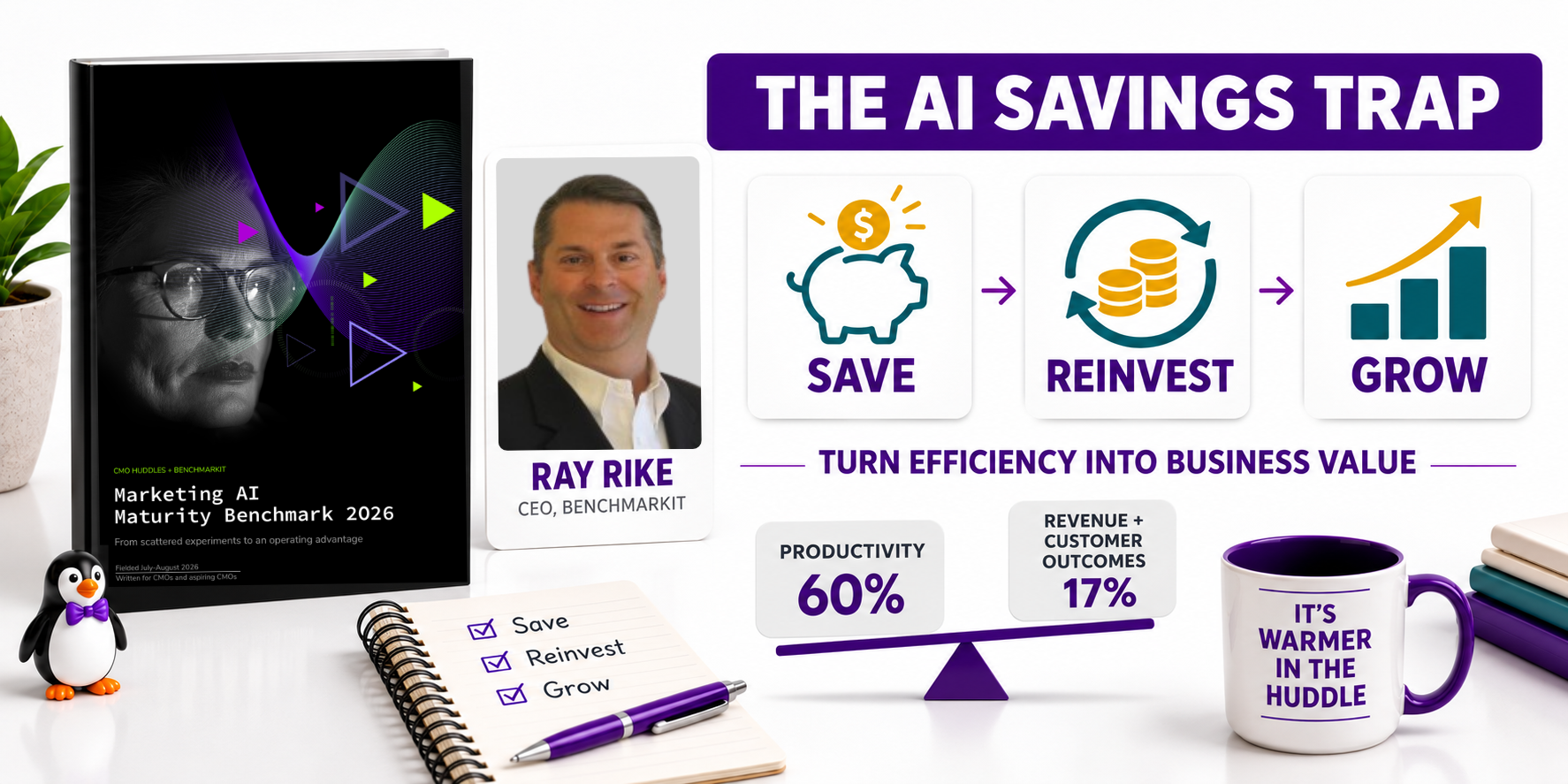
AI is making marketing faster, but speed creates a new leadership risk. In the 2026 Marketing AI Maturity Benchmark Study from CMO Huddles and Benchmarkit, 60% of respondents reported personal-productivity gains while only 17% reported improved revenue or customer outcomes. If CMOs report only the savings, they may reinforce the idea that marketing is a cost to be reduced rather than an investment that creates growth.
Marketing and AI governance advisor Angélique Evrard calls this the “AI savings trap.” Benchmarkit CEO and study coauthor Ray Rike offers a practical escape: agree on the business outcome first, deliberately reinvest some of the capacity AI creates, redesign complete workflows, and measure improvement in the language of the CFO.
“Your AI programme is working,” wrote Angélique Evrard in a recent LinkedIn article. Content that once took weeks now takes days, agency work moves in-house, and teams absorb work from roles that were never backfilled. Then comes the budget review, when the disciplined CMO proudly hands the savings back.
That may feel like responsible stewardship. Evrard warned that it can be interpreted very differently: “It will feel like proof that Marketing is accountable. It will be read as proof that Marketing is a cost.”
Welcome to the AI savings trap, yet another pitfall awaiting CMOs who are doing exactly what the organization asked them to do.
Let’s draw an important line around the evidence. The 2026 Marketing AI Maturity Benchmark Study, which CMO Huddles developed with Benchmarkit, did not ask whether AI savings cause executives to classify marketing as a cost center. It evaluated AI maturity across strategy and leadership, workflow operationalization, talent and change readiness, governance and investment discipline, and measurement and business impact.
The findings nevertheless reveal the conditions that make Evrard’s trap possible. Nearly every respondent uses AI in marketing, but activity is far ahead of operating maturity:
The benchmark was built from 153 complete responses from B2B marketing leaders. The median maturity score was 53 out of 100, suggesting that most organizations have moved well beyond curiosity without yet creating a connected operating model.
As Ray Rike put it during our Expert Huddle, “Usage does not equal business value and outcomes.” That sentence should sit at the top of every CMO’s AI dashboard.
Ray used Parkinson’s Law to explain the problem. If technology allows someone to complete 50 hours of work in 30, the newly available 20 hours do not automatically migrate to the company’s most valuable opportunity. “Without very strategic guidance,” he explained, the capacity can flow toward lower-value activities.
We have all seen the marketing version. The team can create five campaigns instead of three, produce 20 content assets instead of eight, or build another dozen agents during a hackathon. The activity graph rises beautifully while pipeline quality, retention, customer experience, and revenue remain stubbornly unimpressed.
More marketing activity is not necessarily more valuable marketing.
Evrard frames the same issue as a capital-allocation decision. In her words, “The leaders are not banking the savings. They are buying capacity with them.” The CMO’s job is to decide what that capacity should accomplish before it becomes an automatic budget reduction.
Ray’s first recommendation is disarmingly practical: meet with the CFO and identify the two or three business metrics that matter most in the coming year. Then determine which of those outcomes marketing and its use of AI can materially influence.
There is no universal metric for every CMO. The right portfolio depends on the company’s strategy, economics, maturity, and immediate constraints. Useful choices include:
Ray urged CMOs to move beyond program-level attribution and understand the economics of the complete marketing investment. If the business needs more qualified pipeline, the CMO should know how many marketing dollars are currently required to produce it. If expansion is the priority, marketing should understand its contribution to expansion ARR and how that efficiency changes over time.
This is the difference between reporting that AI saved 5,000 hours and demonstrating that the same marketing investment produced more qualified pipeline, stronger retention, or faster growth.
Evrard recommends sitting down with the CFO before the next budget review and agreeing on what happens to verified AI efficiencies. What portion returns to the business? What portion is reinvested? Which growth bets receive that investment, and over what payback window?
Her advice is to report AI in two columns: what it saved and what the saving bought. That might mean showing that reduced agency expense funded entry into a new market, faster production enabled more customer research, or automated reporting released analysts to improve retention modeling.
“Do not hand back the savings. Re-price them,” Evrard wrote. The point is not that marketing should hoard every dollar it frees. The point is that savings should be allocated deliberately against the company’s priorities rather than disappearing by default.
Ray made the financial tradeoff explicit during our conversation. If AI frees 2% of the marketing budget, the CFO can remove it to improve operating margin or ask the CMO what return the company could receive by reallocating it. The CMO who arrives with a credible growth hypothesis and baseline has a much better chance of keeping that capacity in productive use.
The benchmark found that only 38% of respondents had established repeatable AI-enabled workflows. Most organizations are still applying AI to individual tasks rather than redesigning how work travels from business problem to customer or revenue outcome.
Ray described the moment this way: “Applying AI to automate what we’re doing today is nice, but applying AI to fundamentally redesign” is where the larger opportunity sits. A faster content draft may save time, but it does not repair a weak brief, fragmented customer data, slow approvals, inconsistent claims, or a handoff that sales ignores.
To redesign a workflow, CMOs should:
A faster broken workflow remains broken. It may simply reach the wrong destination sooner.
One CMO at the Expert Huddle raised the familiar correlation-versus-causation problem. Can marketing really prove that AI caused the improvement when buyers interact with multiple channels, content assets, sellers, and product experiences?
Ray’s advice was to avoid becoming paralyzed by perfect attribution. Establish the baseline, document the operational change, and monitor the business trend. Did qualified pipeline increase relative to the fully loaded marketing investment? Did opportunities close at a higher rate, in less time, or for more money? Did retention or expansion improve after the workflow changed?
“It’s those trend lines that focus on the outcome that’s going to resonate with the CFO,” Ray explained. A CFO who sees pipeline rise while marketing investment remains flat is less likely to demand forensic proof that one agent deserves all the credit. The more useful question is whether the operating model is becoming more productive in business terms.
This is not an excuse for loose measurement. CMOs should state the hypothesis, establish the baseline, document the intervention, control variables where practical, and be honest about what the evidence can and cannot prove.
The study’s leading barrier to scaling AI was depressingly familiar: data quality and access. Governance was the lowest-scoring maturity dimension, and the research also revealed a significant ownership gap. Senior leaders were far more likely than managers and individual contributors to say the CMO owned AI strategy.
Executive ownership becomes real only when the team can see the priorities, approved tools, expected workflows, quality standards, and measures of success. Ray suggested that CMOs articulate clear guiding principles, the areas where AI should have the greatest business impact, and the responsibility of each level of the organization.
He also warned against asking an already successful functional leader to become the AI implementer as a side job. A product marketing or demand-generation leader can serve as the subject-matter steward, but implementation needs dedicated operational capacity such as an AI operations leader, GTM engineer, or center of excellence spanning marketing, sales, and customer success.
Evrard’s argument leads to the same place. “This is not a finance conversation,” she wrote. “It is an AI operating model decision.” Without clear ownership, the AI dividend will be allocated by whoever reaches the spreadsheet first.
The benchmark organizes marketing teams into a progression from experimentation to transformation. CMOs do not need to leap directly from scattered prompts to autonomous GTM. They do need to make the next move deliberately.
The median score of 53 should be reassuring and unsettling in equal measure. Most marketing organizations are still early, so CMOs who have not solved every AI challenge are hardly alone. At the same time, widespread adoption means experimentation is no longer a meaningful differentiator.
The AI savings trap is avoidable. It requires the CMO to establish the growth outcome before selecting the technology, decide how released capacity will be reinvested, redesign complete workflows, and report progress in terms the CFO already values.
Ray sees an opportunity for CMOs to distinguish themselves across the executive team by improving the economics of acquisition, retention, and expansion. Evrard provides the warning label: if marketing reports only cost savings, the organization may conclude that the best future for marketing is simply less of it.
The question is not merely what AI saved. It is what the CMO made possible with the savings.
Start by taking the free CMO Huddles AI Maturity Calculator. You’ll receive an immediate score, maturity tier, dimension scores, peer context, and suggested priorities. Then download the complete 2026 Marketing AI Maturity Benchmark Study for the underlying findings, practical actions, worksheets, and scorecard.
The AI savings trap occurs when marketing reports AI-driven efficiencies only as lower costs or fewer resources. Those savings may reinforce the perception that marketing is a cost center unless the CMO also explains how the released capacity creates growth, customer value, or strategic advantage.
The study found that 98% of respondents use AI in marketing and 60% report personal-productivity gains. However, only 17% report improved revenue or customer outcomes, 6% connect AI investments to business metrics, and 3% have orchestrated AI across broader GTM processes.
Choose metrics aligned with the company’s priorities, such as qualified pipeline per marketing dollar, new or expansion ARR efficiency, retention, funnel conversion, sales-cycle velocity, customer adoption, or lifetime value. Report efficiency and the business result it funded.
Some savings may appropriately return to the business, but the allocation should be deliberate. CMOs and CFOs should agree in advance on what portion will be returned, what portion will be reinvested, which growth bets it will fund, and how the return will be evaluated.
Start with one business outcome, map the complete workflow, assign an owner, connect the required data and governance, establish a baseline, and measure the business trend. Scale the workflow only when its economics and quality are credible.
The CMO Huddles calculator scores organizations across strategy and leadership, workflow operationalization, talent and change readiness, governance and investment discipline, and measurement and business impact.