
Back to Blogs
Drew Neisser is the founder of CMO Huddles and a globally recognized authority on B2B marketing. He’s an AdAge columnist, LinkedIn TopVoice, leading CMO coach, podcast host & friend of penguins everywhere.
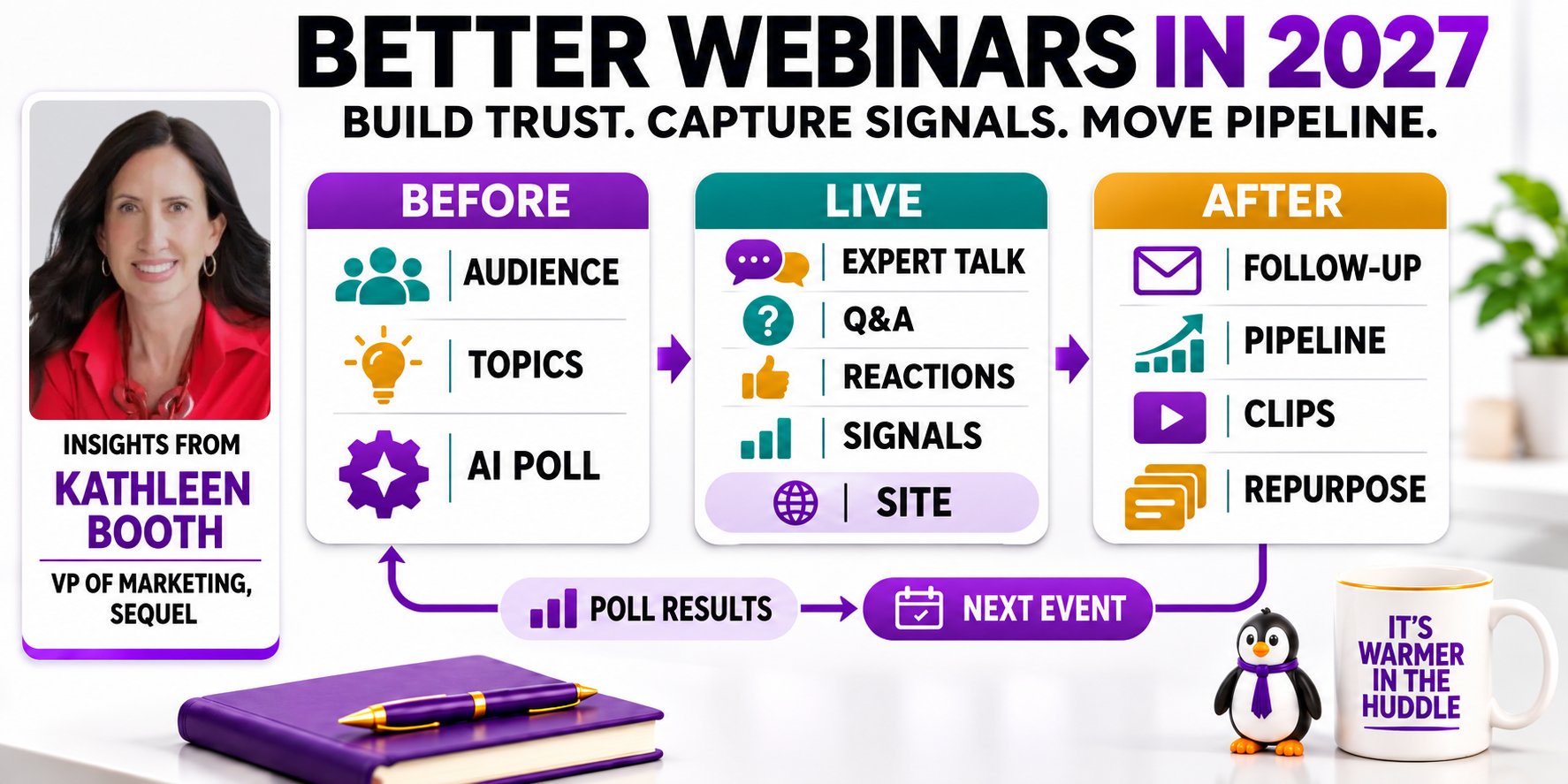
Webinars deserve another look in 2027. At a time when buyers are drowning in AI-generated content, live video gives marketers something increasingly scarce: credible experts, unscripted exchanges, peer interaction, and visible human judgment.
But producing more webinars will not automatically produce more value. CMOs need to treat each program as a complete system spanning topic selection, promotion, live engagement, buyer intelligence, sales follow-up, and content repurposing. In a recent Expert Huddle, Kathleen Booth, VP of Marketing at Sequel, shared a practical playbook for improving every stage.
Disclosure: CMO Huddles is both a Sequel customer and partner. Our endorsement is informed by firsthand use of the platform for Expert Huddles, CMO Huddles Studio, and the Virtual Super Huddle.
Webinar planning often begins with a familiar question: What should we talk about?
Kathleen recommends starting somewhere else. Determine which business outcome the webinar should influence, which buyers need to participate, and what useful signals the program could generate. Registrations and attendance still matter, but they measure reach rather than impact.
“Most marketers’ reporting is all around registrations and attendance,” Kathleen explained. “That says nothing about whether a pipeline moved or a deal moved.” Better measures include attributed pipeline, acceleration of open opportunities, revenue influenced, attendance from target accounts, buying-committee participation, watch time, questions per attendee, and repeat attendance.
The shift matters because it changes how marketers choose topics, recruit guests, design interactions, and follow up.
Kathleen shared a useful framework from ElevenLabs. Before approving a webinar topic, its marketing team asks three questions:
If the team cannot identify specific opportunities that might benefit, the subject may be too generic. If the session will not elicit useful buyer language or produce reusable material, it probably needs more work.
“Their rule of thumb is that if your webinar topic cannot do all three of those things, you should rework it before you start promoting it,” Kathleen said. That filter helps prevent teams from producing another broad thought-leadership session that attracts registrations but creates little downstream value.
CMO Huddles approaches programming through a somewhat different lens because our first obligation is educating and inspiring our community. The underlying principle still applies: every program needs a clearly defined job.
A webinar without a job is just another meeting with better graphics.
Buyers can get facts from a PDF, search engine, or AI assistant. The distinctive value of a live webinar comes from the elements that cannot be reproduced as easily: spontaneous reactions, real questions, candid answers, demonstrations, and peer discussion.
Kathleen described ElevenLabs’ approach as “human by design.” The company automates invitations, clips, and follow-up while protecting the live human exchange that people came to experience.
That is also why format matters. Kathleen said she is far more likely to accept an invitation to a fireside chat than one requiring a presentation deck. A strong interviewer can create energy, guide the discussion, and allow the expert to concentrate on providing useful answers.
This approach can also help reluctant customers or internal experts become comfortable appearing on camera. Sequel uses consistent formats for recurring programs, allowing prospective guests to see previous episodes and understand exactly what they are agreeing to do. The consistency reduces anxiety while helping the audience grow across the series.
Kathleen believes marketers will soon operate most of their webinar programs “headlessly.” Instead of repeatedly entering a webinar platform to create events, configure polls, build registration pages, and export results, marketers will orchestrate these activities from an AI environment such as Codex or Claude Code. The live conversation remains human, but much of the machinery surrounding it can be managed by agents.
This idea immediately resonated with me because we are already working headlessly with Webflow. I can develop content and applications in Codex and publish them without spending much time navigating Webflow itself. Until my conversation with Kathleen, however, I had not considered interacting with Sequel the same way.
Polls are a perfect example. We have always wanted more polls in CMO Huddles programming because they engage attendees, reveal what CMOs are thinking, and create useful data. Occasionally we remembered to prepare one when we used Zoom. More often, someone realized shortly before a program that a poll would be helpful, at which point it was too late.
The best workflow is the one that remembers what your team forgets.
A webinar agent could monitor the programming calendar, understand the subject of each upcoming show, review the polls used previously, and analyze how audiences responded. It could then recommend new questions tailored to the topic and expected attendees. After a human approves them, the agent could program the polls directly into Sequel.
The workflow would continue after the webinar. The agent could retrieve the results, compare them with previous responses, identify meaningful patterns, recommend follow-up content, and use what it learned to improve the next set of questions. Instead of producing isolated snapshots, polls become part of a continually improving audience-intelligence system.
Kathleen tested an early version of this approach by asking an AI assistant to analyze Sequel’s historical audiences, identify demographic and topical patterns, recommend future webinar subjects, build a run of show, and write polls for different audience segments. “The next step for me is I’m going to build an agent that’s triggered when a new event is created in Sequel,” she explained. The agent could suggest polls automatically, ask for approval, and then add them to the scheduled event.
The same model could support landing pages, invitations, speaker preparation, recommended resources, calls to action, follow-up emails, clips, and sales notifications. Kathleen predicted that, aside from the live session itself, marketers could soon run almost the entire webinar program from the AI environment where their company knowledge already resides.
This is a significant unlock for lean marketing teams. Headless webinar operations do more than reduce clicks. They turn a collection of tasks that people complete inconsistently into a connected learning system that improves with every program.
Whether to gate an on-demand webinar depends on the objective. An ungated replay maximizes access and education. A gate can identify viewers, enable follow-up, and help connect webinar activity with the rest of their website behavior.
I remain skeptical of unnecessary gates. Buyers understand that submitting an email address may trigger a torrent of unwanted messages, which is why many of us abandon forms.
Kathleen suggested several middle paths. Marketers can make clips and written summaries freely available while gating the full session. Timed gating can let viewers sample the content before deciding whether it merits an email address. A platform can also remember previous registrants, making registration a one-time action rather than a recurring obstacle.
The right answer depends on the buyer, funnel stage, content value, and intended follow-up. “Your platform should be able to support all of it,” Kathleen noted.
Webinar promotion still relies too heavily on mass email. Kathleen pointed to Clay and ElevenLabs as examples of companies taking a more targeted approach.
ElevenLabs begins its concentrated promotion roughly 14 days before an event. An automated process analyzes Salesforce notes and Gong transcripts to identify buyers whose interests match the topic. Sales representatives then receive account-specific lists and suggested invitation language, making participation as easy as possible. The process runs again about 10 days before the event.
The lesson is not simply to ask sales for help. Salespeople are focused on selling and are unlikely to build invitation lists themselves. Marketing needs to provide the right names, relevant context, and usable copy.
The same principle applies to partners and speakers. Give them prewritten invitations, social copy, graphics, and a clear list of people who would benefit. Clay also supports its successful webinar series with paid promotion, treating webinars as a meaningful acquisition channel rather than a calendar entry.
You have to market the marketing.
Once the webinar begins, marketers should automate less, not more. This is the moment when visible expertise, curiosity, humor, disagreement, and responsiveness build trust.
“Trust today is the hardest thing to build in B2B,” Kathleen said. Buyers are constantly bombarded by sales pitches and undifferentiated content. In-person events remain difficult to beat, but they are expensive and hard to scale. Live video offers the next-best opportunity to attach a face, voice, and personality to the brand.
That advantage disappears when a presenter reads slides for 45 minutes. Kathleen’s advice was blunt: “Don’t do death by PowerPoint.” If the session is simply a voice-over for information that could have been a PDF, buyers have little reason to attend live.
Hosts should explicitly show attendees how to participate. Ask for questions. Explain where the reaction buttons are. Use polls to surface peer perspectives. Refer to comments as they arrive and adapt the conversation accordingly.
As Kathleen pointed out, these practices “break the fourth wall.” The audience stops feeling like a collection of passive viewers and starts contributing to the experience.
The interaction also improves the content produced afterward. Reactions can identify moments that resonated most strongly. Questions reveal information gaps. Poll responses expose priorities and objections. A platform can use those signals to find the most educational, controversial, or popular sections for subsequent clips.
The audience is telling you what to repurpose. Pay attention.
Kathleen originally became a Sequel customer because she could not understand why marketers sent buyers away from their websites at the moment of highest attention. Blogs, case studies, pricing, and product information live on the company site, yet webinars have traditionally been hosted on a third-party destination.
Sequel is differentiated by being built to host the webinar directly on a company’s website. That keeps attendees surrounded by relevant resources and potential next steps while allowing the marketer to connect live behavior with website activity.
Kathleen illustrated the value with two otherwise identical attendees. Both fit the ideal customer profile, hold relevant titles, and engage actively during the session. One spends additional time on the careers page. The other visits pricing and customer case studies.
A conventional webinar report might label both as equally promising. Their website journeys tell two very different stories.
We saw this firsthand after a recent CMO Huddles virtual event. One attendee watched a meaningful portion of the program and then asked our website’s conversational assistant about pricing for our Leader program. Combining those behaviors created a much clearer intent signal than attendance alone.
Capturing engagement data is only useful if someone can act on it. Marketers should determine in advance which questions, poll responses, page visits, or account behaviors deserve immediate attention.
ElevenLabs configured Slack notifications that alert an account owner while a webinar is still happening when a buyer asks a relevant question or answers a poll in a significant way. The representative can respond while interest is high instead of discovering the signal days later in a downloaded spreadsheet.
Kathleen emphasized that the information should reach SDRs, account executives, and customer success managers inside the systems they already use. Some signals may indicate new demand, while others point to expansion opportunities or risks within existing accounts.
Intent has a half-life. Follow-up speed matters.
A strong webinar does not require television-level production throughout, but a few well-chosen elements can improve the experience considerably. Kathleen recommended investing in a strong opening video, clean transitions between speakers, branded lower thirds, quality camera inputs, and reliable local recording.
For larger virtual summits, short transition videos can eliminate awkward pauses as speakers enter and leave. Simulive sessions can reduce the risk of presenter connectivity failures, while local recording protects the quality of footage intended for later repurposing.
The objective is not spectacle. Production should make the content feel credible and remove distractions without overwhelming the substance.
Kathleen offered one of the most useful lines of our conversation: “The recording and the transcript are the start, not the finish.”
Too many teams exhaust themselves producing the live event, send one generic follow-up email, upload the replay somewhere, and move on. They leave most of the value untouched.
Unit21 rebuilt its post-webinar process around the transcript as the starting point. One 60-minute webinar can feed a recap article, persona-specific posts, nurture emails, social videos, and a sales enablement package containing useful language and messaging. Because the source is an original conversation, the resulting content begins with proprietary insights rather than recycled AI output.
Every attendee should not receive the same message. Follow-up can reflect whether someone attended, how long they watched, which questions they asked, how they responded to polls, which pages they visited, and whether their company already has an open opportunity.
A high-intent attendee may deserve immediate personal outreach. Someone who watched briefly may benefit from a concise summary. A customer might receive a related expansion resource, while a no-show should get a compelling reason to return.
Kathleen recommended sending no-shows a strong clip, easy access to the replay, and a specific moment worth watching. Instead of saying, “Sorry we missed you,” a marketer might say, “If improving webinar conversion is your priority, start at minute 10.”
That level of specificity turns a generic replay email into a useful recommendation.
AI can analyze the transcript, but the audience provides another important editing signal. Reactions, questions, chat activity, watch time, and poll participation help identify which moments deserve a second life.
Those moments can become YouTube Shorts, LinkedIn clips, sales follow-up assets, articles, newsletter sections, or inputs for future programming. Marketers can ask for the most educational segments, the most debated statements, or the moments producing the strongest audience reaction.
This is where the economics of webinars become especially compelling. The live event generates human interaction and declared intent. The recording then becomes an original content pillar capable of feeding multiple channels.
The final step is returning to the business objective established at the beginning. Did target accounts attend? Did open opportunities accelerate? Did buyers reveal new priorities? Did sales use the resulting intelligence? Did the program influence pipeline or revenue?
Kathleen cited ElevenLabs as a striking example. The company reportedly began the year with a $300,000 webinar pipeline goal and finished the first half with $14 million in attributed pipeline. The number is impressive, but the larger lesson is that the team designed its program around pipeline and acceleration rather than treating those outcomes as an afterthought.
CMOs will have an easier time protecting or expanding webinar investment when they can connect programs to business impact. Registration totals may flatter the marketing team, but pipeline gets the CFO’s attention.
Kathleen cited recent research presented by Victoria Albert of INFUSE indicating that most marketers plan to produce more webinars in 2027, while few expect additional resources to support them. That combination makes better workflows, automation, and repurposing essential.
The opportunity is substantial. Webinars can build trust, capture buyer intelligence, accelerate opportunities, create original content, and supply sales teams with timely insights. But those returns require marketers to look beyond the live hour.
As Kathleen acknowledged, nobody has the full formula yet. “Anybody out there claiming to have this all figured out is lying to you.” Her analogy captured the moment perfectly: marketers have been handed a grocery cart full of sophisticated AI ingredients without necessarily knowing how to cook the meal.
The answer is to develop the recipes by doing the work: map the current webinar workflow, identify the manual and disconnected steps, decide what should remain human, and automate the rest.
At CMO Huddles, we have already started our own list. Future programs will include more intentional polls, better use of audience reactions, tighter workflows, faster follow-up, and more systematic repurposing. Despite producing virtual programming regularly, we left this conversation with plenty of new experiments to run.
That may be the most encouraging part. Webinars are hardly new, but the combination of live human interaction, richer buyer intelligence, and AI-enabled orchestration gives CMOs a fresh opportunity to make them more valuable than ever.
Track business impact in addition to registrations and attendance. Useful measures include attributed pipeline, acceleration of open opportunities, revenue influenced, target-account participation, buying-committee coverage, watch time, questions per attendee, repeat attendance, and meaningful post-event website behavior.
A headless workflow lets marketers orchestrate webinar-platform functions from an AI environment such as Codex or Claude Code. Agents can help create events, recommend and program polls, prepare invitations, retrieve results, trigger follow-up, and improve future programs while humans retain approval and own the live conversation.
Use live video for candid expert conversations, demonstrations, questions, and peer interaction that buyers cannot get from a static asset. Automate the operational work surrounding the event while protecting the visible human judgment and spontaneity that give people a reason to attend.
The decision should follow the objective. Ungated access maximizes education and reach, while gating can identify viewers and connect their activity to follow-up. Timed gating, freely available clips, and ungated summaries can balance buyer convenience with useful audience intelligence.
Marketing should provide representatives with account-specific invitation lists, relevant context, and usable copy instead of merely asking them to share a link. During and after the event, route meaningful questions, poll responses, and intent signals into the systems sales and customer success already use.
Treat the recording and transcript as raw material. Use audience reactions and engagement data to identify strong moments, then create articles, persona-specific posts, social clips, nurture emails, sales enablement assets, and recommendations for future programming.
Watch the complete Expert Huddle with Kathleen Booth for more examples and practical recommendations about producing better webinars in 2027.
If you are a B2B CMO who wants to learn alongside peers tackling these same challenges, join the free CMO Huddles Starter program.