
Back to Blogs
Drew Neisser is the founder of CMO Huddles and a globally recognized authority on B2B marketing. He’s an AdAge columnist, LinkedIn TopVoice, leading CMO coach, podcast host & friend of penguins everywhere.
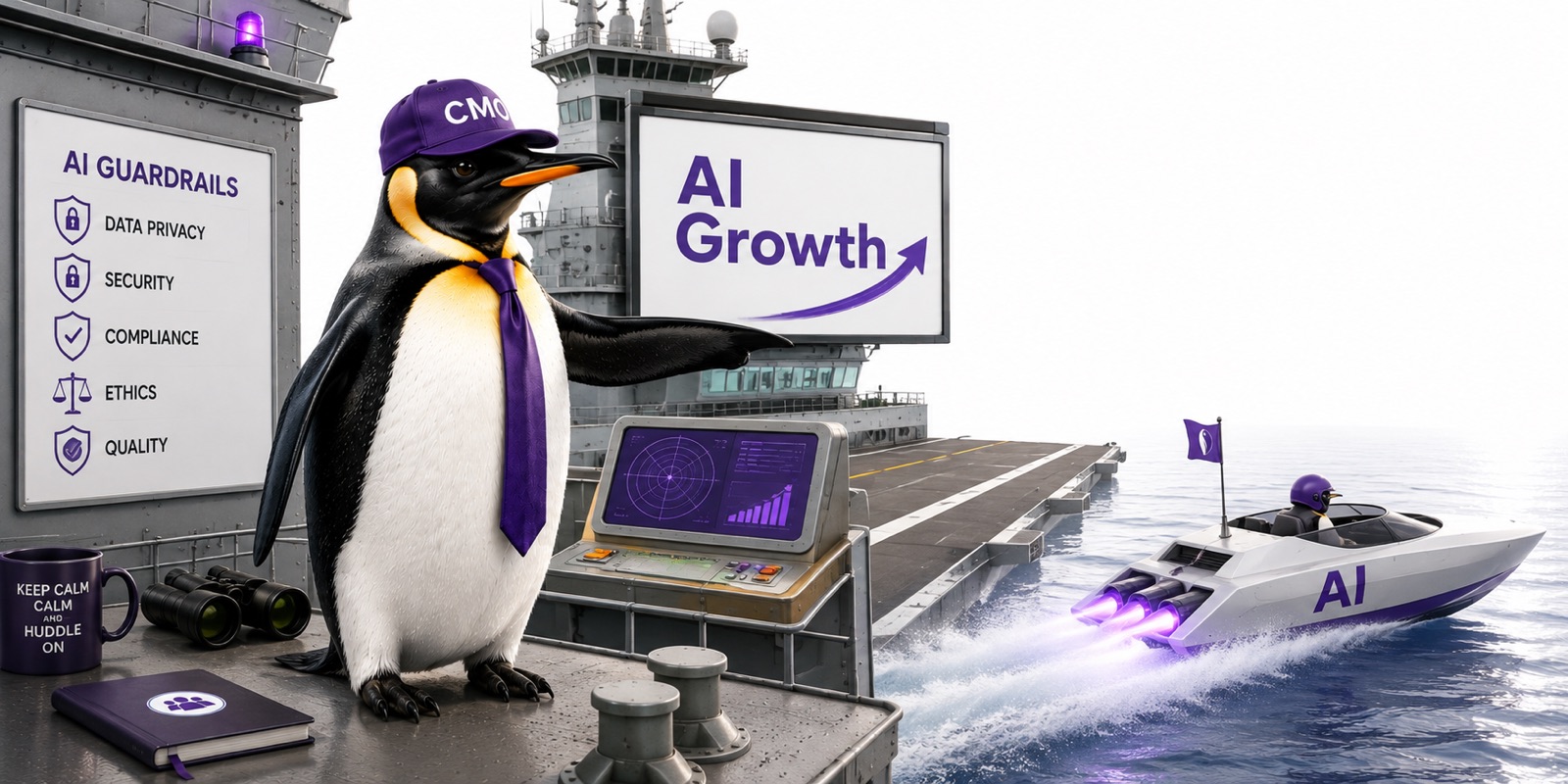
Enterprise CMOs need AI governance, but avoidance-only training will not create growth. Inspired by a CMO’s painful corporate AI training story, this Drew’s Take argues that large companies need sanctioned marketing AI skunk works: Structured, outcome-focused teams that learn inside guardrails while rebuilding workflows for pipeline, conversion, retention, and efficiency.
The huddle shuddered while I pondered the fate of big companies.
To be clear, I’m not anti-governance. Big companies have big risks, big brands, and big legal departments. A wrong email from a rogue agent is not a cute learning moment.
But corporate AI training that only teaches avoidance is not training. It is legal self-protection wearing a learning management system badge.
Congratulations, you now know 47 ways to get fired and zero ways to grow faster.
This is where the Innovator’s Dilemma sails into the harbor. Incumbents often protect the current business, the current process, and the current definition of “safe” until the new thing looks too messy to fund.
Then the new thing becomes the market.
There is nothing wrong with guardrails. In fact, enterprise CMOs should want them. Nobody needs an enthusiastic intern pasting customer data into a public model while Legal quietly develops a facial twitch.
But there is a difference between governing AI use and preventing AI learning. The first protects the company. The second protects the company from the future.
Alexandra Wright captured this perfectly in a LinkedIn comment on my original rant: “The ‘guardrails are not a go-to-market operating model’ line is the thing I want to print out and send to every legal department that has killed an AI experiment with a blanket policy.”
Exactly. Guardrails matter. But guardrails do not generate pipeline, improve conversion, reduce cost per opportunity, or redesign workflows.
They keep the car from going off the road. They do not decide where the car should go.
The AI-era version of the Innovator’s Dilemma is not just about products. It is about operating models.
Startups and smaller companies are experimenting because they have no choice. They are rebuilding workflows because the old ones were never that institutionalized in the first place. They can test, break, learn, and rebuild before the enterprise has finished scheduling the steering committee to discuss whether testing should be allowed.
Large companies have advantages that should matter: Data, customers, brand equity, distribution, institutional knowledge, and budgets that do not require someone’s cousin to approve the software subscription. But those advantages only matter if the organization can learn fast enough to use them.
Otherwise, the enterprise becomes a museum of potential.
Years ago, my company produced a video game called Carrier: Fortress at Sea, which meant I learned more than expected about aircraft carriers. One fact stuck with me: A carrier needs roughly five miles to come to a complete stop.
That is not a steering problem. That is physics.
Large companies have the same issue. They have scale, data, customers, brand equity, and distribution. They also have inertia, compliance layers, procurement drag, approval loops, and a thousand smart people trained to slow things down before something breaks.
So no, a $6B conglomerate will not turn like a speedboat.
But it can launch one.
Tom Perchinsky said it well in a LinkedIn comment: “Large companies can’t turn like speedboats, but they absolutely have the deck space to launch them.”
That is the opportunity for enterprise CMOs right now. Corporate can and should create guardrails, but marketing needs a way to learn inside them. Not theoretically. Not someday. Not after the ninth policy revision. Now.
Marketing needs its own AI skunk works.
Not a rogue team hiding from IT. Not a prompt-sharing Slack channel. Not three enthusiastic people making demos that impress the offsite and then die quietly in a folder called “Innovation.”
A real skunk works. Sanctioned. Structured. Business-outcome obsessed.
Give it a mandate: Improve pipeline, conversion, retention, customer experience, and cost per opportunity. Give it permission to rebuild workflows, not just add AI sprinkles to broken ones. Give it access to the data, systems, and cross-functional partners required to make the work real.
And give it its own training program, because “don’t paste confidential information into ChatGPT” is not a curriculum.
upGrad International added a useful point in a LinkedIn comment: “The balance between governance and hands-on learning is where real progress happens. People build confidence with AI when they can apply it to real business challenges within clear boundaries, not just learn what to avoid.”
That is the whole game. Clear boundaries plus real work. Safety plus learning. Governance plus growth.
Otherwise, AI training becomes corporate abstinence education. Everyone knows what not to do. Nobody knows what to do when the moment arrives.
Snowflake offers a useful counterexample. Denise Persson’s team is building AI fluency through training, hackathons, AI goals, and governed agents. She has also cited a 30% reduction in cost per opportunity.
That is the big-company dream: Carrier-sized data, speedboat-style learning.
Notice the difference. Snowflake is not treating AI as a compliance module. It is treating AI fluency as an operating capability. Training matters, but training is tied to action. Hackathons matter, but they are not theater. Governed agents matter, but they are not built to sit in a slide deck wearing a little digital tuxedo.
This is what enterprise CMOs should be fighting for: A model that lets teams learn quickly without pretending risk does not exist.
Because risk does exist. But so does competitive decay.
My favorite part of Carrier: Fortress at Sea was trying to land an F-15 on the carrier. If you crashed, the game delivered a brutal little message: “Congratulations, you just crashed a perfectly good $30 million airplane!”
That is what many corporate AI programs feel designed to prevent. No crashes. No mistakes. No mess.
Fair enough. Nobody wants to crash the plane.
But at some point, someone still has to learn how to land it.
This is the part enterprise leaders need to sit with. If the only training people receive is how not to crash, they will not become pilots. They will become passengers with compliance certificates.
CMOs cannot afford that. Marketing is too close to the customer, too exposed to new buyer behavior, and too dependent on workflow speed to wait for perfect corporate clarity. The work has to move from policy to practice.
Enterprise AI governance is necessary. Avoidance-only AI training is not enough.
CMOs need to push for sanctioned learning environments where marketing teams can test AI against real business problems, rebuild workflows, and measure outcomes that matter. Guardrails should make experimentation safer, not make experimentation disappear.
You may not be able to stop the ship in under five miles.
But you can launch something from the deck today.
If you want to see what AI transformation looks like inside a large marketing organization, join our Expert Huddle on August 18 at 2pm ET: AI Transformation: How Lumen’s CMO Is Rewiring a 330-Person Marketing Org with Ryan Asdourian, CMO of Lumen.
Because it teaches employees what not to do without helping them learn how to apply AI to growth, efficiency, customer experience, or workflow redesign. Risk reduction matters, but it is not the same as capability building.
It should include hands-on application to real business problems, clear use-case examples, workflow redesign principles, approved tools, data-use rules, and measurable outcomes tied to pipeline, conversion, retention, customer experience, or cost efficiency.
It is a sanctioned, structured team or program designed to test AI against high-value marketing workflows. It should operate within governance rules while having enough freedom to learn quickly, rebuild processes, and produce measurable business results.
They can create clear boundaries, approved environments, and cross-functional oversight while giving teams permission to experiment inside those boundaries. The goal is not reckless speed. The goal is governed learning.
CMOs should measure business outcomes, not just activity. Useful metrics include cost per opportunity, campaign cycle time, conversion rates, sales productivity, content production speed, customer response quality, and retention impact.
CMO Huddles helps B2B marketing leaders win by bringing together peers, fresh perspectives, and opportunities to build stronger personal brands. Want to join the huddle? Learn more about CMO Huddles and apply to join the community.